
For many people, the biggest obstacle to owning a smartphone isn’t the total price. It’s having all the money at once.
Sun King is betting that customers who cannot afford to buy a smartphone upfront can still afford to pay for one a little at a time.
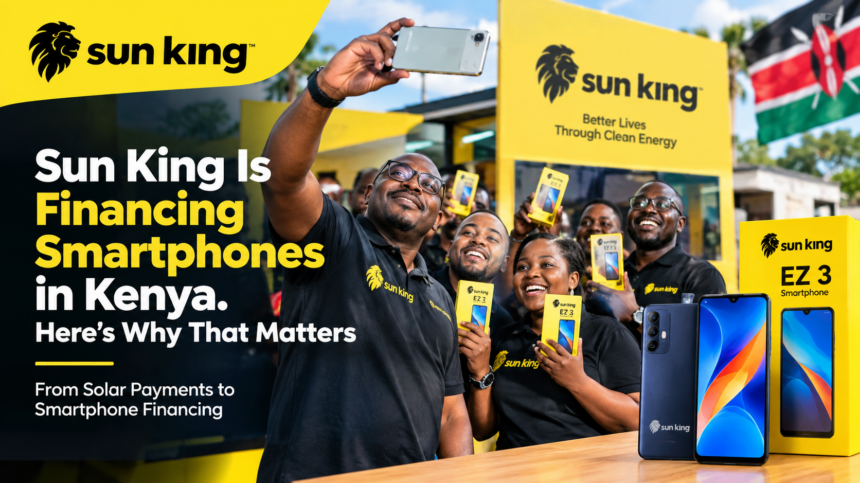
The off-grid solar company is now manufacturing smartphones in Kenya and financing them through the same PayGo model that helped build its solar business.
Its latest device, the EZ 3, requires a KES 2,299 deposit followed by KES 55 per day for 365 days.
That puts Sun King directly into competition with companies such as M-KOPA and Watu, which have already built businesses around financing smartphones and other productive assets.
The Story
Sun King is taking PayGo beyond solar
Sun King has spent years proving that customers can pay for essential technology in small instalments rather than making one large payment.
The company originally built its African business around off-grid solar products.
Now it is applying the same idea to one of the most important pieces of technology in consumers’ daily lives: the smartphone.
Sun King entered Kenya in 2009 under the name Greenlight Planet. Since then, it has built a large network of agents and customers across the country.
The company says one in five Kenyan households has access to a Sun King product.
That existing distribution network gives Sun King something valuable as it moves into smartphones: a customer base that already understands its financing model.
Sun King’s Kenyan factory changes the equation
The smartphone push is also tied to local manufacturing.
In October 2025, Sun King opened a manufacturing facility in Tatu City, north of Nairobi.
The facility has the capacity to produce up to 700,000 units annually and assembles smartphones and solar-powered televisions.
That matters because Sun King is no longer relying entirely on imported finished products.
Local assembly, combined with its existing distribution network, could give the company more control over pricing and how quickly devices reach customers.
And in a market where affordability is everything, those advantages can make a significant difference.
Sun King Smartphones: The EZ 3 Financing Model
Sun King’s latest smartphone, the EZ 3, follows the company’s familiar PayGo approach.
Customers pay:
- KES 2,299 upfront
- KES 55 per day
- 365 days
That brings the total cost to KES 22,374, or roughly $173 based on the figures supplied.
The company does not sell the phone as a conventional outright purchase. Instead, customers enter into a financing agreement and gradually pay for the device.
The EZ 3 comes with:
- 6.75-inch display
- 5,000mAh battery
- 4GB RAM
- 64GB storage
Sun King launched its first branded smartphone, the EZ 1, in February 2026.
That device required a KES 2,999 upfront payment and KES 60 per day.
The EZ 3 therefore lowers both the initial deposit and daily repayment.
Sun King is entering a market M-KOPA already understands
Kenya already has an established market for financed smartphones.
M-KOPA is one of the biggest players, offering its own smartphones alongside devices from brands such as Samsung.
Customers can make repayments daily, weekly or monthly.
Watu is another major player. The Kenyan digital credit company finances Samsung smartphones through its connectivity business while also financing motorcycles and tuk-tuks.
Sun King’s advantage is that smartphone financing isn’t being built from scratch.
The company already has experience collecting small payments from customers through its PayGo solar business.
The pricing battle is already getting serious
Sun King’s own smartphone catalogue shows how competitive the market has become.
Its financed devices include:
| Device | Deposit | Daily payment | Term |
|---|---|---|---|
| Sun King EZ 3 | KES 2,299 | KES 55 | 365 days |
| Tecno Pop 10 | KES 2,799 | KES 55 | 364 days |
| Infinix Smart 10 | KES 2,799 | KES 55 | 364 days |
| Samsung A06 | KES 2,899 | KES 60 | 364 days |
The numbers tell an important story.
Sun King isn’t only competing against other financing companies. It is also competing on which smartphone customers can get for the lowest manageable payment.
That shifts the conversation from:
“How much does the phone cost?”
to:
“How much can I afford to pay every day?”
That distinction is at the heart of the PayGo model.
The phone itself becomes the security
There is another important part of Sun King’s model: device control.
The EZ 3 remains unlocked while customers keep up with their repayments.
Payments can be made through several channels, including:
- The phone’s lock screen
- Sun King’s app
- SIM Toolkit
- USSD
If customers stop paying, the financing system can restrict access to the device.
This gives the lender a form of collateral that traditional consumer loans often don’t have.
But it also creates another challenge.
Kenya has already seen attempts to bypass similar financing controls, including efforts involving financed phones, software flashing and IMEI manipulation.
If device unlocking becomes widespread, it could undermine the system that allows companies to finance smartphones for customers who may not qualify for conventional credit.
A smartphone is becoming a business tool
The bigger reason companies are willing to finance smartphones is simple: the device can help customers earn money.
A smartphone is no longer just a communication device.
For small businesses and informal workers, it can be a point-of-sale terminal, marketing tool, accounting system, banking interface and connection to customers.
GSMA research found that 86% of male and 79% of female micro-entrepreneurs used mobile phones for business in 2024.
A 2026 Nairobi study by the International Growth Centre also found that using a smartphone-based point-of-sale application improved areas including record-keeping, inventory management and daily sales.
That makes smartphone financing more than a consumer-credit business.
It can also be viewed as financing access to a productive business tool.
8. Key Numbers
KES 2,299
The upfront deposit for Sun King’s EZ 3.
KES 55
The daily repayment for the EZ 3.
KES 22,374
The total cost of the EZ 3 under the stated 365-day payment plan.
700,000
The annual production capacity of Sun King’s Kenyan manufacturing facility.
5,000mAh
The EZ 3’s battery capacity.
4GB
RAM included with the EZ 3.
64GB
Internal storage on the device.
86% vs 79%
The percentage of male and female micro-entrepreneurs respectively who used mobile phones for business in 2024, according to GSMA.
9. Why It Matters
Sun King’s smartphone strategy reflects a bigger change happening across Africa’s technology market.
Device ownership is increasingly becoming a financing problem rather than simply a technology problem.
A customer may have enough income to pay KES 55 every day but may not have enough cash available to purchase a smartphone outright.
PayGo companies are designed around exactly that gap.
For Sun King, there is another advantage: the company can potentially combine manufacturing, distribution, financing and device management within one business model.
That could allow it to compete aggressively on affordability.
It also means the smartphone becomes part of a broader financial relationship between Sun King and its customers.
10. What Happens Next
The next phase will be about scale.
Sun King already has a manufacturing facility and an established Kenyan agent network. The question is whether it can turn those assets into a smartphone business large enough to compete with M-KOPA and Watu.
Pricing will be critical.
So will repayment performance.
If customers consistently repay their devices, Sun King could expand its financing model into more smartphones and potentially other technology products.
But if defaults, device unlocking and financing costs become difficult to manage, the economics could become much harder.
Kenya therefore becomes an important test of whether Sun King’s PayGo model can successfully move from solar energy to consumer technology.
11. The TechBrass Take
The TechBrass Take: Sun King Is Not Really Selling Phones
The most interesting part of Sun King’s smartphone strategy isn’t the EZ 3 itself.
It’s the business model behind it.
Sun King understands something that traditional smartphone retailers often don’t: affordability isn’t always about reducing the sticker price.
Sometimes it’s about changing the payment schedule.
A KES 22,374 smartphone may be difficult for a customer to purchase in one transaction. But KES 55 a day can feel considerably more manageable.
That is the same psychological and financial logic that helped PayGo solar products spread across African markets.
Now Sun King is applying it to smartphones.
The bigger opportunity could be even more interesting.
Once a company controls the device, financing relationship, payment channel and customer distribution, the smartphone becomes more than hardware. It becomes an entry point into a broader digital-finance ecosystem.
But there is a catch.
The model depends heavily on trust, repayment discipline and effective device controls. If customers find ways around the financing restrictions, lenders could become less willing to finance people who lack conventional credit histories.
Sun King’s Kenyan smartphone push is therefore worth watching beyond the number of phones it sells.
It is testing whether PayGo can become a mainstream way for Africans to access the digital tools they increasingly need to work, communicate and earn.