
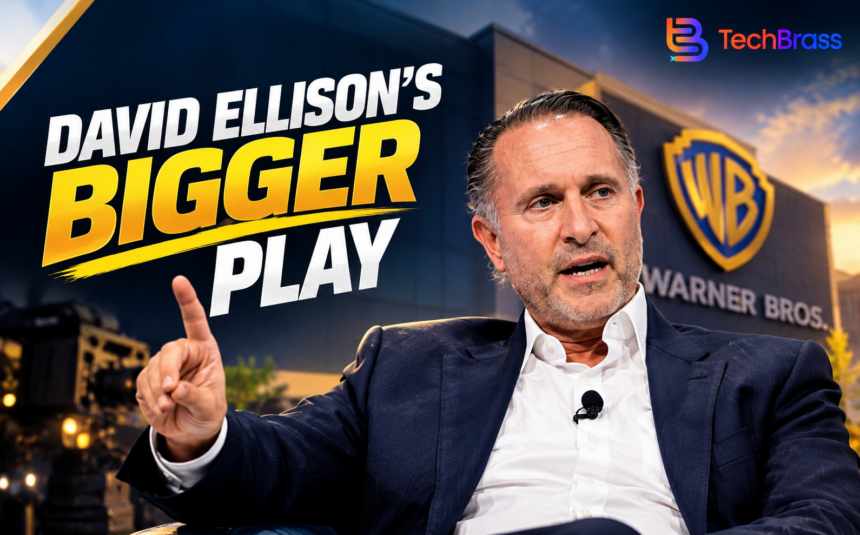
The transformation of Warner Bros. Discovery is entering a decisive phase.
David Ellison’s Paramount Skydance is preparing to take control of Warner Bros. Discovery in a transaction valued at roughly $110 billion, creating a much larger media company built around Paramount, Warner Bros., HBO, streaming services, television networks and a vast library of intellectual property. The combined company is expected to operate under the Skydance name.
However, the deal comes with a difficult financial challenge: how do you reduce a massive debt burden while simultaneously investing enough money in streaming to compete with Netflix, Disney, Amazon and YouTube?
That balancing act could define Ellison’s early years at the company.
What Is David Ellison’s Plan for Warner Bros.?
At its core, David Ellison’s strategy is about combining scale with operational efficiency.
Paramount and Warner Bros. Discovery bring together major film studios, television businesses and streaming platforms. The companies have also identified technology integration and operational efficiencies as important sources of savings.
Paramount has previously said the combined company expects more than $6 billion in synergies, including technology integration, procurement savings, real-estate efficiencies and other operational improvements.
The strategy can be viewed through four major priorities:
- Reduce debt and improve the company’s financial position.
- Integrate overlapping technology systems.
- Strengthen streaming businesses.
- Continue investing in valuable film and television content.
The challenge is that all four require careful capital allocation.
The Debt Problem Behind the Deal
The biggest obstacle is the company’s debt load.
The combined business is expected to carry more than $80 billion in debt, making deleveraging one of Ellison’s most important financial priorities. Reuters reported that the leadership team is targeting $6 billion in cost savings while managing the combined debt burden.
That creates a complicated equation.
Reducing debt generally means preserving cash and limiting unnecessary spending. Streaming, on the other hand, requires continued investment in technology, content, marketing and customer experience.
If management cuts too aggressively, the company could weaken its streaming products.
If it spends too aggressively, debt reduction could take longer.
That tension is central to the Warner Bros. strategy.
Why Streaming Is So Important
Traditional television has become increasingly challenging as audiences move toward on-demand platforms.
Warner Bros. Discovery already operates a major streaming business, while Paramount brings Paramount+ into the combination. The merger therefore creates an opportunity to build a larger streaming ecosystem around some of Hollywood’s strongest entertainment brands.
The technology challenge, however, is significant.
The companies operate different platforms, infrastructure, data systems and customer experiences. Combining those systems could create efficiencies, but it also requires substantial technical work.
The Technology Stack Could Become a Major Savings Opportunity
Paramount has specifically identified the consolidation of streaming technology stacks and migration toward common enterprise systems as part of its expected synergies.
That could involve areas such as:
- Cloud infrastructure
- Video delivery systems
- Customer databases
- Advertising technology
- Subscription billing
- Recommendation systems
- Analytics
- Enterprise software
- Content-management platforms
For consumers, much of this work may happen behind the scenes.
For the company, however, it could determine how efficiently billions of dollars are spent.
HBO Could Be One of the Biggest Assets
One of Ellison’s most important strategic decisions will involve HBO.
HBO has become one of Warner Bros. Discovery’s most valuable entertainment brands, while HBO Max gives the company an established streaming platform and subscriber ecosystem.
Ellison has previously emphasized the importance of keeping HBO strong rather than weakening the brand as part of the combination.
That philosophy matters because streaming growth is no longer simply about having the largest possible library.
Consumers also care about:
- Exclusive programming
- Brand identity
- User experience
- Content discovery
- Pricing
- Reliability
- Advertising options
- Device compatibility
A stronger HBO-centered strategy could therefore become an important part of the new company’s streaming ambitions.
A Major Streaming Leadership Change
The streaming strategy is already influencing the company’s executive structure.
Paramount’s streaming chief Cindy Holland left the company in September 2026. Bloomberg reported that HBO head Casey Bloys is expected to take a leading role in the combined streaming operation after the Warner Bros. transaction.
That potential leadership structure is significant.
Rather than treating Paramount+ and HBO Max as completely separate businesses, the company could eventually look for ways to make its streaming operations more efficient while preserving the strongest individual brands.
The exact structure remains an important question for the new company.
What Happens to Paramount+ and HBO Max?
One of the biggest unanswered questions is whether the two streaming services will eventually become one product.
A merger does not necessarily mean an immediate technical combination.
There are several possible approaches.
1. Keep Both Services Separate
Paramount+ and HBO Max could continue operating independently while sharing more infrastructure behind the scenes.
This would preserve their individual identities.
2. Create a Bundle
The company could encourage customers to subscribe to both services through a single package.
This approach could increase customer value without requiring an immediate technological merger.
3. Build One Unified Platform
Eventually, the company could combine the services into a larger streaming product.
That could simplify the consumer experience, but it would also involve substantial technical and operational complexity.
The company has not publicly settled every aspect of this long-term strategy.
Why the Deal Is Also a Technology Story
At first glance, the Paramount-Warner transaction looks like a traditional Hollywood merger.
It is actually a major technology story.
Modern entertainment companies increasingly depend on technology for almost every stage of their business.
A streaming platform must manage:
- Content storage and processing
- Video encoding
- Global content delivery
- User authentication
- Subscription payments
- Advertising
- Personalization
- Search and recommendations
- Customer analytics
- Security and privacy
Therefore, combining two major entertainment businesses also means combining complicated technology environments.
If Ellison’s team can simplify those systems without damaging the customer experience, technology could become one of the merger’s biggest sources of efficiency.
The $6 Billion Question
The company’s projected $6 billion in synergies is one of the most closely watched elements of the strategy.
The important question is not simply whether $6 billion can be identified on a spreadsheet.
The question is where the savings will come from.
Possible areas include:
- Eliminating duplicate corporate functions
- Combining technology infrastructure
- Consolidating procurement
- Reducing overlapping facilities
- Streamlining operations
- Improving advertising systems
- Combining certain business processes
Some savings could come from workforce reductions as companies eliminate overlapping positions. Reuters reported that operational efficiency and cost reduction will be central to Ynon Kreiz’s role as co-CEO.
That makes execution just as important as the original merger.
David Ellison Has Another Challenge: Content
Debt reduction alone will not create a successful streaming business.
The company still needs compelling content.
Paramount and Warner Bros. own some of the entertainment industry’s most recognizable franchises, including properties associated with Warner Bros., HBO, DC, Paramount, CBS and other brands. Paramount has said the combined company intends to continue investing in its studios and expand direct-to-consumer operations.
The challenge is finding the right balance between expensive content production and sustainable financial returns.
A streaming service can attract subscribers with major productions, but expensive content does not automatically translate into long-term profitability.
That makes data, analytics and technology increasingly important to content decisions.
A New Kind of Media Company
The new organization is expected to combine traditional Hollywood production with a much stronger technology and streaming focus.
That creates an unusual business model.
The company will need to operate simultaneously as:
- A film studio
- A television producer
- A streaming company
- A technology platform
- An advertising business
- A content licensing company
- An intellectual-property owner
That diversity could provide resilience.
It could also make management significantly more complicated.
What Consumers Should Watch
For everyday viewers, the most important changes may not happen immediately.
Instead, consumers should watch for several signals over the next few years:
Streaming pricing
Will customers receive better value through bundles or new subscription structures?
Platform integration
Will Paramount+ and HBO Max become more closely connected?
Content availability
Will more Warner Bros. and Paramount programming move between platforms?
Advertising
Could a larger combined streaming audience create a stronger advertising business?
User experience
Will the company invest enough in recommendation technology, search and personalization to compete with the biggest streaming platforms?
These changes could ultimately matter more to consumers than the corporate structure itself.
What Investors Will Be Watching
Investors will likely focus on three major questions.
Can the company reduce debt?
The new company needs to demonstrate that it can generate enough cash to reduce leverage without damaging its growth businesses.
Can streaming become more profitable?
Subscriber growth alone is not enough. The economics of streaming will matter.
Can management deliver the promised synergies?
The projected $6 billion in savings will be closely scrutinized as the companies integrate.
If management achieves those goals while protecting content investment, Ellison’s strategy could strengthen the company’s competitive position.
If not, the debt burden could limit its ability to compete.
What This Means for the Streaming Industry
The Paramount-Warner combination could reshape competition across the streaming market.
Netflix, Disney, Amazon and other major platforms have spent years building scale. Ellison’s strategy effectively responds with another form of scale: combining major entertainment libraries and distribution businesses under one corporate structure.
The result could be a company with significantly greater negotiating power, a larger content portfolio and more opportunities to distribute entertainment directly to consumers.
But scale alone does not guarantee success.
The real test will be whether the company can turn that scale into better technology, stronger content economics and sustainable cash flow.
Frequently Asked Questions
What is David Ellison’s Warner Bros. plan?
David Ellison’s strategy centers on combining Paramount and Warner Bros. Discovery, reducing costs, integrating technology systems, managing the company’s large debt burden and expanding its streaming business.
How much debt will the combined company have?
The combined company is expected to carry more than $80 billion in debt, making debt reduction a major priority for management.
What is the value of the Paramount-Warner Bros. deal?
The transaction has been valued at approximately $110 billion on an enterprise-value basis.
Will HBO Max and Paramount+ merge?
A complete technical merger has not been established as an immediate requirement. The companies could instead pursue bundling, shared infrastructure or a later platform consolidation.
Who is expected to lead the combined streaming business?
Bloomberg reported that HBO head Casey Bloys is expected to take a leading role in the combined streaming operation following the transaction.
What will the new company be called?
David Ellison said the combined Paramount and Warner Bros. Discovery company will be named Skydance. The legal transition is expected to take place in October 2026.
Conclusion
David Ellison’s Warner Bros. strategy is bigger than a Hollywood acquisition.
It is a test of whether a massive entertainment company can use technology, streaming and operational efficiency to manage an enormous balance sheet while continuing to invest in content.
The opportunity is clear: combine powerful entertainment brands, modernize technology infrastructure and create a streaming business capable of competing at global scale.
The risk is equally clear.
Debt reduction, technology investment and content spending all compete for the same financial resources.
For Ellison and the new Skydance leadership team, the challenge will be finding the point where those priorities reinforce rather than undermine one another.
The next chapter of Hollywood may therefore be decided as much by cloud infrastructure, streaming technology, data and capital allocation as by the movies and television shows appearing on screen.
What do you think—can David Ellison turn Paramount and Warner Bros. into a serious Netflix competitor while reducing its enormous debt burden? Share your thoughts with TechBrass.