
Artificial intelligence is moving deeper into biology, and some of the biggest names in technology are betting that better data could transform how scientists understand disease.
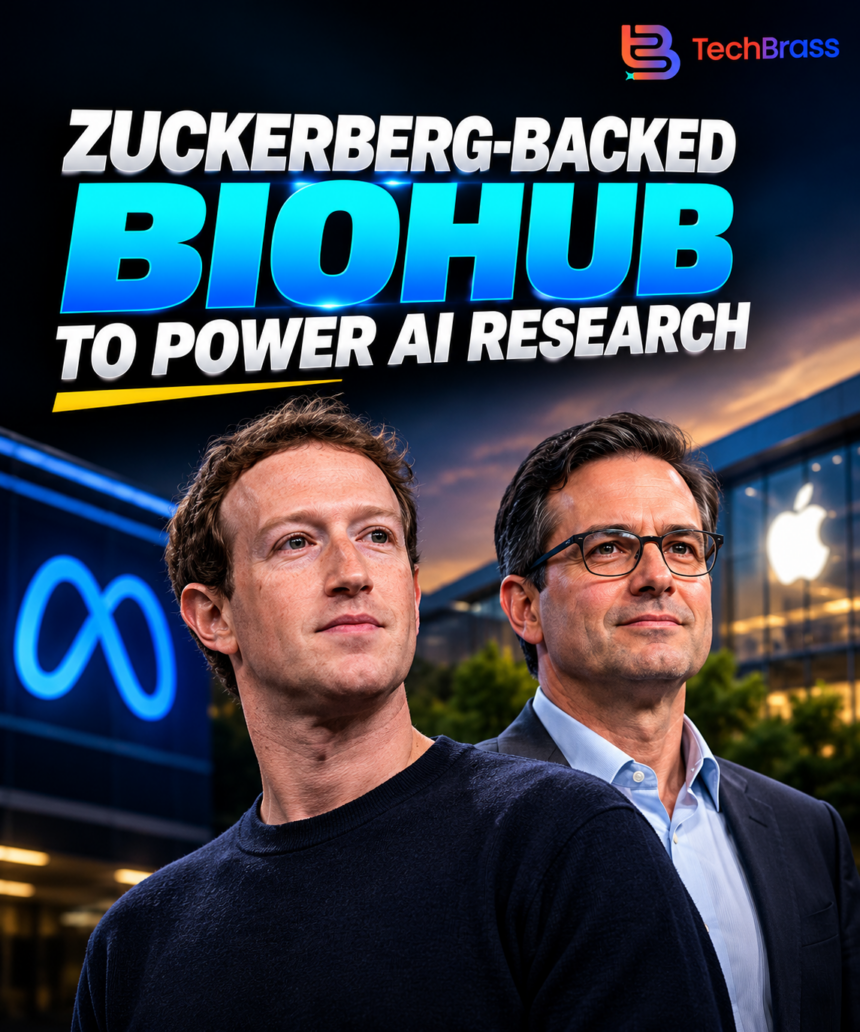
Google DeepMind, Meta and AI drug-discovery company Isomorphic Labs are collectively investing $300 million in Biohub’s Virtual Biology Initiative, a broader effort that has now grown to $1.8 billion through contributions of funding, data, computing resources and measurement technology. The initiative aims to create large, AI-ready biological datasets that can help researchers model how cells behave and eventually conduct biological experiments digitally.
The ambition is significant: build increasingly accurate AI models of biology that could help scientists ask, predict and answer biological questions digitally before testing ideas in the physical laboratory.
What Is Biohub Building?
Biohub, a biomedical research organization co-founded by Mark Zuckerberg and Priscilla Chan, is leading the Virtual Biology Initiative.
The project focuses on generating the biological data needed to train sophisticated AI models. Rather than relying primarily on existing datasets, researchers plan to generate new measurements of how cells respond to different interventions and conditions.
The objective is to build predictive models capable of representing biological systems at a much deeper level.
In simple terms, imagine giving scientists a digital environment where they can ask:
- What might happen to a cell if a particular biological process changes?
- How could a disease alter cellular behavior?
- Which biological intervention appears promising?
- Which experiments are worth testing in a laboratory?
- How might different cells respond to a potential treatment?
The technology is still being developed. It is not a digital replacement for laboratory science today.
Instead, the goal is to make AI a powerful research partner.
Why Google and Meta Are Investing
The investment brings together organizations with expertise in AI, computing and biological research.
The $300 million commitment comes jointly from Google DeepMind, Meta and Isomorphic Labs. It forms part of the larger $1.8 billion Virtual Biology Initiative announced by Biohub.
For these companies, the project represents an opportunity to push AI beyond conventional applications such as chatbots, image generation and software development.
Biology presents a very different challenge.
A language model can learn patterns from enormous amounts of text. Biology, however, requires models to understand complex interactions between genes, proteins, cells, tissues and other biological systems.
That requires high-quality data at enormous scale.
The Biggest Problem: Biology Needs More Data
One of the major challenges facing AI-powered biology is the availability of suitable data.
Researchers already have enormous amounts of biological information. However, the data is often fragmented, collected using different technologies and focused on different biological conditions.
Biohub’s initiative aims to address this by generating standardized, multimodal datasets specifically designed to support AI research.
The U.S. National Institutes of Health will also coordinate relevant datasets, repositories and knowledge bases developed through more than $500 million in previous federal investment, while the Department of Energy plans to contribute more than $500 million over five years toward laboratory measurement, modeling and computation.
Together, these efforts are intended to create a much stronger foundation for AI models of biology.
What Is a “Virtual Cell”?
One of the most ambitious ideas behind the project is the development of a virtual cell.
A virtual cell would be an AI-powered computational representation of cellular biology that could predict how cells respond to different conditions or interventions.
Instead of immediately conducting every possible experiment physically, researchers could potentially use AI to explore hypotheses digitally first.
For example, a scientist could use a model to compare several potential interventions and determine which ones appear most promising before investing significant laboratory resources.
That does not mean the AI would automatically discover a cure.
Rather, it could help scientists prioritize experiments and generate better hypotheses.
Biohub has previously described its broader goal as building digital representations of molecules, genomes, cells and living systems so researchers can conduct virtual experiments at a scale and speed that would be difficult to achieve entirely in physical laboratories.
How AI Could Change Drug Discovery
Drug discovery is one of the areas that could benefit from better biological AI.
Traditional research can require scientists to test many hypotheses and compounds through extensive laboratory experimentation.
AI could potentially reduce the number of physical experiments required by helping researchers predict which possibilities deserve closer examination.
A simplified workflow could look like this:
- Collect biological data
- Train AI models
- Model biological responses
- Identify promising hypotheses
- Test the strongest candidates in laboratories
- Feed new experimental results back into the models
This creates a feedback loop between AI and experimental science.
The better the data becomes, the more useful the models could become. At the same time, new experiments can generate additional data that improves future predictions.
The Initiative Goes Beyond Drug Discovery
Although medicine is an obvious application, the technology could have broader scientific uses.
AI models that better understand biological systems could potentially support research into:
- Disease mechanisms
- Cellular biology
- Genetics
- Drug development
- Protein engineering
- Immunology
- Human health
- Biological processes and interactions
Biohub says its broader AI-powered biology program is focused on developing models that can understand how human cells behave and how they can change.
Biohub Has Already Been Building AI Biology Models
The latest investment is not starting from zero.
Biohub has already developed AI models for biological research, including TranscriptFormer, GREmLN, VariantFormer, CryoLens and rBio.
The organization has also been building large biological datasets and computing infrastructure to support AI research. In 2025, Biohub announced plans to expand its compute capacity tenfold to 10,000 GPUs by 2028.
This shows that the latest $1.8 billion initiative is part of a longer-term strategy rather than a standalone investment.
Why Open Biological Data Matters
Another important part of the initiative is its focus on creating an open resource for the research community.
Biohub says the project is intended to generate and make accessible foundational biological data that researchers can use to develop predictive AI models.
That could be important because access to high-quality data can determine how quickly researchers and AI developers can build useful biological models.
However, there is an initial access period for commercial partners involved in generating the data before the resulting datasets are made publicly available, according to reporting on the initiative.
What This Means for the Future of AI
The investment reflects a broader shift in artificial intelligence.
The next major AI breakthroughs may not come exclusively from making chatbots smarter.
They could come from teaching AI to understand the physical world.
Biology is one of the most complex areas of that challenge.
If researchers can successfully combine massive biological datasets, advanced AI models, laboratory automation and large-scale computing, scientists could gain a powerful new way to explore biological systems.
Still, there are major uncertainties.
A virtual model must be accurate enough to make useful predictions. Biological systems are extraordinarily complex, and success in simulation does not automatically translate into successful treatments in humans.
The science will therefore require continuous validation through real-world experiments.
What the $1.8 Billion Initiative Could Ultimately Change
The scale of the initiative is significant because it brings together technology companies, government agencies and biomedical researchers around a common AI-and-biology infrastructure.
The broader $1.8 billion commitment includes:
- $300 million from Google DeepMind, Meta and Isomorphic Labs
- More than $500 million from the U.S. Department of Energy over five years
- More than $500 million in existing federal datasets and resources coordinated through the NIH
- $500 million previously committed by Biohub to anchor the Virtual Biology Initiative
The real test, however, will not be the size of the investment.
It will be whether the resulting data and AI systems can produce reliable biological predictions that accelerate real scientific discoveries.
Frequently Asked Questions
What is Biohub?
Biohub is a biomedical research organization co-founded by Mark Zuckerberg and Priscilla Chan. It focuses on developing technologies and scientific resources to help researchers understand biology and disease.
How much are Google and Meta investing in Biohub’s AI biology initiative?
Google DeepMind, Meta and Isomorphic Labs are collectively investing $300 million in the Virtual Biology Initiative.
What is a virtual cell?
A virtual cell is the concept of a computational model capable of representing and predicting aspects of how biological cells behave. The goal is to allow researchers to explore biological questions digitally before conducting physical experiments.
Will AI replace biological researchers?
No. The initiative is designed to support scientific research, not eliminate laboratory science. Physical experiments remain essential for validating AI predictions.
Could this technology help develop new medicines?
Potentially. More accurate biological models could help researchers identify promising hypotheses and prioritize experiments. However, the technology is still under development, and AI predictions must be experimentally validated.
Why is biological data important for AI?
AI models learn patterns from data. High-quality, standardized biological datasets can help researchers build models capable of understanding complex relationships between genes, proteins, cells and biological conditions.
Conclusion
The partnership between Google, Meta, Isomorphic Labs and Zuckerberg-backed Biohub represents one of the most ambitious attempts yet to bring frontier AI into biological research.
The central idea is simple but powerful: give AI enough high-quality biological data, computing power and scientific context, and it may become possible to simulate parts of biology rather than studying everything exclusively through physical experiments.
Whether that vision becomes a practical scientific tool remains to be proven.
But if it works, the impact could extend far beyond the AI industry — potentially changing how scientists investigate disease, test hypotheses and develop future treatments.
TechBrass will keep tracking the technologies turning ambitious scientific ideas into real-world possibilities. Follow TechBrass for the latest AI, technology and digital innovation news.