
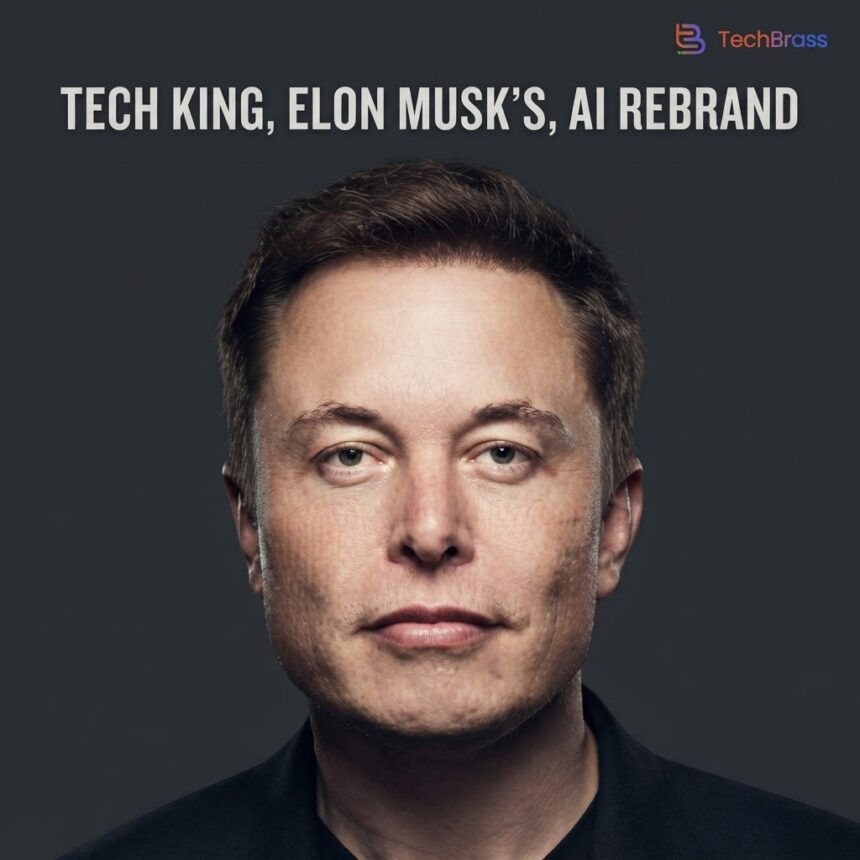
Elon Musk is changing the name of SpaceX’s artificial intelligence business.
Musk said on October 4 that SpaceXAI will be renamed SpaceXSI, adopting the abbreviation for “Super Intelligence” after President Donald Trump pushed the terminology as a replacement for “Artificial Intelligence” and “AI.” Musk said the new name is better, but he did not provide a timeline for when the rebranding will officially take effect.
The move may look like a simple branding change. However, it comes at a significant moment for the technology industry.
The U.S. government has formally instructed executive-branch agencies to use “Super Intelligence” and “SI” instead of “Artificial Intelligence” and “AI” in many official communications.
For TechBrass readers, the bigger story is what this change says about the rapidly evolving relationship between AI, politics, business and technology.
Elon Musk Confirms the SpaceXSI Name Change
The announcement came through Musk’s posts on X.
Musk first wrote that there would be “No more AI” and that “SI” was better. When a user asked whether SpaceXAI would be renamed SpaceXSI, Musk replied that the company would make the change.
However, the rebranding had not yet been completed at the time of reporting.
Reuters reported that the SpaceXAI X account had not changed and that Musk had not provided additional details about the timing.
That distinction matters.
The name change has been announced, but SpaceXSI is not yet confirmed as the fully implemented public brand.
Why Is Musk Changing SpaceXAI to SpaceXSI?
The answer is closely connected to a new terminology push from the Trump administration.
On September 29, President Donald Trump signed Executive Order 14434, “Inaugurating the Era of Super Intelligence.”
The order directs executive departments and agencies to use “Super Intelligence” and “SI” instead of “Artificial Intelligence” and “AI” in official correspondence, public communications, websites, reports, policy documents and other non-statutory materials, to the maximum extent permitted by law.
The order also defines “Super Intelligence” and “SI” for its purposes as technologies covered by the existing federal statutory definition of artificial intelligence.
So, at least within the U.S. executive branch, this is more than a marketing slogan.
It is now part of official government terminology.
What Does “Super Intelligence” Mean?
The phrase “super intelligence” can sound like an entirely new category of technology.
However, Trump’s executive order uses the term broadly.
Under the order, “Super Intelligence” and “SI” refer to technologies and systems encompassed by the existing statutory definition of artificial intelligence.
That means the terminology change does not automatically mean that SpaceX has suddenly created a completely new type of intelligence.
Instead, it represents a different way of describing the technology.
This distinction is important for businesses, developers and consumers.
AI and SI Are Not Automatically Two Different Technologies
In everyday technology discussions, AI remains the widely recognized term for artificial intelligence.
“Super Intelligence” can suggest systems that go substantially beyond today’s AI capabilities.
But the executive order’s definition is broader.
Therefore, readers should not assume that every company using “SI” is announcing a new technical breakthrough.
In SpaceX’s case, the immediate news is primarily about branding and terminology.
SpaceX’s AI Business Is Already Bigger Than a Name
The timing is especially interesting because SpaceX’s AI business is part of a much larger technology strategy.
SpaceX announced in February 2026 that it had acquired xAI, describing the combination as a vertically integrated business connecting AI, rockets, space-based internet, direct-to-mobile communications and other technologies.
That means the company’s AI ambitions are not isolated from its other businesses.
Instead, SpaceX can potentially connect computing, connectivity and space infrastructure in ways that are unusual in the technology industry.
Its own prospectus describes the AI segment as a recent strategic expansion and says xAI was acquired as the foundational platform for that segment.
This makes the SpaceXSI name more interesting than a simple corporate rename.
Why AI Matters to SpaceX
SpaceX has traditionally been associated with rockets and satellites.
Today, its technology ecosystem is considerably broader.
The company operates businesses and infrastructure involving:
- Space launch
- Satellite internet
- Direct-to-mobile communications
- Artificial intelligence
- Computing infrastructure
- Data
- Advanced engineering
The combination creates the possibility of a vertically integrated technology platform.
For example, AI systems require enormous computing resources.
Computing infrastructure requires electricity and connectivity.
Space-based infrastructure can provide communications and data capabilities.
SpaceX’s strategy brings several of these pieces under the same corporate umbrella.
That does not guarantee commercial success, but it gives the company an unusual technological foundation.
The Trump Administration Wants “SI” to Become the New Government Term
Trump’s September executive order explicitly frames the terminology shift as a reflection of rapidly advancing AI capabilities.
The White House argues that modern frontier systems increasingly amplify human creativity and capabilities beyond what early AI systems were designed to do.
The order therefore establishes “Super Intelligence” as the preferred terminology within the executive branch.
The White House has also described the initiative as part of a broader effort to position the United States at the forefront of advanced intelligence technologies.
But the change does not rewrite the entire technology industry
This is an important point.
The executive order applies to the executive branch of the U.S. government.
It does not force every technology company, researcher or country to stop using “AI.”
Therefore, terms such as:
- Artificial intelligence
- AI models
- AI software
- Generative AI
- AI assistants
- AI chips
- Machine learning
will continue to be widely used across the technology sector.
SpaceX’s decision is voluntary.
Why Musk’s Decision Matters
Musk’s decision could give the terminology change additional visibility.
SpaceX is one of the world’s most recognizable technology companies, while Musk has an enormous audience on X.
A corporate brand called SpaceXSI could therefore make “SI” more visible in technology discussions.
Other companies could choose to follow.
However, there is currently no evidence that the broader technology industry is abandoning the term AI.
That means SpaceX’s rebranding should be viewed as an early and highly visible response to the terminology shift rather than proof of an industry-wide transformation.
Could Other AI Companies Follow?
That is one of the most interesting questions.
Technology companies often respond to major shifts in terminology when branding can provide a competitive advantage.
However, companies also have reasons to preserve established names.
“AI” is:
- Globally recognized
- Short
- Embedded in technical language
- Used throughout academic research
- Common in consumer products
- Familiar to investors and businesses
Changing from AI to SI could therefore create marketing benefits while also creating confusion.
For SpaceX, the decision may make strategic sense because of Musk’s willingness to embrace the terminology.
Other companies may take a different approach.
What the Name Change Means for Consumers
For ordinary users, almost nothing changes immediately.
If you use an AI chatbot, image generator, coding assistant or other AI product, changing the abbreviation does not automatically change what the software can do.
The practical difference is mainly terminology.
For example:
Old:
“AI-powered software”
New terminology:
“SI-powered software”
The underlying technology could remain exactly the same.
What matters more is the capability of the system, how it is trained, how it is deployed and what safeguards surround it.
What Businesses Should Watch
Companies should pay attention to this development for reasons beyond the name.
The terminology shift is part of a larger conversation about how governments approach advanced AI.
Businesses should monitor:
1. Regulation
Government definitions can influence future laws and compliance requirements.
2. Safety standards
As AI systems become more capable, businesses may face additional requirements around testing and risk management.
3. Procurement
Government agencies may begin using “SI” terminology in technology contracts and documentation.
4. Public perception
Companies need to communicate clearly about what their AI systems actually do rather than relying on fashionable terminology.
5. Infrastructure
Advanced AI increasingly depends on computing power, electricity, networking and data-center capacity.
These infrastructure requirements could become just as important as the software itself.
The Bigger Story Is Not the Name
The most important part of this announcement is not whether the acronym becomes SI instead of AI.
The bigger story is that artificial intelligence is increasingly being treated as strategic infrastructure.
Governments want leadership.
Technology companies want access to computing resources.
Businesses want productivity gains.
Consumers want better products.
Researchers want increasingly capable systems.
At the same time, policymakers and the public are concerned about safety, privacy, cybersecurity, misinformation and economic disruption.
That makes the terminology debate a reflection of something much larger.
SpaceX Is Building a Broader Technology Ecosystem
SpaceX’s acquisition of xAI provides another important piece of context.
The company said the combination was designed to connect AI with space and connectivity businesses.
This strategy could eventually allow SpaceX to integrate technologies that are normally controlled by separate companies.
Imagine a future ecosystem where:
AI + Computing + Connectivity + Satellites + Space Infrastructure
operate within a common corporate structure.
That is a much bigger story than simply changing a name from SpaceXAI to SpaceXSI.
What Happens Next?
For now, the next step is implementation.
Musk has confirmed that SpaceXAI will become SpaceXSI, but no public timeline was provided in the reporting available on October 4.
The company will eventually need to determine whether and when the new name appears across:
- Websites
- Social media accounts
- Product branding
- Corporate documents
- Public communications
- Other business materials
Meanwhile, the Trump administration’s terminology policy will continue developing.
The executive order calls for proposed legislative language within 60 days to establish a federal definition of “Super Intelligence” and “SI.”
That could make the terminology debate more consequential over time.
Frequently Asked Questions
What is SpaceXSI?
SpaceXSI is the name Elon Musk says SpaceX’s AI business will adopt, replacing the SpaceXAI name. The “SI” refers to “Super Intelligence.” Musk has confirmed the change but has not provided a timeline for its implementation.
Why is SpaceXAI being renamed?
The planned rename follows President Donald Trump’s push for the term “Super Intelligence” and “SI” to replace “Artificial Intelligence” and “AI” in U.S. executive-branch communications.
Did the U.S. government officially replace AI with SI?
President Trump’s September 29 executive order directs executive departments and agencies to use “Super Intelligence” and “SI” instead of “Artificial Intelligence” and “AI” in many official communications. It does not require the private sector to adopt the terminology.
Is SpaceXSI a new AI technology?
Not necessarily. The announcement concerns the name of SpaceX’s AI business. The terminology change itself does not establish that the underlying technology has changed.
What happened to xAI?
SpaceX announced in February 2026 that it had acquired xAI as the foundation for its AI segment and described the combined strategy as a vertically integrated technology operation.
Will other companies stop using the term AI?
There is no indication yet that the entire technology industry will abandon “AI.” The U.S. executive order applies to the executive branch, while private companies can decide how they describe their products and businesses.
Conclusion
Elon Musk’s decision to rename SpaceXAI to SpaceXSI may look like a small branding change, but it arrives at a much larger turning point for the technology industry.
The Trump administration is attempting to establish “Super Intelligence” as the preferred terminology for AI within the U.S. executive branch. Musk has now chosen to embrace that language for SpaceX’s AI business.
Yet the real story goes beyond terminology.
SpaceX has already positioned AI alongside rockets, satellite connectivity and computing as part of its broader technology strategy. The planned SpaceXSI brand could therefore become another visible sign of how deeply AI is becoming integrated into the company’s future.
For businesses and technology users, the lesson is simple:
Don’t focus only on what AI is called. Focus on what the technology can actually do, how safely it is deployed and how quickly it is evolving.
The name may change.
The technology race is not slowing down.
What do you think about Musk’s decision to replace “AI” with “SI”? Is “Super Intelligence” a more accurate description of today’s technology—or is it simply a branding exercise? Share your thoughts with TechBrass.