
Tesla is pushing ahead with its plan to bring the Cybercab to customers by the end of 2026, even as US federal regulators examine whether the futuristic, driverless vehicle complies with existing safety standards.
The gold-coloured, two-seat electric vehicle takes a radical approach to transportation. It has no conventional steering wheel or pedals and is designed to operate autonomously. That design could help Tesla build a new business around self-driving transport, but it also raises important questions about safety, regulation and who will be responsible when something goes wrong.
Tesla’s vehicle engineering chief, Lars Moravy, said on October 21 that the company aims to begin customer deliveries before the end of the year. However, the National Highway Traffic Safety Administration (NHTSA) is investigating Tesla’s self-certification of the Cybercab, creating a significant regulatory challenge as the company prepares for a wider rollout.
For consumers, the Cybercab represents a possible new chapter in autonomous mobility. For Tesla, it is a test of whether a vehicle designed without traditional driver controls can move from a limited robotaxi service to a product that customers can own.
What Is the Tesla Cybercab?
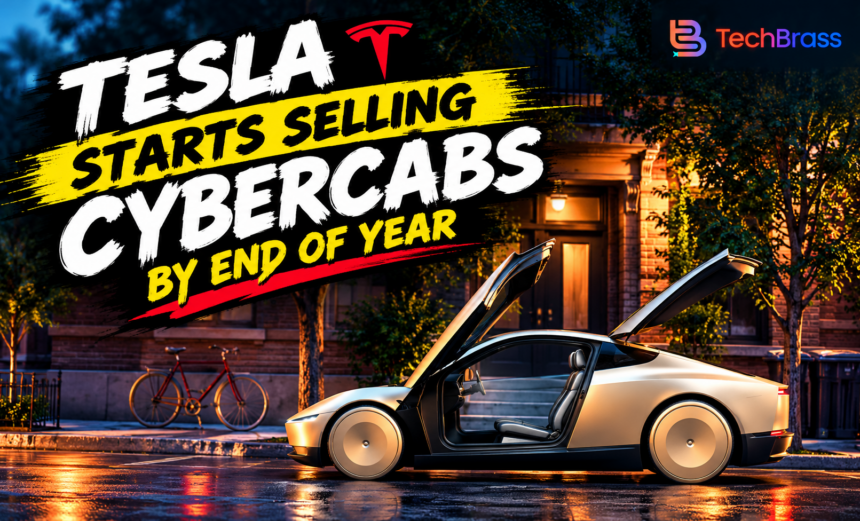
Its distinctive design includes:
Two passenger seats
A gold-coloured exterior
Butterfly-style doors
No conventional steering wheel or accelerator and brake pedals
An operating model centred on autonomous driving and robotaxi services
The vehicle is part of Tesla’s wider ambition to make autonomy and AI central to its business.
Unlike a conventional electric car, which gives a human driver direct control, the Cybercab is designed to handle driving tasks itself. That approach could change how people book transport, use vehicles and think about car ownership.
However, its unusual design also raises a major question: can a vehicle without traditional driving controls meet the safety requirements created largely for human-driven cars?
Tesla Plans to Sell Cybercabs by the End of 2026
Tesla’s engineering chief, Lars Moravy, said the company is aiming to begin delivering Cybercabs to customers by the end of 2026.
He also indicated that Tesla would start small, learn how vehicle ownership and fleet management work with autonomous vehicles in customers’ hands, and then expand deliveries.
That distinction matters. Tesla has announced a target, but the target should not be interpreted as a guarantee that the vehicle will be widely available to everyone before the end of the year.
The company has already started offering paid Cybercab rides through a limited service in Austin, Texas. Tesla also said it planned to expand the service to Dallas in November 2026.
Will customers be able to buy one for personal use?
Tesla has discussed selling Cybercabs to customers, but its broader strategy remains closely tied to its robotaxi network. Elon Musk has said the vehicles will mainly be owned by Tesla and used for its ride-hailing service.
As a result, the precise balance between private ownership and Tesla-operated fleet use remains an important part of the story.
Potential buyers will also need clear information about pricing, delivery schedules, operating restrictions, insurance and what happens if the autonomous system cannot complete a journey.
Why Is the US Government Investigating Tesla’s Cybercab?
The National Highway Traffic Safety Administration opened an investigation into the Cybercab’s safety certification on September 4, 2026, following its commercial deployment in Austin.
The agency is examining the technical information and process Tesla used to certify that the vehicle meets applicable Federal Motor Vehicle Safety Standards. One focus is whether Tesla determined that certain requirements for conventional vehicles do not apply to a vehicle designed to operate autonomously.
This is an important distinction: the investigation does not, by itself, establish that Tesla violated safety rules. It means regulators are examining the basis for the company’s certification.
The problem with a car that has no steering wheel
Many existing vehicle safety requirements were written around cars controlled by human drivers. The Cybercab challenges that framework because it is designed to operate without conventional manual controls.
Regulators need to determine whether the vehicle’s design and certification comply with the rules currently in force.
The NHTSA has said it is working on updates to federal standards that could accommodate autonomous vehicles without human controls. However, the agency has also made clear that existing requirements remain in force until relevant changes are completed.
What happens next?
Tesla has until October 30, 2026, to respond to the regulator’s questions, following an extension to its original deadline.
The company’s response and any subsequent regulatory action could affect how quickly it expands the Cybercab programme.
For Tesla, the challenge is not simply manufacturing the vehicle. It must also demonstrate that its approach to safety certification satisfies the regulator.
Can the Cybercab Make Autonomous Transport More Convenient?
The Cybercab could offer several potential benefits if Tesla can demonstrate that it operates safely and reliably at scale.
1. A different ride-hailing experience
Passengers could request a ride without a human driver behind the wheel. In principle, this could allow a transport service to operate with less dependence on human drivers.
However, the economics would depend on vehicle utilisation, maintenance, cleaning, charging, insurance, remote assistance and other operating costs.
2. A new approach to vehicle design
Removing conventional driving controls gives designers more freedom to build a cabin around passengers rather than a driver’s position.
Nevertheless, the absence of a steering wheel and pedals also creates new questions about emergency procedures, passenger support and how the vehicle should respond when it encounters a situation its autonomous system cannot handle.
3. Potential changes to transport businesses
If autonomous vehicles become commercially viable, ride-hailing companies, fleet operators and mobility startups could explore new service models.
For example, an operator might eventually use a fleet of autonomous vehicles to provide scheduled airport transfers or transport in a defined urban area. Such a service would still need to meet local rules, demonstrate reliability and provide an effective response when something goes wrong.
These are possible applications, not proof that the Cybercab can already deliver them at scale.
The Biggest Challenges Tesla Must Overcome
Tesla’s plans face several practical challenges beyond the design itself.
Safety and regulation
Tesla must address the questions raised by the NHTSA and establish a clear path for compliant deployment.
Manufacturing at scale
Building early vehicles is different from producing enough vehicles to support a large commercial network. Tesla will need consistent production, quality control and service support.
Real-world driving conditions
Roadworks, unpredictable pedestrians, severe weather and unusual traffic situations can complicate autonomous driving. Performance must be evaluated under the conditions in which the service will operate.
Customer trust
Passengers need confidence in the vehicle’s safety, while owners and fleet operators need clarity on maintenance, liability, insurance and support.
These challenges will help determine whether the Cybercab becomes a commercially successful product or remains a limited service while Tesla resolves technical and regulatory questions.
What Does Tesla’s Cybercab Mean for the Future of Electric Vehicles?
The Cybercab reflects a wider change in the automotive industry. Companies are increasingly exploring vehicles where software, artificial intelligence and autonomous driving are central to the product.
Tesla has positioned the Cybercab as part of its transition toward AI and robotics, rather than treating it only as another electric car.
For the wider industry, the outcome could influence how manufacturers design future autonomous vehicles and how regulators adapt safety standards to new technology.
Still, a radical design is not enough on its own. The Cybercab must demonstrate practical reliability, meet applicable regulations and provide an operating model that makes sense for customers and businesses.
For now, its planned customer deliveries and the federal investigation are developing in parallel. How Tesla addresses both will be central to the vehicle’s future.
Frequently Asked Questions
When will Tesla start selling the Cybercab?
Tesla is aiming to begin customer deliveries by the end of 2026, according to its vehicle engineering chief. This is a target, not a guarantee of broad availability.
Does the Tesla Cybercab have a steering wheel?
No. The Cybercab is designed without a conventional steering wheel, accelerator pedal or brake pedal. It is intended to operate autonomously.
Why is the Tesla Cybercab under investigation?
The NHTSA is examining how Tesla certified that the vehicle meets federal safety standards despite its lack of traditional manual controls. The investigation is ongoing; it is not itself a finding of non-compliance.
Can customers use the Cybercab as a private car?
Tesla has said it aims to begin customer deliveries, but its broader strategy also centres on operating Cybercabs within its robotaxi network. Details about the availability and terms of private ownership remain important questions.
Will the Cybercab be available outside the United States?
Tesla’s current reported rollout plans focus on its US robotaxi operations. Availability in other countries will depend on Tesla’s plans, local regulations and the vehicle’s ability to meet each market’s requirements.
Is the Cybercab fully autonomous?
It is designed as a driverless vehicle, but that design intention should not be confused with proof that it can operate safely in every situation or location. Its real-world capabilities, operating limits and regulatory status remain important considerations.
Conclusion: Tesla’s Cybercab Faces a Critical Test
Tesla’s plan to begin Cybercab customer deliveries by the end of 2026 could mark a major step in the company’s autonomous-transport ambitions. Its two-seat design, lack of traditional driving controls and focus on robotaxi operations set it apart from conventional electric vehicles.
Yet the federal investigation shows that innovation must be matched by compliance and demonstrable safety. Tesla must address regulators’ questions while proving that the Cybercab can be manufactured, operated and supported at scale.
The coming weeks will be important as the October 30 response deadline approaches and Tesla works toward its delivery target.
Follow TechBrass for the latest updates on Tesla, electric vehicles, artificial intelligence and the technologies shaping the future of transportation. Visit techbrass.com for more technology news and analysis.