
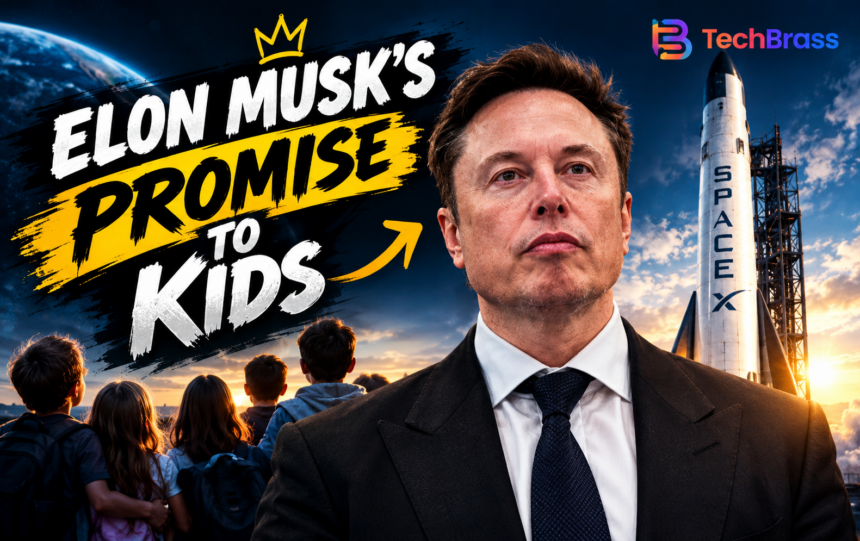
Elon Musk has made an extraordinary promise: give one share of SpaceX to every child in the United States in 2027. But while the announcement sounds like a historic act of generosity, it has also raised questions about whether the plan can be delivered as described.
The pledge, announced on October 19, 2026, could involve roughly 72 million children. Based on reported SpaceX share prices at the time, the proposed distribution could be worth around $10.5 billion. However, Musk has not publicly explained all the details needed to turn the announcement into a working programme.
The timing is also notable. Musk made the announcement shortly after AI company Anthropic revealed plans to dedicate 5% of its shares to a public-benefit fund. The contrasting proposals have sparked a wider debate about how technology billionaires should share the wealth created by the AI and technology boom.
The central question is not simply how much the proposed gift is worth. It is whether the promise will become a clearly defined, legally workable distribution — and what recipients would actually receive.
What Did Elon Musk Promise?
Musk announced on his social media platform, X, that he intended to give one of his SpaceX shares to every child in America the following year. He described it as the first of what could become multiple distributions.
The proposal would give eligible children an ownership interest in SpaceX, the company known for its rockets, space transportation and Starlink satellite internet service.
Based on estimates of approximately 72 million children in the United States and a share price around $146, the pledge could represent a distribution worth more than $10 billion. The exact total would depend on the final number of recipients and the share price used to calculate the value.
That is a headline-grabbing figure. Nevertheless, the estimated value should not be confused with cash that children would receive.
A share represents ownership in a company. Its value can rise or fall, and the ability to sell or transfer it depends on the relevant rules and arrangements.
Most importantly, Musk’s announcement is a pledge, not confirmation that the shares have already been distributed.
Why Is Musk’s SpaceX Share Promise Facing Scrutiny?
The scepticism surrounding the proposal is not proof that Musk will abandon it. Rather, it reflects the gap between announcing a large giveaway and establishing a process that can deliver it to millions of recipients.
1. The distribution process remains unclear
Musk has not publicly provided a complete set of instructions explaining how every eligible child would receive a share.
A programme of this scale would need to address several practical questions:
Who qualifies as a child in the United States?
Would eligibility depend on age, citizenship, residency or another criterion?
How would parents or guardians register eligible children?
Which organisation would administer the transfers?
When in 2027 would the distribution take place?
How would the programme handle children who do not already have investment accounts?
These are not minor administrative details. They determine who receives the shares, how ownership is recorded and whether the plan can operate at the promised scale.
Until the rules are published, families cannot reliably determine whether a particular child would qualify.
2. A large financial pledge needs a clear implementation plan
A promise valued at more than $10 billion naturally attracts attention. But a financial estimate does not establish how the gift will be funded, administered or completed.
Reports indicate that Musk has considered distributing the shares through the US government’s Trump Accounts programme, which provides investment accounts for eligible children. However, the public announcement did not provide a complete operational plan for the proposed giveaway.
Using an existing programme could potentially simplify account administration. Even so, the final arrangement would need to explain how the shares would be transferred, how recipients would be identified and what restrictions would apply.
The distinction matters: an announcement can be genuine while the details needed for delivery remain unresolved.
3. Receiving a share is not the same as receiving cash
The reported estimate of around $10.5 billion is based on the potential value of the shares at the time of the announcement. It is not a promise that every child will receive that amount in money.
For an individual recipient, the immediate value would be tied to one share’s market price. That value could change over time.
Families would also need to understand whether recipients could sell their shares immediately, whether the shares would be held in custodial accounts and whether any restrictions would apply.
These details are especially important because the intended recipients are minors, who generally cannot manage financial assets in the same way as adults.
What Are Trump Accounts, and Could They Be Used for the Giveaway?
Trump Accounts are US investment accounts created under federal legislation to support long-term savings for eligible children. The programme has attracted commitments from wealthy donors and businesses seeking to contribute to children’s financial futures.
Musk’s proposed SpaceX share distribution may use this existing infrastructure, but the precise arrangement has not been fully disclosed publicly.
If the accounts are used, several issues would still need to be resolved:
Eligibility: The programme’s eligibility rules would need to be reconciled with Musk’s broader promise to reach every child in America.
Account ownership: The process would need to establish how each child’s share is legally held.
Transfer restrictions: Any applicable restrictions on transferring or selling shares would need to be explained.
Administration: A system would be required to identify recipients, record ownership and handle errors or disputed claims.
An existing account programme could provide a useful starting point. It would not, by itself, settle every question about the proposed giveaway.
How Does Musk’s Promise Compare With Anthropic’s Philanthropic Plan?
The timing of Musk’s announcement has drawn attention because it followed a different approach to technology-sector philanthropy.
Anthropic announced plans to commit 5% of its shares to a public-benefit fund intended to support initiatives addressing issues such as AI safety, biomedical research and the social effects of AI. Musk responded by advocating direct share distributions and then announcing his plan for American children.
The proposals represent two different approaches to sharing wealth created by the technology industry.
Elon Musk’s proposal
Distribute one SpaceX share to every child in America, with the intended distribution in 2027. The operational details remain to be clarified.
Anthropic’s proposal
Allocate 5% of the company’s shares to a public-benefit fund that would support selected initiatives for public good, rather than giving a share directly to every child.
The distinction is significant. Direct ownership could give recipients a financial stake in a company, while a public-benefit fund can direct resources towards broader social goals.
Neither approach should be judged by its headline valuation alone. Its practical impact will depend on whether the commitment is fulfilled, how the assets are managed and what benefits recipients or communities ultimately receive.
Is This a Historic Act of Generosity or a Promise That Needs Proof?
It is possible to recognise the potential significance of Musk’s proposal while still asking for evidence of how it will work.
If completed as described, the distribution would give millions of children a financial interest in a major space and technology business. That could introduce more young people to investing and company ownership.
However, several steps separate the announcement from that outcome.
What would demonstrate real progress?
Readers should watch for concrete developments rather than relying only on social media statements:
A published eligibility policy explaining who qualifies and how eligibility will be verified.
A confirmed distribution mechanism identifying how the shares will reach recipients.
Clear legal and administrative arrangements explaining ownership, custodianship and any transfer restrictions.
A defined timeline with specific milestones for 2027.
Evidence of completed transfers showing that the distribution has moved beyond planning.
These milestones would make it easier for the public to assess whether the pledge is progressing.
Until such details emerge, it is reasonable to describe the giveaway as an announced intention rather than a completed philanthropic action.
What Could This Mean for the Future of Technology Philanthropy?
The debate extends beyond Musk and SpaceX. Technology companies and their founders control assets that can reach enormous valuations, especially as artificial intelligence, space technology and digital infrastructure expand.
Their decisions about philanthropy can influence how the public thinks about wealth, corporate responsibility and the distribution of economic opportunity.
There are several broader implications.
More attention on how billionaires share wealth
Large technology fortunes increasingly attract debate about whether private wealth should support public needs more directly.
Some initiatives focus on charities and research. Others support investment accounts, education or direct distributions. Musk’s proposal adds another model to that discussion.
Greater scrutiny of public commitments
Social media allows business leaders to announce ambitious plans to a global audience almost instantly. But the speed of an announcement does not eliminate the need for legal, financial and administrative work.
A clear implementation plan helps the public distinguish between an aspiration, a formal commitment and a completed transfer.
Financial literacy could become part of the conversation
If children receive company shares, families may need to understand basic concepts such as ownership, market risk, diversification and long-term investing.
A share can be a valuable educational opportunity, but its price can fluctuate. Financial education would help young recipients understand that stock ownership is not a guaranteed cash benefit.
Frequently Asked Questions
Is Elon Musk really giving SpaceX shares to every American child?
Musk publicly announced that he intends to give one SpaceX share to every child in America in 2027. However, the full distribution rules and implementation details have not been publicly established. The announcement should therefore be treated as a pledge, not proof that the shares have been distributed.
How much could Musk’s SpaceX giveaway be worth?
Reports estimated the proposed distribution at roughly $10.5 billion, based on approximately 72 million children and a SpaceX share price of around $146 at the time. The actual value could change with the share price and the final number of recipients.
When will children receive the shares?
Musk identified 2027 as the intended year. However, no definitive public distribution date or complete timetable was included in the announcement.
Will children receive cash or company shares?
The announcement concerns shares in SpaceX, not a cash payment. The financial value of a share can rise or fall, and the rules governing ownership and transfers will determine how recipients can use their shares.
Why are people questioning Musk’s promise?
The main questions concern eligibility, administration, the transfer of millions of shares and the legal arrangements needed to distribute them. Those unanswered questions justify scrutiny, but they do not independently prove that the promise will not be fulfilled.
What is the connection between Musk’s announcement and Anthropic?
Musk announced the proposed giveaway after Anthropic revealed plans to allocate 5% of its shares to a public-benefit fund. The announcements illustrate different approaches to distributing some of the wealth generated by the technology sector.
Conclusion: The Real Test Will Be What Happens Next
Elon Musk’s promise to distribute SpaceX shares to American children is an ambitious proposal with a potentially enormous financial value. If fulfilled, it could give millions of young people an opportunity to participate in company ownership.
But the announcement also illustrates why major financial pledges require more than a headline and an estimated valuation. Eligibility rules, legal arrangements, transfer procedures and evidence of delivery will determine whether the promise becomes reality.
For now, the fairest assessment is neither to dismiss the proposal outright nor to treat it as a completed act of generosity. The public needs clearer details and, ultimately, evidence that the shares have reached their intended recipients.
Follow TechBrass for independent technology coverage, business developments and the stories shaping the future of innovation.