
Nigeria’s startup ecosystem has attracted significant venture capital, built globally recognized companies and created new digital businesses across fintech, commerce, logistics and other sectors. Yet one major piece of the ecosystem remains underdeveloped: how investors eventually get their money out.
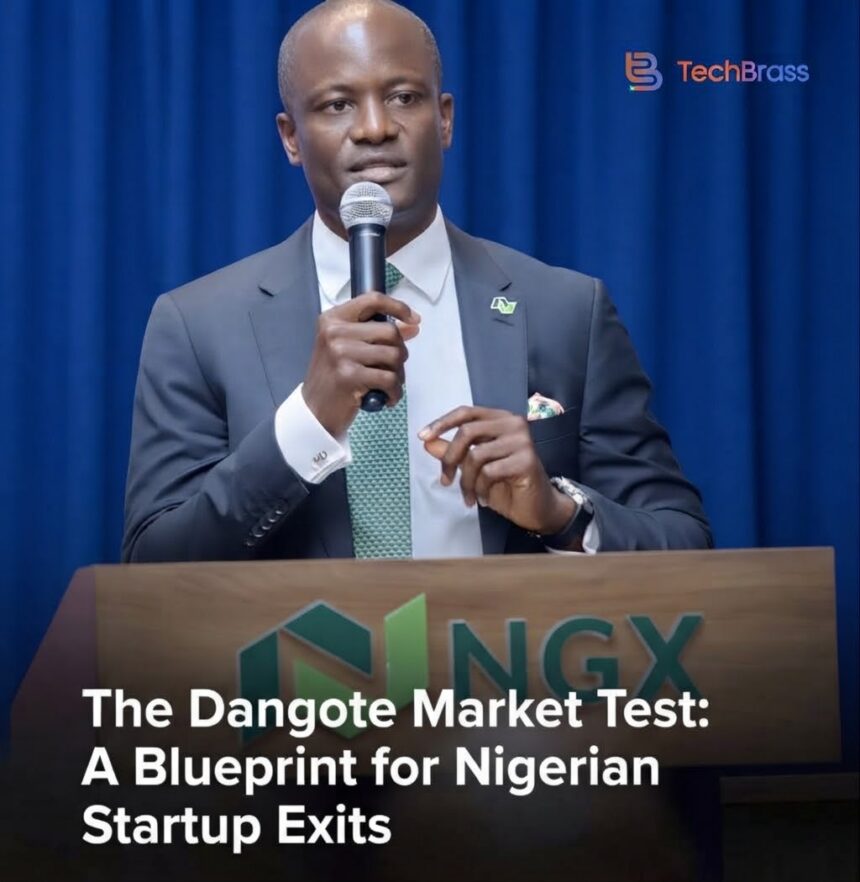
That is why the ongoing Dangote Petroleum Refinery IPO deserves attention beyond the refinery itself.
The public offer, which opened on September 14, 2026, comprises 4.1 billion ordinary shares priced at ₦525 each, with the subscription window scheduled to close on October 13, 2026. The Nigerian Exchange says the offer is expected to raise about ₦2.15 trillion.
For technology founders and investors, however, the more interesting question is not simply whether the Dangote IPO succeeds.
It is whether the transaction can demonstrate that Nigeria has enough public-market capital, investor participation and digital infrastructure to support much larger exits in the future.
And that could matter enormously for Nigerian startups.
⸻
Why the Dangote IPO Matters to Nigeria’s Startup Ecosystem
A startup can raise money from angel investors, venture capital firms and institutional investors for years.
But eventually, those investors usually need an exit.
An exit allows early investors to convert their ownership into cash and gives founders, employees and later-stage shareholders an opportunity to realize the value created by the company.
Common exit routes include:
- Acquisition by another company
- Sale of shares to another investor
- Secondary transactions
- Management buyouts
- Public listings or IPOs
For Nigerian technology companies, the public-market option has remained largely untested.
That is important because a healthy startup ecosystem needs more than capital entering companies. It also needs mechanisms for capital to eventually come back out.
⸻
The NGX Has Already Created a Route for Technology Companies
The idea of Nigerian technology companies accessing the public market is not new.
The Nigerian Exchange created its Technology Board specifically for technology-based companies seeking to list and raise capital. The SEC approved the board’s listing rules in December 2022.
NGX also maintains a dedicated checklist for companies seeking an initial listing on its Technology Board.
So, in principle, the infrastructure for technology listings already exists.
The bigger challenge is whether Nigerian startups, investors and the wider market are ready to use it.
In 2023, NGX and government representatives were already discussing how to encourage startup listings and improve access to public capital. NGX leadership also acknowledged that demand for private capital had been outpacing public capital.
The Dangote IPO therefore arrives at an interesting moment.
The market now has an unusually large real-world test of investor participation.
⸻
What the Dangote IPO Is Actually Testing
It would be inaccurate to suggest that a successful Dangote IPO automatically means Nigerian startups can successfully go public.
Dangote Refinery is fundamentally different from a venture-backed technology startup.
The businesses operate at different scales, serve different markets and attract different types of investors.
However, the transaction can provide useful evidence about several things.
1. Is there enough domestic investor appetite?
A major IPO requires investors willing to commit capital.
The Dangote offer is open to retail, institutional and eligible African investors, creating an opportunity to observe how different categories of investors respond to a large Nigerian company entering the public market.
For startups, that matters because future technology IPOs would also need investors prepared to evaluate companies based on their growth prospects, financial performance and long-term potential.
⸻
2. Can technology make investing more accessible?
The Dangote offering is also testing Nigeria’s increasingly digital capital-market infrastructure.
NGX has highlighted how investors can participate through digital channels, while its NGX Invest platform is designed to make primary-market participation more accessible.
This is particularly relevant to technology companies.
If buying shares in a public company becomes easier for ordinary Nigerians, the potential investor base for future listings could become broader.
That could eventually benefit companies beyond traditional industrial businesses.
⸻
3. Can Nigeria build deeper public-market liquidity?
Getting investors to buy shares is only part of the equation.
A functioning public market also needs liquidity.
In simple terms, investors need confidence that there will be other buyers and sellers when they eventually want to trade their shares.
For startups, this is especially important.
A technology company may grow rapidly but still struggle as a public company if investors cannot easily value or trade its shares.
Therefore, the longer-term question is not simply:
“Did investors subscribe?”
It is also:
“What happens after the listing?”
⸻
The Startup Exit Problem Goes Beyond IPOs
The Nigerian startup ecosystem does not have to rely exclusively on IPOs.
Acquisitions remain another important pathway.
A larger company can purchase a startup, giving founders and early investors an opportunity to realize returns without the company becoming publicly listed.
However, relying heavily on private acquisitions can limit the number of available exit opportunities.
Public markets can potentially create another channel.
That diversification matters.
A mature ecosystem could eventually give founders and investors several choices:
Build → Scale → Raise Capital → Grow → Exit
And the exit could happen through an acquisition, secondary transaction or public listing depending on the company’s size and circumstances.
⸻
Why Nigerian Startups May Still Find IPOs Difficult
The existence of the NGX Technology Board does not remove the practical challenges of becoming a public company.
A startup considering an IPO needs much more than a good product.
It needs strong financial reporting, corporate governance, investor communication, regulatory readiness and a business model that public-market investors can understand.
There is also the question of valuation.
A private startup may be valued primarily on growth expectations and future potential.
Public-market investors, however, can apply different valuation frameworks and demand a much higher level of transparency.
That creates an important transition for founders.
Private-company mindset
- Focus heavily on growth
- Raise funding from a relatively small investor group
- Report privately to shareholders
- Operate with greater flexibility
Public-company mindset
- Greater disclosure
- Broader shareholder base
- More scrutiny
- Ongoing investor communication
- Greater regulatory responsibilities
- Continuous market valuation
For some startups, that transition could be difficult.
⸻
Currency Is Another Major Consideration
Currency risk adds another layer to the Nigerian startup exit conversation.
The 2025 TLP Advisory ecosystem report found that 76.5% of surveyed startups experienced currency mismatch, while 53% of surveyed founders cited a lack of awareness of the NGX listing process.
The issue is straightforward.
A company can generate significant revenue in naira while raising investment in dollars.
If the naira changes significantly against the dollar, the value of the investment can look very different when an investor eventually exits.
For international investors, that creates an additional consideration beyond whether the startup itself is growing.
Consequently, developing a stronger pool of local capital could help reduce some of the currency mismatch facing Nigerian startups.
⸻
What Founders Can Learn From the Dangote IPO
The most useful lesson for technology entrepreneurs may not be “take your company public.”
Instead, it is to start thinking about the eventual exit much earlier.
1. Build for institutional credibility
A startup planning for a potential future listing should take governance, accounting and reporting seriously long before an IPO becomes realistic.
2. Understand your capital structure
Founders should know who owns what, how much dilution has occurred and what different funding rounds mean for future investors.
3. Build a durable business
Growth alone is not enough.
A company needs a business model capable of producing sustainable value.
4. Understand the local capital market
The NGX Technology Board exists, and companies should understand its requirements rather than treating the public market as something completely outside the Nigerian technology ecosystem.
5. Think beyond fundraising
Raising another round should not always be the end goal.
Founders should also understand how investors might eventually realize returns.
⸻
Could Nigeria Produce a Major Tech IPO?
Potentially, yes.
But the Dangote transaction should be viewed as a market test rather than proof that the startup exit problem has already been solved.
That distinction matters.
A large industrial company attracting investors does not automatically prove that a fintech, SaaS company, marketplace or other venture-backed technology business would receive the same response.
However, if the transaction demonstrates strong investor participation and reinforces confidence in Nigeria’s digital and public-market infrastructure, it could contribute to a broader ecosystem in which future companies feel more comfortable considering public listings.
And that would be significant.
⸻
The Bigger Opportunity: Keeping More Value in Nigeria
There is an even bigger issue behind the startup-exit conversation.
When Nigerian technology companies raise money from international investors, significant ownership can eventually sit outside the country.
That is not necessarily a problem. International capital can provide startups with the funding, expertise and networks they need to expand.
But a deeper Nigerian public market could give local investors greater opportunities to participate in the growth of successful technology companies.
In other words, the goal is not to replace international capital.
It is to add more sources of capital.
A stronger ecosystem could allow Nigerian companies to raise money internationally while also giving Nigerian investors opportunities to participate when those businesses mature.
⸻
What Happens Next?
The Dangote IPO will ultimately provide only one piece of the puzzle.
For Nigerian startups to develop a stronger exit market, several things will need to work together:
- More investor education
- Stronger corporate governance
- Better financial reporting
- Deeper local capital pools
- Greater awareness of public-market options
- More technology companies preparing for eventual listings
- Improved secondary-market liquidity
- Continued development of digital investment infrastructure
NGX has already established a framework for technology listings, and the current IPO demonstrates that large-scale public-market participation is becoming increasingly digital.
The next challenge is turning that infrastructure into a market that technology companies can confidently use.
⸻
Frequently Asked Questions
What is the Dangote IPO?
The Dangote Petroleum Refinery and Petrochemicals IPO is a public share offering on the Nigerian Exchange. NGX says it consists of 4.1 billion ordinary shares priced at ₦525 each, with the offer scheduled to close on October 13, 2026.
Why does the Dangote IPO matter to Nigerian startups?
It provides a real-world test of investor participation and Nigeria’s public-market infrastructure. A strong outcome could increase confidence that Nigerian capital markets can support large corporate fundraising and potentially future technology listings.
Does the Dangote IPO mean Nigerian startups can now easily go public?
No. Dangote Refinery and venture-backed startups have very different business models, scales and investor profiles. The IPO is better understood as a market signal than a guarantee of a viable startup IPO route.
Does Nigeria have a technology-focused stock-market board?
Yes. NGX has a Technology Board designed for technology-based companies to list and raise capital. Its rules were approved by the SEC in 2022.
What are the main alternatives to an IPO for startups?
Startups can potentially pursue acquisitions, secondary share sales and other private transactions. The appropriate exit depends on the company’s ownership structure, maturity, market conditions and investor requirements.
⸻
Conclusion: Nigeria Needs More Ways for Startups to Exit
The most important thing about the Dangote IPO may ultimately have little to do with Dangote.
It is about what the transaction can reveal about Nigeria’s capacity to move capital through the entire business lifecycle.
Startups need money to build.
They need markets to grow.
And investors eventually need credible ways to exit.
Nigeria has already taken steps toward creating a public-market pathway for technology companies through the NGX Technology Board.
The question now is whether the market can develop enough depth, liquidity and investor confidence for Nigerian technology companies to use that pathway at scale.
The Dangote IPO cannot answer that question by itself.
But it can help start the conversation.
For TechBrass readers, the bigger story is clear: Nigeria’s next technology breakthrough may not only be about building the next unicorn. It may be about building an ecosystem where successful companies can eventually become publicly owned Nigerian businesses.
Follow TechBrass for more technology, startup, fintech and business stories shaping Nigeria and Africa.