
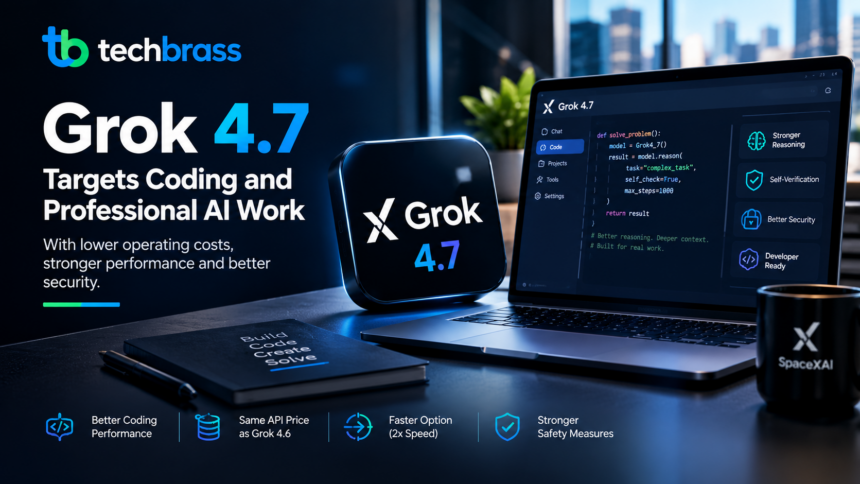
SpaceXAI has released Grok 4.7, a new artificial intelligence model designed to handle complex coding tasks and professional knowledge work.
The company says the new model is built to work on difficult problems for longer periods, check its own answers more carefully, and provide stronger safeguards for high-risk use cases.
Grok 4.7 is available at the same API price as its predecessor, Grok 4.6. Developers pay $2 per million input tokens and $6 per million output tokens.
For applications where speed is a priority, SpaceXAI also offers an expedited version. This variant generates output at twice the standard speed but costs twice as much.
The launch puts Grok 4.7 into competition with other advanced AI systems used for software development, research, engineering, legal work, healthcare, and other professional tasks.
Grok 4.7 focuses on longer and harder tasks
According to SpaceXAI’s technical release, Grok 4.7 is designed to spend more time working through difficult problems.
The model uses an expanded base architecture combined with extended reinforcement learning. The training process focused on complex tasks that can require several hours of reasoning.
The company also expanded the model’s ability to handle long contexts. This is important for coding projects and professional work where an AI system may need to process large amounts of information before producing an answer.
Another major feature is self-verification.
Instead of simply producing an answer, Grok 4.7 is designed to check its work more carefully. This can help the model identify errors before completing a task.
The model also supports the Grok Bot harness, which SpaceXAI says helps improve conversational interaction and the handling of less structured information.
Grok 4.7 shows gains in coding benchmarks
The model’s performance is particularly focused on software development.
On CursorBench 4.0, which measures performance on sustained programming assignments, Grok 4.7 recorded a 46.3% success rate at an average cost of $11.95 per completed task.
That compares with:
- Grok 4.6: 40.4%
- GPT-5.6 Sol: 41.7%
- Fable 5.1: 51.8%
- Grok 4.7: 46.3%
Grok 4.7 also recorded a 71% score on DeepSWE v1.1 when tested with high-effort settings.
The result was higher than Grok 4.6 at 65.2% and Fable 5.1 at 70%.
The model also made a significant jump on Terminal-Bench 4.0. Its score increased to 38%, compared with 20.3% for the previous generation.
These results suggest that the model has improved at tasks that require an AI agent to work through several programming steps rather than simply answer a short coding question.
Performance extends beyond software development
Grok 4.7 is also being positioned as a model for professional knowledge work.
On the GDPval benchmark, the model achieved an Elo rating of 1695.
For comparison, Fable 5.1 recorded 1735 Elo, while Grok 4.6 scored 1605 Elo and GPT-6 Astra recorded 1542 Elo.
The model also performed strongly on the EEBench electrical engineering evaluation, where it scored 64.0%.
That was higher than the 39.4% score reported for GPT-5.6 Sol.
The results show that SpaceXAI is targeting more than general chatbot use. The company is positioning Grok 4.7 for technical and specialised professional tasks.
Stronger results in legal and healthcare testing
Grok 4.7 also showed improvements in specialised professional evaluations.
On the Harvey Legal Agent Benchmark, the model scored 19.6%.
That was higher than Grok 4.6 at 15.8%, Fable 5.1 at 6.7%, and GPT-5.6 Sol at 2.5%.
Healthcare testing produced a different picture.
On HealthBench Professional, Grok 4.7 achieved 56.7%.
The result improved on Grok 4.6’s 48.5%. However, GPT-5.6 Sol scored 60.5%, while Fable 5.1 reached 62.1%.
This shows that model performance can vary significantly depending on the type of professional task being tested.
Security remains a major focus
SpaceXAI also says it has strengthened Grok 4.7’s security systems.
The company rebuilt its defensive filtering architecture to address the risks that can come with powerful AI systems.
One area of focus is biological safety.
On LatchBio’s biological safety benchmark, Grok 4.7 recorded a 62.4% rating. The evaluation measures the model’s ability to remain useful for legitimate questions while restricting assistance that could create biological hazards.
The model was also tested on HackerBench v0.3, which covers potentially destructive cybersecurity operations.
According to the supplied results, Grok 4.7 restricted unauthorised completions to 3.3% of risky prompts while still allowing legitimate security workflows.
SpaceXAI has also provided selected cybersecurity partners with restricted access to evaluate the system’s capabilities in defensive security research.
Grok 4.7 is available to developers
Grok 4.7 is now being made available through several channels.
Developers can access the model through the Grok API, third-party model routers, and managed cloud services.
The model is also available through development environments such as Cursor and Grok Build.
Terminal-based tools are available as well, allowing developers to interact with the model directly from standard command-line environments.
This broad availability could make Grok 4.7 easier to integrate into existing software development workflows.
What Grok 4.7 means for AI development
The release reflects a wider shift in the AI industry.
The focus is moving beyond models that simply answer questions or generate short pieces of code. Companies are increasingly developing AI systems that can work on larger projects for longer periods.
For software developers, this means AI agents may increasingly be used to investigate codebases, implement features, fix problems, update dependencies, and complete multi-step engineering assignments.
However, benchmark results also show that performance varies across tasks. A model can perform strongly in one field while producing weaker results in another.
For businesses, factors such as price, speed, accuracy, security, and reliability will therefore remain important when choosing an AI model.
With Grok 4.7, SpaceXAI is targeting this growing market with a system designed specifically for coding and professional knowledge work.
The combination of longer reasoning, self-checking capabilities, specialised performance, and API access makes Grok 4.7 another significant development in the race to build more capable AI agents.