
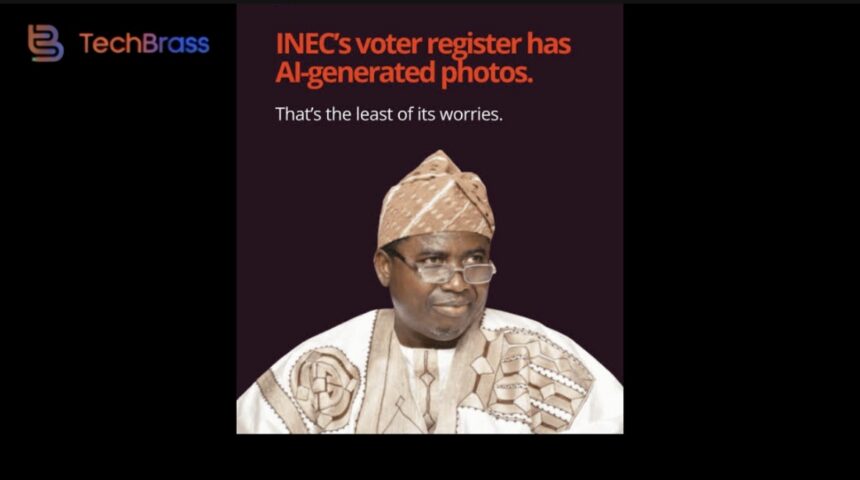
Nigeria’s electoral commission is investigating 268 questionable voter records after suspected AI-generated photographs, duplicate entries and other irregularities appeared in its preliminary voter register. But the controversy exposes a bigger problem than artificial intelligence: whether the people responsible for managing Nigeria’s electoral data can be trusted to protect it.
The discovery has raised fresh concerns about the credibility of the voter register ahead of the 2027 general elections.
The Independent National Electoral Commission (INEC) has acknowledged that some photographs in its preliminary register were generated using artificial intelligence. Its Director of Information and Communication Technology, Lawrence Bayode, said some registration officers allegedly used their official login credentials to introduce questionable records into the database.
The commission says it has started investigating and cleaning up the affected records.
But the central question is no longer simply whether AI-generated photographs can enter an electoral database. It is how questionable information was allowed into a system that determines who gets to vote in Nigeria.
What Exactly Happened Inside INEC’s Voter Register?
The controversy became public on October 26, 2026, when INEC uploaded its preliminary Register of Voters to its website.
Nigerians examining the database began sharing screenshots of questionable voter photographs, including entries reportedly linked to a polling unit in Etsako West Local Government Area of Edo State.
Some photographs appeared artificial, while other entries raised questions about duplicate registrations and the inclusion of deceased persons.
INEC initially said it was investigating the records. But on October 30, its ICT director, Lawrence Bayode, provided a more detailed explanation.
He said some registration officers across different states allegedly used their official login credentials to introduce irregularities into the database.
According to Bayode, the commission discovered the questionable entries through its Automated Biometric Identification System (ABIS).
This system helps identify potential duplicate biometric records and other registration inconsistencies.
The commission said it had identified how some irregularities entered the system, although the motives of the officers involved were not yet clear.
INEC Has Flagged 268 Questionable Records
One of the most important developments is the number of records currently under review.
On November 1, Bayode disclosed that INEC’s Automated Biometric Identification System had flagged 268 records for further examination.
These records involve suspected AI-generated photographs and other irregularities. It would be inaccurate to say all 268 have been conclusively confirmed as AI-generated.
He also explained that some individuals allegedly exploited a special registration provision designed for people with disabilities who have incomplete fingers or no fingers.
The provision allows eligible people who cannot provide the usual fingerprints to register through an alternative process. INEC suspects that the system was abused to create questionable voter profiles.
The commission says it has started removing records confirmed to be irregular.
Not Every AI-Enhanced Photograph Is Fake
There is another important distinction.
INEC says it will not automatically remove every photograph that has been processed using AI tools.
For example, someone might use an AI-powered phone camera to improve the lighting, sharpness or quality of a genuine photograph.
That is different from generating an entirely artificial face and presenting it as the photograph of a real voter.
The commission says it intends to remove wholly AI-generated photographs while retaining genuine photographs that have simply been enhanced.
This distinction matters because the use of AI in photography does not automatically mean that a person’s identity is fake.
The Bigger Problem May Be Human Access, Not Artificial Intelligence
This is where the controversy becomes more serious.
Artificial intelligence is a tool. It can generate realistic faces, modify photographs and create convincing digital content.
But AI cannot independently log into INEC’s registration system and insert voter records without some form of access.
INEC’s own explanation points towards alleged misuse of official login credentials by registration officers.
That raises several important questions:
How were registration officers able to introduce questionable records?
Were their activities monitored?
Did the system require additional verification before accepting suspicious entries?
Can INEC identify every officer responsible?
How many records were affected beyond the 268 already flagged?
Were any questionable records used to produce Permanent Voter Cards?
These questions are more important than simply identifying which photographs were generated by AI.
A digital electoral system is only as reliable as the people, security controls and verification processes protecting it.
If authorised users can manipulate records without effective oversight, even sophisticated biometric technology may not be enough to guarantee data integrity.
However, there is currently no public evidence establishing that the entire INEC database has been compromised or that the identified irregularities have changed an election outcome.
The investigation must establish the actual extent of the problem.
Nigeria’s Voter Register Contains More Than 103 Million People
The scale of the database makes the issue particularly sensitive.
According to INEC chairman Joash Amupitan, the preliminary register contains more than 103 million registered voters.
This is the database that will help determine who is eligible to participate in Nigeria’s 2027 general elections.
During the nationwide display of the preliminary register, INEC received more than 4,800 claims and approximately 600 objections.
That is a combined total of around 5,400 claims and objections from Nigerians seeking corrections or challenging information in the register.
These complaints are not all necessarily connected to AI-generated photographs. They cover broader concerns about the accuracy of voter records.
The online publication also helped expose additional discrepancies that citizens had not previously noticed.
Civil Society Groups Are Calling for an Independent Investigation
The controversy has also attracted attention from civil society organisations.
The Socio-Economic Rights and Accountability Project (SERAP) has urged President Bola Tinubu to direct the Nigeria Data Protection Commission (NDPC) to investigate the suspected AI-generated photographs and other questionable records.
SERAP wants the investigation to establish whether personal information was unlawfully accessed or altered and whether the incident amounts to a breach of the Nigeria Data Protection Act 2023.
The organisation has also called for an independent forensic examination of the affected database and systems.
That investigation could help establish:
The number and geographical distribution of affected records.
When the questionable records were created or modified.
Whether authorised credentials were misused.
Who was responsible for any confirmed wrongdoing.
Whether INEC’s data-protection obligations were breached.
SERAP argues that an internal investigation by INEC should not replace independent oversight by the data-protection regulator.
These are calls for investigation, not findings that INEC has already been found guilty of violating the law.
INEC Says the Final Register Will Be Ready on December 15
Despite the controversy, INEC maintains that the published register is preliminary, not the final certified version.
The commission explained that the online register published on October 26 was the same preliminary document physically displayed at Registration Areas across the country between October 9 and 15.
The display exercise was designed to give Nigerians an opportunity to identify errors, challenge questionable entries and request corrections.
INEC says it is working through the verification, adjudication and data-cleaning process before the final register is certified on December 15, 2026.
That deadline is important because the commission needs to establish an accurate database before the 2027 elections.
INEC chairman Joash Amupitan has also said the commission is addressing the concerns and will take corrective action based on verified findings.
What Nigerians Should Be Watching Before the 2027 Elections
The next few weeks will be important for INEC.
It is not enough for the commission to announce that questionable photographs have been removed. Nigerians need evidence that the underlying weaknesses have been addressed.
There are five areas worth watching.
1. A transparent investigation
INEC should explain how the questionable records entered the system and publish meaningful updates on the investigation.
2. Accountability
If officials are found to have deliberately manipulated voter records, there should be appropriate disciplinary and legal consequences.
3. Stronger access controls
Registration officers should not be able to introduce questionable records without adequate verification, monitoring and audit trails.
4. Protection of legitimate voters
The cleanup must not result in genuine registered voters being wrongly removed from the database.
5. Independent verification
Independent technical scrutiny would help establish whether the affected records have been properly identified and corrected.
The commission’s handling of this matter could influence public confidence long before Nigerians arrive at polling stations.
Frequently Asked Questions
1. Did INEC confirm that AI-generated photographs were in its voter register?
Yes. INEC’s ICT director acknowledged that some photographs in the preliminary register were AI-generated. The commission is investigating and removing records confirmed to be irregular.
2. How many questionable voter records has INEC identified?
INEC disclosed that its Automated Biometric Identification System flagged 268 records for review. These include suspected AI-generated photographs and other irregularities.
3. Did AI create fake voters in Nigeria?
INEC has said some questionable records were allegedly introduced by registration officers using their official credentials. However, the full number of affected records, identities involved and extent of the irregularities are still being investigated.
4. Is Nigeria’s entire voter register compromised?
There is currently no public evidence establishing that the entire database has been compromised. The commission has identified questionable records and says it is conducting a cleanup exercise.
5. When will INEC release the final voter register?
INEC has scheduled December 15, 2026, for certification of the final Register of Voters after verification, adjudication and data cleanup.
6. What should Nigerians do if their voter information is incorrect?
Final Thoughts: Nigeria’s Election Technology Must Be Protected From the People Using It
The discovery of AI-generated photographs in Nigeria’s preliminary voter register is a serious development.
But the biggest lesson may have little to do with artificial intelligence itself.
The more important issue is whether the systems protecting Nigeria’s electoral database have enough safeguards to prevent authorised users from introducing false or questionable information.
Nigeria is preparing for another major election, and public confidence in the process matters.
INEC now has an opportunity to demonstrate that it can identify the problem, establish accountability, correct the affected records and strengthen its systems before election day.
Because an election cannot be trusted simply because it uses technology. The technology must be secure, the records must be accurate, and the people managing the system must be accountable.
Do you think INEC can restore public confidence in the voter register before the 2027 elections, or has this discovery exposed a much deeper problem with Nigeria’s electoral system?