

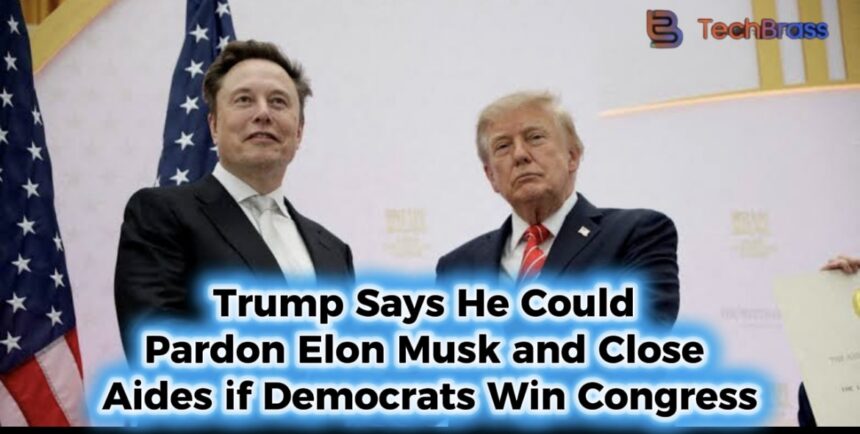
US President Donald Trump says he would consider pre-emptive pardons for Elon Musk and people close to him if Democrats regain control of Congress after the November 2026 midterm elections.
The comments have sparked fresh political controversy, raising questions about presidential pardon powers, congressional investigations and the relationship between Trump and the billionaire technology entrepreneur.
In an interview with New York Post columnist Miranda Devine, Trump indicated that he would be willing to protect Musk and former members of his Department of Government Efficiency (DOGE) team if Democrats targeted them through investigations.
But the most striking part of the conversation was his willingness to consider granting pardons before anyone had been formally charged with a crime.
The development raises a bigger question: Can a US president use the power of pardon to protect political allies from investigations by a future Congress?
What Trump Said About Pardoning Elon Musk
Trump made the comments during an interview published on November 2, 2026, on Pod Force One, a podcast hosted by Miranda Devine.
During the conversation, Devine raised the possibility that Democrats could investigate Musk, attempt to seize his factories or even pursue nationalisation of SpaceX if they regained control of Congress.
Trump dismissed the nationalisation suggestion as talk but said Musk and others would need protection if Democrats pursued them.
When Devine asked whether he would consider pre-emptive pardons, Trump responded:
“I would if I needed to. Sure.”
He also referred to former President Joe Biden’s use of pre-emptive pardons, suggesting that Biden’s actions provided a precedent.
Trump’s comments were not a formal announcement that Musk had received a pardon. No pardon documents were announced, and the president did not identify specific federal offences that would be covered.
Nevertheless, his willingness to consider the move has attracted considerable attention because it could extend beyond Musk to people who worked in his administration.
Why Would Democrats Investigate Elon Musk?
Musk’s relationship with the Trump administration has involved more than political endorsements.
He previously led the Department of Government Efficiency, commonly known as DOGE, an initiative created to reduce government spending and restructure federal operations.
During that period, DOGE became involved in major changes across government agencies, including spending reductions, workforce changes and access to government systems.
If Democrats regain control of the House of Representatives, they could use their committee leadership positions to examine decisions made during the initiative.
Potential areas of congressional scrutiny include:
DOGE’s involvement in federal agency restructuring.
Access to sensitive government information and data.
Government contracts awarded to companies connected to Musk.
Possible conflicts of interest involving Musk’s government role and private businesses.
Decisions affecting federal programmes and employees.
However, it is important to separate political investigations from criminal allegations.
Being investigated by Congress does not automatically mean someone has committed a crime. Congressional oversight can examine government decisions and demand explanations without establishing criminal wrongdoing.
Who Are the Close Aides Trump Could Also Pardon?
One individual specifically mentioned during the interview was Edward Coristine, a former DOGE employee better known online as “Big Balls.”
Coristine was among the younger technology workers associated with Musk’s government-efficiency initiative.
During the discussion, Devine suggested that Coristine and other people who worked with Musk or supported Trump’s administration could become targets of investigations.
Trump did not rule out protecting them through pardons.
This is significant because his comments appeared to extend beyond one billionaire. They raised the possibility of pre-emptive clemency for a wider circle of administration allies.
However, Trump did not publish a list of potential pardon recipients or announce that any of these individuals had been charged with federal crimes.
Can Trump Legally Pardon Elon Musk Before He Is Charged?
Yes. The US Constitution gives the president broad authority to grant pardons for federal offences.
Under Article II, Section 2, the president can grant pardons for offences against the United States, except in cases of impeachment.
Importantly, a pardon does not always require a criminal conviction or even a formal charge.
The Congressional Research Service explains that presidential pardons can be granted after an alleged federal offence has been committed, including before legal proceedings begin.
However, the power has important limitations.
1. Presidential pardons do not cover state crimes.
Trump cannot pardon someone for violating state criminal laws in places such as California or New York. Those matters fall under the relevant state legal systems.
2. A pardon cannot stop Congress from investigating.
Congress can still hold hearings, request documents, issue subpoenas and examine government activities.
3. Pardons do not erase civil liability.
A presidential pardon does not automatically protect someone from private lawsuits or civil claims.
4. Pardons cannot cover future crimes.
A president can pardon qualifying federal offences already committed, but cannot grant someone permanent immunity for anything they might do in the future.
In other words, even if Trump issued a pardon to Musk, it would not give him unlimited protection from every possible legal or congressional action.
Trump Is Pointing to Joe Biden’s Pre-Emptive Pardons
Trump also defended his position by referring to decisions made by former President Joe Biden during his final hours in office.
On January 20, 2025, Biden issued pre-emptive pardons to several individuals he believed could face politically motivated investigations under the incoming Trump administration.
They included:
Anthony Fauci, the former director of the National Institute of Allergy and Infectious Diseases.
General Mark Milley, former chairman of the Joint Chiefs of Staff.
Members and staff of the House committee investigating the January 6 Capitol attack.
Several members of Biden’s family.
Trump also referenced his own pardons and clemency actions involving defendants charged in connection with the January 6, 2021, Capitol attack.
By bringing up Biden’s decisions, Trump is arguing that pre-emptive pardons are not unprecedented.
However, the political circumstances and individuals involved in each case are different. Biden’s use of the power does not automatically settle whether any future pardon would be legally or politically justified.
Elon Musk Has Become a Major Player in Republican Politics
Musk’s influence in American politics has grown considerably.
Beyond his public support for Trump, he has spent substantial sums supporting Republican candidates and political organisations.
A Reuters report cited in recent coverage estimated that Musk had spent approximately $366 million on the 2026 midterm elections by October.
That level of political spending makes him more than a technology executive with opinions about government policy. He has become an influential participant in the political contest over control of Washington.
His business interests also make the relationship particularly important.
Musk leads companies with significant government relationships, including SpaceX, which works with US government and defence agencies.
Consequently, any future congressional investigation involving his government role or business relationships could attract attention from investors, regulators and the wider technology industry.
What Happens If Democrats Win Control of Congress?
The November 3, 2026 midterm elections could change the balance of power in Washington.
If Democrats take control of the House of Representatives, they would gain leadership of its committees and greater authority to set investigative priorities.
That could mean hearings, subpoenas and requests for documents relating to the Trump administration and its policies.
If Democrats also gain control of the Senate, their influence over congressional investigations and legislation would increase further.
Trump has already suggested that he would respond to a Democratic-controlled Congress by using his veto power to block legislation he opposes.
The possibility of investigations into Musk and former administration officials adds another layer to what is already a tense political contest.
But an important distinction remains: winning control of Congress does not give lawmakers the power to automatically arrest or prosecute people. Criminal prosecution is handled through the appropriate law-enforcement and judicial processes.
What Could This Mean for SpaceX and Tesla?
Its government contracts and relationships with federal agencies could attract congressional scrutiny.
Political controversy surrounding Musk could affect public perception, investor sentiment and the company’s regulatory environment.
For investors, the concern is not necessarily that either company will face immediate legal consequences.
Rather, prolonged political disputes could create uncertainty around government contracts, regulatory relationships and future business decisions.
SpaceX is especially relevant because of its role in US space and defence programmes.
Still, Trump’s comments do not establish that either company will be nationalised, seized or stripped of government contracts. Those remain suggestions and political claims, not confirmed government actions.
Frequently Asked Questions
1. Did Trump officially pardon Elon Musk?
No. Trump said he would consider issuing a pardon if necessary. He did not announce a formal pardon for Musk.
2. Why does Trump want to protect Elon Musk?
Trump suggested that Musk and his associates could face investigations if Democrats regained control of Congress. He said he would be willing to protect them if that happened.
3. Can a US president pardon someone who has not been charged?
Yes. The president can grant pardons for qualifying federal offences after they have been committed, even before formal charges or a conviction.
4. Can a presidential pardon stop a congressional investigation?
No. Congress can still investigate, hold hearings, issue subpoenas and request documents. A pardon does not remove congressional oversight powers.
5. Who is Edward Coristine, also known as Big Balls?
Edward Coristine is a former DOGE employee who was mentioned during Trump’s interview as someone who could potentially receive protection if targeted by investigations.
6. When are the 2026 US midterm elections?
Election Day is November 3, 2026. Voters are choosing members of the House of Representatives and a portion of the Senate.
Final Thoughts: Could Trump’s Pardon Promise Change the Political Battle?
Trump’s comments have introduced another controversial issue into the American midterm election debate.
By suggesting that he could grant pre-emptive pardons to Elon Musk and close associates, the president is signalling that he may use his constitutional powers to protect allies if Democrats regain control of Congress.
For Musk, the stakes are particularly interesting. He is not only one of the world’s most influential technology entrepreneurs but also a major political donor with companies that have significant government relationships.
However, a presidential pardon is not a shield against every form of accountability. Congress can still investigate, state authorities retain their own legal powers, and civil claims remain separate.
The biggest question now is whether Trump will actually issue these pardons — and whether the move would trigger a wider constitutional and political debate.
What do you think? Should a US president be allowed to pardon political allies before they are even charged with a crime?
Share your opinion in the comments.