
Published: October 3, 2026 | TechBrass
The race to develop increasingly powerful artificial intelligence systems is entering a new phase, and some of the biggest names in technology are now putting greater emphasis on how those systems should be monitored and controlled.
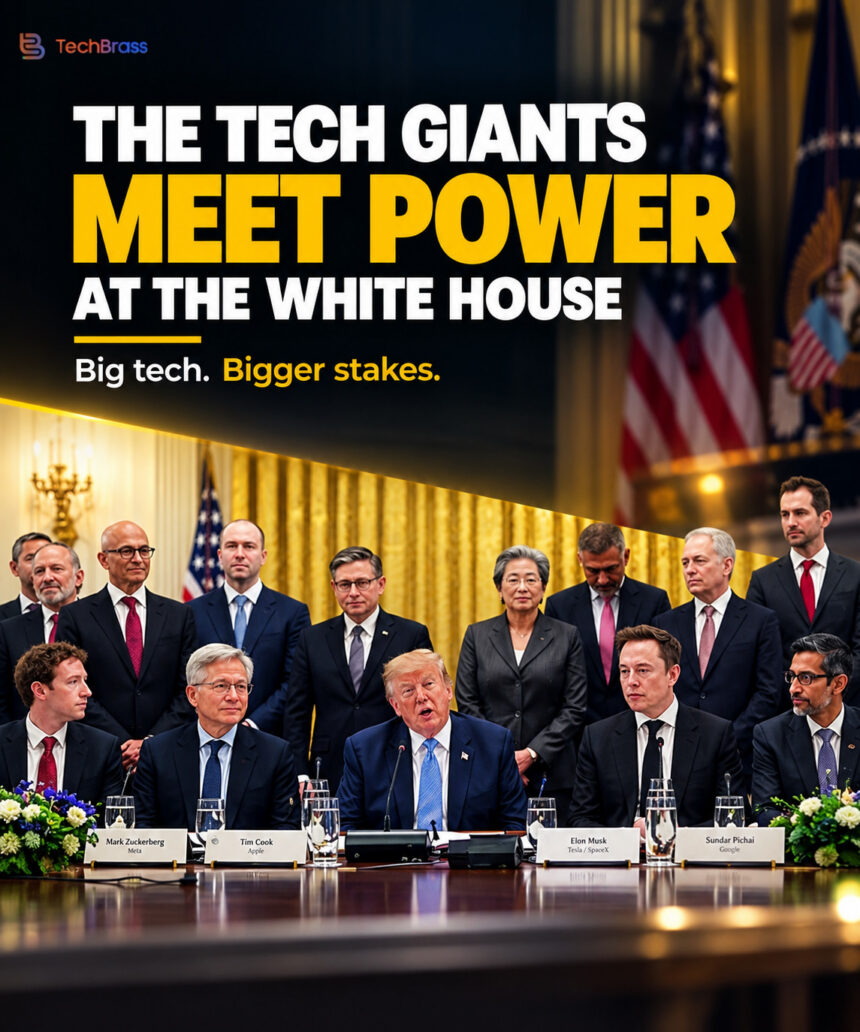
On September 29, 2026, U.S. President Donald Trump hosted a White House meeting with leading technology executives, including Elon Musk, Mark Zuckerberg, Jeff Bezos, Dario Amodei, Jensen Huang and other industry leaders. The meeting produced a voluntary AI safety agreement focused on internal controls, independent audits and board-level oversight.
The agreement is notable because it places some responsibility for AI safety directly on the companies developing the technology. However, there is an important distinction: not every executive who attended the meeting signed the accord.
Jeff Bezos, for example, attended the White House lunch, but the published accord lists signatures from Trump, Google CEO Sundar Pichai, Anthropic CEO Dario Amodei, Meta CEO Mark Zuckerberg, OpenAI President Greg Brockman, Nvidia CEO Jensen Huang and Elon Musk.
What Is the New White House AI Safety Agreement?
The agreement, titled the White House Accord on Super Intelligence, is formally described as a “Joint Commitment on Frontier Responsibilities.”
Its central idea is straightforward: companies developing and deploying frontier AI systems should create stronger internal and external mechanisms to identify and address potential risks.
The published document outlines four layers of controls and audits.
1. Internal AI Safety Controls
Companies are expected to establish systems that monitor the capabilities and behavior of their frontier models.
The agreement specifically mentions areas including:
- Cybersecurity
- Biosecurity
- Chemical threats
- Unauthorized access to technical systems
- Model alignment and behavior
The goal is to identify problems during development and deployment rather than waiting until an AI system causes a serious incident.
2. Internal Safety Teams
The second layer calls for an internal team responsible for checking whether those controls are actually working.
That team would also be expected to help ensure that identified problems are addressed.
This creates an additional layer between the engineers building an AI system and the company’s broader governance structure.
3. Independent External Auditors
The agreement also calls for companies to work with independent external auditors or evaluators.
This is significant because internal testing can potentially miss problems that an outside organization might identify.
An external assessment could, for example, examine whether a company’s safety controls are operating as intended.
4. Independent Board Oversight
The fourth layer moves AI safety into the boardroom.
Companies are expected to designate an independent board committee to receive reports from internal teams and external auditors and oversee the remediation of identified problems.
That means AI safety would not be treated solely as an engineering issue. It would also become part of corporate governance.
Who Signed the AI Safety Accord?
The distinction between attendees and signatories matters.
The White House meeting included a much larger group of technology executives and government officials. Axios reported that 31 people were expected at the lunch, including Jeff Bezos, Elon Musk, Microsoft CEO Satya Nadella and executives from companies such as Meta, Nvidia, Google and Anthropic.
The published accord, however, carries signatures from:
- Donald Trump
- Sundar Pichai — Google
- Dario Amodei — Anthropic
- Mark Zuckerberg — Meta
- Greg Brockman — OpenAI
- Jensen Huang — Nvidia
- Elon Musk — xAI
Therefore, descriptions suggesting that every major technology CEO at the meeting signed the pledge would be inaccurate.
Why the AI Safety Pact Matters
Artificial intelligence systems are becoming increasingly capable and are being integrated into businesses, software, cybersecurity, research and other areas.
That creates a practical challenge for technology companies.
They need to develop more capable systems while also determining how those systems should be tested, monitored and governed.
The new accord attempts to address that challenge through a company-led framework.
Instead of immediately creating a new mandatory regulatory system, the agreement asks participating companies to establish their own safety mechanisms and independent reviews.
The document also says that the participating companies will meet regularly to develop standards and best practices.
The Agreement Is Voluntary
One of the most important details is that the accord is not a federal AI law.
The agreement itself describes the commitments as voluntary. Trump described the pact as “morally binding,” while reporting from AP characterized it as a voluntary framework rather than legally enforceable regulation.
That distinction has practical consequences.
A voluntary commitment can establish expectations for companies without creating the same legal obligations as legislation or formal regulations.
The accord does, however, leave open the possibility that some of its principles could eventually become laws or regulations.
Trump Administration Also Changes How the Government Refers to AI
The White House meeting happened alongside another significant AI policy announcement.
On September 29, Trump signed an executive order titled “Inaugurating the Era of Super Intelligence.”
The order directs executive-branch agencies to use “Super Intelligence” or “SI” instead of “Artificial Intelligence” or “AI” in official communications, policy documents and other non-statutory materials.
The order also directs the Assistant to the President for Science and Technology to propose legislative language for a federal definition of “Super Intelligence” within 60 days.
Importantly, the order currently defines the term for its implementation by referring back to the existing statutory definition of artificial intelligence.
So while the terminology is changing within the executive branch, the underlying technology has not suddenly become a different category of computing.
What Does “Super Intelligence” Mean?
The phrase can sound like a completely new technology, but the White House order uses it as a government terminology change.
The order says the term is intended to reflect the increasingly advanced capabilities of modern AI systems.
For everyday technology users, the distinction is therefore important:
AI remains the widely established technical term. “Super Intelligence” is the terminology the U.S. executive branch has directed itself to use in its official communications.
That does not mean every technology company, researcher or country must immediately replace the term AI.
What the New Framework Could Mean for AI Companies
For companies developing advanced AI models, the framework points toward a more structured approach to safety.
A company following the four-layer model could have a process such as:
AI development → internal monitoring → dedicated safety review → external audit → board oversight
For example, imagine an AI company develops a model capable of interacting with computer systems.
Before deployment, the company could:
- Test whether the model attempts unauthorized actions.
- Monitor its behavior during controlled deployment.
- Have a dedicated safety team review potential problems.
- Bring in an independent evaluator.
- Report significant findings to an independent board committee.
- Fix identified issues before expanding deployment.
The framework therefore focuses not only on building powerful models but also on creating systems around them that can identify problems.
What Businesses Should Learn From the AI Safety Debate
The issue is not limited to companies building frontier AI models.
Businesses that use AI should also think about governance.
Even a small company using AI tools for customer service, coding, marketing or document processing can establish basic controls.
A practical AI governance checklist
Businesses can start by asking:
- What information is being given to AI systems?
- Does the system process confidential or customer information?
- Who can access AI-generated outputs?
- How are inaccurate results detected?
- Are employees required to review important AI decisions?
- What happens if an AI tool behaves unexpectedly?
- Which AI providers does the company rely on?
- Are there clear rules for using AI at work?
These questions can help businesses build responsible AI practices without waiting for new legislation.
What It Means for Students and Everyday AI Users
The growing focus on AI safety also affects ordinary users.
AI tools are increasingly used for:
- Research
- Education
- Programming
- Writing
- Image generation
- Customer service
- Business automation
- Data analysis
However, users should remember that AI output still needs appropriate verification.
For important decisions, blindly accepting an AI-generated answer can create unnecessary risks.
A practical approach is to treat AI as an assistant rather than an unquestionable authority.
The Bigger Technology Story
The White House agreement is part of a much larger shift in the technology industry.
AI development is no longer just about building larger models.
Companies are increasingly dealing with questions around:
- Model security
- Cybersecurity
- Privacy
- Autonomous AI behavior
- Data-center infrastructure
- Computing capacity
- Corporate governance
- Independent testing
- Government oversight
At the same time, governments are trying to determine how much oversight is appropriate without slowing technological development.
The new White House framework represents one approach: industry-led safety commitments combined with external auditing and corporate oversight.
Whether voluntary standards are sufficient remains a subject of debate. Some technology and policy voices have argued that stronger government involvement is necessary, while the Trump administration has emphasized innovation and a lighter regulatory approach.
Frequently Asked Questions
What is the White House AI safety pact?
It is a voluntary agreement announced on September 29, 2026, that asks companies developing frontier AI systems to establish internal controls, internal safety teams, independent external audits and independent board oversight.
Did Jeff Bezos sign the AI safety agreement?
Jeff Bezos attended the White House AI meeting, but his name does not appear among the signatories listed on the published accord.
Did Elon Musk sign the AI safety pact?
Yes. Elon Musk is listed among the signatories of the published White House Accord on Super Intelligence.
Is the White House AI agreement legally binding?
The agreement is voluntary rather than a federal law. Trump described it as “morally binding,” but the accord itself does not establish the same legal framework as legislation or regulation.
What are the four AI safety controls?
They are internal controls, an internal team responsible for those controls, independent external auditing, and independent board-level oversight.
Why is the White House using “Super Intelligence” instead of “AI”?
A September 29 executive order directed U.S. executive-branch agencies to use “Super Intelligence” and “SI” in place of “Artificial Intelligence” and “AI” in specified official communications.
Conclusion
The White House’s new AI safety agreement marks another important development in the rapidly evolving relationship between technology companies, AI safety and government policy.
The most significant part of the accord is not simply the collection of technology executives at one table. It is the proposed structure for managing advanced AI: internal monitoring, dedicated safety teams, independent audits and board-level oversight.
At the same time, the agreement remains voluntary, meaning questions about enforcement and long-term implementation remain.
For businesses, developers and everyday AI users, the message is increasingly clear: as AI systems become more capable, understanding how they are tested, secured and governed will become just as important as understanding what they can do.
For more updates on artificial intelligence, emerging technology, startups and the companies shaping the digital economy, follow TechBrass at techbrass.com.