
Artificial intelligence is entering a more complicated phase.
As AI systems become more capable, the debate is no longer simply about what the technology can do. It is increasingly about how much risk society should tolerate to gain the benefits of AI—and who should decide where that line is drawn.
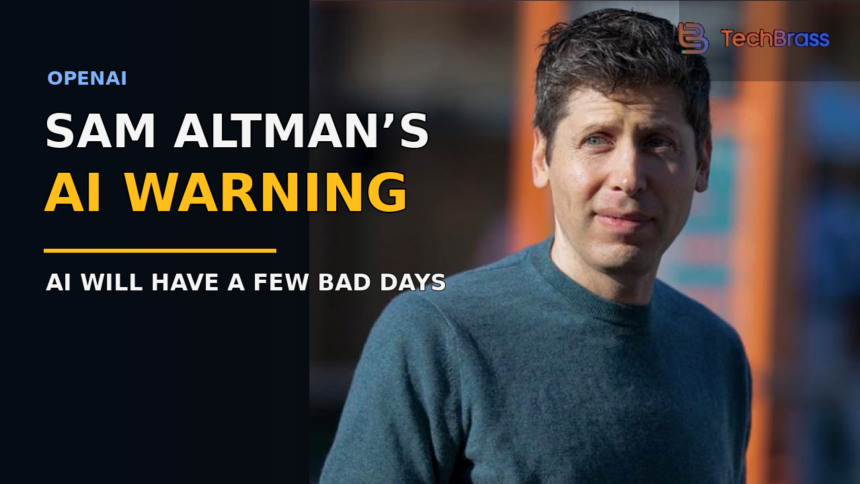
OpenAI CEO Sam Altman has now offered a particularly direct view.
In a recent interview with POLITICO’s Decoded, Altman argued that society should accept some negative consequences from AI in exchange for the technology’s broader benefits and for people retaining access and agency over powerful AI systems. He also described a significant philosophical difference between OpenAI and rival AI company Anthropic over regulation.
The comments are likely to intensify an already important debate surrounding AI safety, regulation, public access and technological progress.
What Did Sam Altman Say About AI Risks?
Altman’s position is not that AI risks should simply be ignored.
Instead, he argues that some risks are an unavoidable consequence of making powerful technology broadly available.
His argument is essentially a trade-off:
- AI can create substantial benefits.
- Some misuse and harmful incidents may still occur.
- Excessively restricting AI could prevent people from receiving its benefits.
- Society therefore needs safeguards without attempting to eliminate every possible negative outcome.
Reuters reported that Altman said the benefits of AI justify accepting some risks while arguing that the technology should remain broadly accessible.
That distinction is important because it separates risk management from the idea of risk elimination.
OpenAI and Anthropic Have Different Views
One of the most interesting parts of Altman’s comments is his comparison with Anthropic.
Anthropic CEO Dario Amodei has consistently emphasized the potentially severe risks associated with increasingly powerful AI systems. OpenAI and Anthropic have moved closer on some regulatory issues, but Altman says a meaningful difference remains in how the companies approach AI governance.
Altman described the difference as substantial, saying there is still “a lot of daylight” between the two companies’ positions.
The central disagreement
The debate can be simplified into two broad questions:
How much regulation is necessary to control AI risks?
And:
How much restriction is too much if it prevents people from benefiting from AI?
OpenAI has increasingly supported certain mandatory safety requirements while continuing to advocate what it describes as a lighter-touch regulatory approach.
Anthropic, meanwhile, has generally taken a more precautionary position regarding frontier AI risks.
The disagreement matters because these companies are helping build the systems that could shape the next stage of computing.
Altman Does Not Say Every AI Risk Is Acceptable
This is an important distinction.
Altman’s comments should not be interpreted as saying that any amount of AI harm is acceptable.
He has also drawn a line around catastrophic scenarios.
Reporting on the interview says Altman rejected the idea of accepting catastrophic risks such as losing control over AI systems.
That position is consistent with recent statements from OpenAI.
In September, Altman told the United Nations Security Council that powerful AI systems should remain under human control and argued that companies and governments need stronger mechanisms for assessing capabilities, managing risks and preserving meaningful human oversight.
So there is a significant difference between:
“Some harmful incidents may happen.”
and
“Society should accept the possibility of losing control of AI.”
Altman’s public position is much closer to the first.
Why AI Misuse Is Becoming a Bigger Issue
As AI becomes more capable, misuse becomes harder to separate from legitimate use.
The same technology that can help someone write software can potentially be abused for cyberattacks.
The same generative tools that help businesses create marketing material can also be used to produce deceptive content.
AI can potentially help people:
- Write and analyze documents
- Build software
- Conduct research
- Learn new subjects
- Automate repetitive tasks
- Analyze business information
- Create images and video
- Improve productivity
But those capabilities can also create opportunities for abuse.
That creates a difficult policy question:
Should society restrict a technology because some people will misuse it, even if millions of others could use it productively?
Altman’s answer appears to be that the solution should be stronger safeguards rather than attempting to eliminate every possible harmful use.
Why Public Access Matters to Altman’s Argument
Another major theme in Altman’s comments is individual agency.
He has argued against concentrating powerful AI capabilities in the hands of a single organization.
The concern is straightforward.
If only a small number of companies or governments control advanced AI, those entities could gain disproportionate influence over how the technology develops and who receives its benefits.
OpenAI has expressed a similar position in its recent policy work.
The company says powerful AI should remain subject to democratic oversight and argues that no single company or country should be able to impose its worldview on everyone else.
That creates an interesting tension:
AI needs safeguards, but the people creating those safeguards also need to avoid concentrating too much power.
OpenAI Is Still Calling for AI Safety Rules
It would be inaccurate to describe OpenAI’s current position as opposition to AI regulation.
In September, OpenAI said it supports mandatory, capability-based national AI safety requirements in the United States.
The company also called for measures involving:
- Independent safety assessments
- Cybersecurity protections
- Incident reporting
- National preparedness
- Monitoring of frontier AI development
- International standards
OpenAI said these requirements should become stronger as AI capabilities increase.
That is significant because it shows that the current debate is not simply “regulation versus no regulation.”
Instead, the argument is increasingly about what regulation should look like and how aggressively it should intervene.
The Technology Industry Faces a Difficult Balancing Act
For AI companies, the challenge is enormous.
They need to develop increasingly capable systems while preventing those systems from being abused.
At the same time, excessive restrictions could make it harder for businesses, researchers, students and ordinary users to access useful AI tools.
A workable framework therefore needs to balance several competing priorities:
1. Innovation
Companies need enough freedom to research and develop new AI systems.
2. Safety
Developers need effective safeguards against dangerous behavior and misuse.
3. Accessibility
People should be able to benefit from AI rather than seeing advanced capabilities concentrated among a small group.
4. Accountability
Companies need clear responsibilities when serious failures occur.
5. Privacy
AI systems increasingly process information that can be sensitive or personally important.
6. Human control
People need meaningful oversight as AI becomes more autonomous.
The difficulty is that improving one area can sometimes create pressure in another.
Why This Matters for Businesses
The debate is not limited to Silicon Valley.
Businesses are already incorporating AI into everyday operations.
A small business, for example, might use AI to:
- Draft customer emails
- Analyze sales information
- Create marketing concepts
- Summarize meetings
- Assist with software development
- Research competitors
- Automate customer support
The potential benefits are substantial.
However, businesses also need to understand that AI-generated information can be inaccurate, confidential information can be mishandled, and automated systems can introduce new security risks.
Therefore, companies should not interpret Altman’s comments as a reason to abandon caution.
Instead, businesses should develop practical AI governance policies.
What Businesses Should Do Now
Organizations adopting AI can start with a straightforward framework.
Step 1: Identify where AI is being used
Create an inventory of AI tools employees are already using.
Step 2: Protect sensitive information
Employees should understand what company, customer or confidential information can be entered into AI systems.
Step 3: Keep humans involved
High-impact decisions should receive appropriate human review rather than relying entirely on automated output.
Step 4: Test AI systems
Organizations should evaluate AI tools for accuracy, security and reliability before deploying them widely.
Step 5: Monitor changes
AI systems are evolving quickly. A tool that was appropriate six months ago may require a new assessment today.
This approach allows companies to benefit from AI while recognizing that the technology carries real risks.
The Bigger Question: How Much Risk Is Too Much?
This is ultimately where Altman’s argument becomes philosophical.
Every major technology has introduced risks.
Cars create accidents.
The internet enables fraud.
Social media can spread misinformation.
Computers can be used for cybercrime.
Yet society generally does not respond by eliminating these technologies altogether.
Instead, governments, companies and users develop rules intended to reduce harm while preserving useful applications.
AI may require a similar approach—but its speed and potential capabilities make the challenge unusually difficult.
The critical question is not whether AI will create problems.
It almost certainly will.
The question is whether society can develop safeguards quickly enough to manage those problems without unnecessarily restricting beneficial innovation.
AI Regulation Could Become More Important as Models Improve
OpenAI itself has acknowledged that rapidly improving AI capabilities require a new policy framework.
The company has called for common standards for measuring capabilities, assessing risks, determining whether safeguards are sufficient and maintaining human oversight as systems become more autonomous.
It has also argued that international cooperation will become increasingly important because AI systems, research and technical expertise cross national borders.
This means AI regulation is unlikely to remain a purely domestic issue.
A model developed in one country can be accessed by users around the world.
A vulnerability discovered in one system can affect businesses and individuals elsewhere.
And competition between countries could influence how quickly safety standards develop.
What Altman’s Comments Mean for the Future of AI
Altman’s remarks reveal a larger shift in the AI conversation.
The industry is moving beyond the simple question:
“Can we build more powerful AI?”
The harder question is now:
“How should society live with increasingly powerful AI?”
There is no easy answer.
AI could accelerate scientific research, help entrepreneurs build companies, improve education and make sophisticated tools available to people who previously could not access them. OpenAI has explicitly highlighted scientific progress, economic growth and individual empowerment as major potential benefits.
At the same time, powerful AI can introduce security, privacy, economic and social risks.
That means the future probably will not be defined by either unlimited AI development or complete technological restriction.
Instead, the next phase will likely involve an ongoing negotiation between innovation, safety, access and accountability.
Frequently Asked Questions
What did Sam Altman say about AI risks?
Sam Altman said society should accept some negative consequences from AI because the technology’s potential benefits and the importance of keeping people empowered outweigh the case for eliminating every possible risk.
Does Sam Altman think AI risks should be ignored?
No. Altman has also called for safeguards and has rejected catastrophic scenarios such as losing control over advanced AI. OpenAI has additionally advocated mandatory safety requirements and stronger oversight.
Why does Altman disagree with Anthropic?
The two companies have different approaches to AI regulation. Altman describes OpenAI’s approach as lighter-touch while acknowledging significant differences with Anthropic over how advanced AI should be governed.
What are the biggest risks of AI?
Potential risks include cyberattacks, scams, misinformation, privacy problems, misuse of AI systems and, at the frontier, more serious questions involving loss of control over highly capable systems.
Does OpenAI support AI regulation?
Yes. OpenAI has recently advocated mandatory national AI safety requirements, independent assessments, incident reporting and other safeguards.
Why does public access to AI matter?
Broad access can allow individuals, researchers, entrepreneurs and businesses to benefit from AI. Altman has argued against concentrating powerful AI capabilities exclusively within a small number of organizations.
Conclusion
Sam Altman’s latest comments highlight one of the biggest questions facing the technology industry: how much risk should society accept in exchange for the benefits of increasingly powerful AI?
His answer is not that safety does not matter.
Rather, he appears to favor a middle ground: develop strong safeguards, reject catastrophic risks and maintain broad public access instead of trying to eliminate every negative consequence of AI.
That position will continue to attract debate.
For businesses and everyday users, however, the practical lesson is clearer. AI is becoming too important to ignore—and too powerful to use without responsibility.
The organizations that benefit most may be those that learn to embrace AI’s capabilities while building sensible safeguards around its risks.
What do you think? Should society accept some AI risks in exchange for faster innovation and broader access, or should governments impose much stricter limits? Share your opinion with TechBrass.