
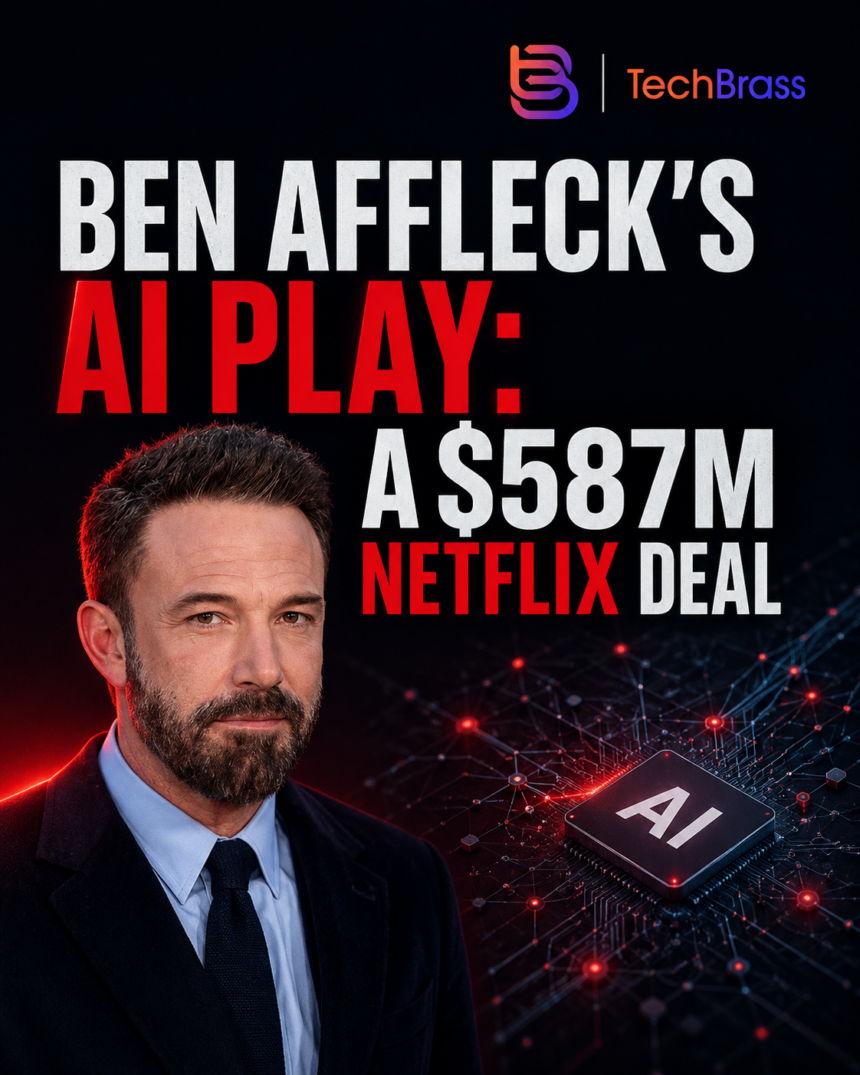
Ben Affleck’s AI company, InterPositive, has been acquired by Netflix in a deal valued at approximately $587 million, highlighting the growing role of artificial intelligence in filmmaking. The acquisition marks a significant development in the entertainment technology industry, where AI is increasingly being used to improve production workflows, reduce technical challenges and give filmmakers more creative flexibility.
The deal also challenges a common perception that AI innovation is driven primarily by traditional technology entrepreneurs. In this case, a Hollywood actor and filmmaker helped build a technology company focused on solving real problems in film production.
But what exactly does InterPositive do, and why was Netflix willing to invest hundreds of millions of dollars in it? The answers reveal how AI could reshape the future of filmmaking.
What Is InterPositive, Ben Affleck’s AI Company?
InterPositive is an AI filmmaking technology company founded by Ben Affleck in 2022. Unlike many generative AI platforms that create videos from text prompts, the company focuses on helping filmmakers improve footage captured during actual production.
The company was developed around a practical challenge: filmmaking does not always go according to plan.
A scene may have lighting problems, a missing shot, an unwanted object in the background or other technical issues that become expensive to correct during post-production. Traditionally, resolving these problems could require additional editing, visual effects work or even reshooting a scene.
InterPositive aims to address such challenges with AI-powered tools designed specifically for filmmaking.
Netflix announced its acquisition of the company on March 5, 2026, with Affleck joining the streaming company as a senior advisor. The acquisition brought InterPositive’s entire team into Netflix.
Why Did Netflix Pay $587 Million for InterPositive?
Netflix initially announced the acquisition without revealing the financial terms.
However, a subsequent regulatory filing disclosed an acquisition valued at approximately $587 million in cash. Reporting by technology and entertainment publications linked the transaction to InterPositive.
The investment reflects Netflix’s interest in AI technology that can improve the filmmaking process rather than simply generate entertainment content.
Several factors help explain the strategic importance of the acquisition.
1. Improving film production efficiency
Film production involves multiple stages, including planning, shooting, editing, sound design and visual effects.
When unexpected problems arise, correcting them can consume time and resources. AI-assisted tools may help filmmakers address certain technical issues more efficiently.
For example, a production team might need to correct inconsistent lighting or adjust elements within a shot. Technology designed for these tasks could reduce the amount of manual work required.
However, results depend on the footage, the complexity of the task and the level of human review involved.
2. Reducing post-production challenges
Post-production is one of the areas where AI could deliver practical benefits to film studios.
InterPositive focuses on tools that help filmmakers work with footage they have already captured. This approach differs from generating an entirely new scene from a written description.
Potential applications include:
● Correcting lighting inconsistencies.
● Replacing or adjusting backgrounds.
● Addressing certain missing-shot problems.
● Improving visual continuity between scenes.
● Supporting specialised editing and visual effects workflows.
These capabilities could help production teams solve specific problems without relying exclusively on traditional, time-consuming methods.
3. Strengthening Netflix’s filmmaking technology
Netflix operates across a global entertainment market where production quality, delivery schedules and operating costs matter.
By acquiring InterPositive, the company gains access to specialised AI technology and a team with experience developing tools for filmmakers.
The acquisition also gives Netflix greater control over how this technology is developed and integrated into its production processes.
For the streaming industry, this represents a broader shift towards investing in technology that supports content creation, not just content distribution.
How Does InterPositive’s AI Technology Work?
InterPositive takes a filmmaking-focused approach to artificial intelligence.
Rather than treating every video as an opportunity to generate something entirely new, its technology is designed to understand and work with the visual material produced during a film shoot.
This distinction matters because filmmaking requires consistency.
A character’s appearance, the lighting in a room, the position of objects and the continuity between shots must remain believable. An AI tool that produces visually impressive results but fails to preserve these details may not be suitable for professional production.
InterPositive aims to build tools that account for cinematic requirements and give filmmakers greater control over the editing process.
A practical example
Imagine a film scene shot in a dark room.
During production, the lighting may not match the look the director intended. Correcting the problem could require extensive colour grading, visual effects work or another shoot.
An AI-assisted workflow could help the team adjust the footage while preserving important visual details.
Similarly, if a background element needs to change, an appropriate tool might help modify that part of the image without rebuilding the entire scene manually.
These examples illustrate the types of challenges such technology is designed to address. They should not be interpreted as a guarantee that every production problem can be solved automatically.
Human editors, cinematographers, visual effects artists and directors would still need to evaluate the results.
What Does This Acquisition Mean for the Future of AI in Hollywood?
The acquisition arrives at a time when the entertainment industry is debating how AI should be used in creative work.
Some filmmakers see the technology as an opportunity to improve efficiency and expand their creative options. Others worry about job security, unauthorised use of creative work and the possibility of synthetic content replacing human contributions.
InterPositive’s filmmaker-focused approach offers one perspective on this debate: AI can be developed to support established creative workflows.
AI could change how visual effects are produced
Visual effects can involve complicated technical work, specialist software and teams of experienced professionals.
AI-assisted tools could help automate selected tasks and allow artists to spend more time on creative decisions.
Nevertheless, complex effects will continue to require technical expertise, artistic judgment and quality control.
Production budgets could benefit
If AI tools reduce the time needed to complete certain tasks, studios may be able to manage some production costs more effectively.
For example, a team that resolves a technical issue during post-production may avoid some of the expense associated with reshooting a scene.
However, actual savings will vary. AI tools also require development, computing resources, integration and human supervision.
It is therefore too early to assume that every film will become cheaper to produce because of AI.
Human creativity remains central
Filmmaking involves far more than producing visually convincing images.
Storytelling, emotional performances, directing, cinematography and editing require creative judgment. Technology can assist with technical execution, but it does not automatically replace the artistic decisions that make a film meaningful.
For AI to gain wider acceptance in Hollywood, studios will need to address concerns about consent, intellectual property, performers’ rights and the impact on creative jobs.
What Businesses and Entrepreneurs Can Learn From Ben Affleck’s AI Startup
The InterPositive acquisition offers lessons beyond the entertainment industry.
For entrepreneurs, the central takeaway is that valuable technology businesses often begin by identifying a specific problem and developing a practical solution.
Here are four lessons business owners can apply.
1. Solve a real industry problem
InterPositive focuses on challenges that filmmakers encounter during production and post-production.
Entrepreneurs in other industries can follow a similar approach by identifying repetitive, expensive or time-consuming tasks that technology could improve.
For instance, a business could use AI to organise customer enquiries, assist with document processing or support quality checks.
The objective should be measurable business value, not simply adopting AI because it is popular.
2. Build technology for a specific audience
A general-purpose AI tool may not meet the needs of every profession.
Industry-specific products can be more useful when they account for specialised workflows, terminology, regulations and customer expectations.
Businesses should understand their target users before deciding which AI capabilities to develop.
3. Treat AI as a business strategy
AI adoption requires more than installing software.
Companies should consider how the technology fits into existing operations, what problems it will solve and how its performance will be measured.
A sensible implementation process includes testing, employee training, data protection and ongoing evaluation.
4. Protect human expertise
Successful AI implementation should consider the people who use the technology.
Tools that help professionals complete tasks more effectively may deliver greater long-term value than systems introduced without regard for existing workflows.
For entrepreneurs, the opportunity lies in combining automation with human expertise.
The Risks and Challenges of AI-Powered Filmmaking
Despite its potential, AI filmmaking technology presents challenges that studios cannot ignore.
Creative control: Filmmakers need meaningful oversight of AI-assisted changes to their work.
Copyright and consent: Companies must consider the rights associated with the footage, performances and other material used to develop or operate AI systems.
Employment concerns: Automating some tasks could change demand for particular roles, making responsible implementation and workforce adaptation important.
Quality assurance: AI-generated edits can introduce visual inconsistencies or errors that require human correction.
Trust and transparency: Studios must establish appropriate standards for how AI is used in productions and how those decisions affect creative teams.
Addressing these issues will be essential as AI becomes more deeply integrated into entertainment production.
Frequently Asked Questions (FAQs)
1. Did Ben Affleck sell his AI company to Netflix?
Yes. Netflix announced its acquisition of InterPositive, the AI filmmaking technology company founded by Ben Affleck, in March 2026.
2. How much did Netflix pay for Ben Affleck’s AI company?
Netflix’s financial disclosure reported an acquisition valued at approximately $587 million in cash. News reports linked the transaction to InterPositive. This is the reported purchase price of the company, not a confirmed figure for Affleck’s personal earnings.
3. What does InterPositive do?
InterPositive develops AI-powered tools designed to help filmmakers improve footage and address technical challenges during post-production, including certain lighting, background and missing-shot issues.
4. Does InterPositive generate entire movies using AI?
Its core focus is on AI tools for filmmaking workflows and footage captured during production, rather than simply generating complete movies from text prompts.
5. Will AI replace filmmakers and visual effects artists?
Not necessarily. AI may automate or simplify some technical tasks, but filmmaking still relies on creative direction, artistic judgment and human collaboration. The long-term employment impact will depend on how studios adopt the technology.
6. Why is Netflix investing in AI filmmaking?
AI-assisted production tools could help Netflix improve certain workflows, address technical challenges and give filmmakers more options during post-production. The acquisition also gives the company access to specialised technology and expertise.
7. What can entrepreneurs learn from the InterPositive acquisition?
Entrepreneurs can learn the importance of solving specific industry problems, developing products for clearly defined audiences and using AI to deliver practical value rather than adopting it without a clear business objective.
Conclusion: A New Chapter for AI and Entertainment
Ben Affleck’s InterPositive acquisition demonstrates how AI innovation is expanding beyond traditional software companies and into established creative industries.
Netflix’s reported $587 million purchase highlights the potential value of specialised technology designed to solve real production challenges. Rather than focusing exclusively on generating new content, InterPositive aims to help filmmakers work more effectively with footage they have already captured.
However, the long-term impact will depend on how well these tools perform in real production environments and how studios balance efficiency with creative control.
For technology enthusiasts, entrepreneurs and business leaders, the larger lesson is clear: AI creates opportunities when it addresses meaningful problems and works alongside human expertise.
Stay ahead of the latest developments in artificial intelligence, business innovation and emerging technology with TechBrass. Visit techbrass.com for more technology news, insights and practical guides.