
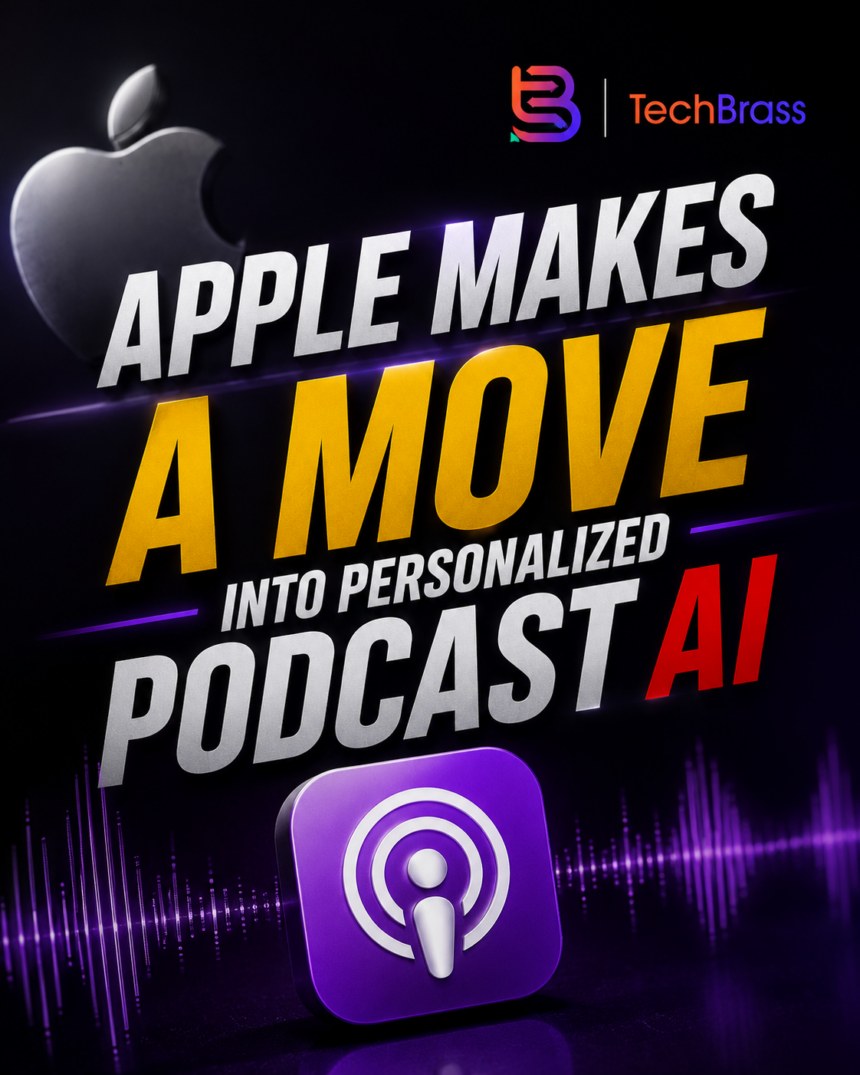
Apple is expanding its access to artificial intelligence expertise through a newly disclosed agreement with Huxe, a startup that developed personalized, AI-generated audio experiences. The arrangement gives Apple the opportunity to recruit certain Huxe employees and obtain a non-exclusive license to the startup’s intellectual property.
The deal highlights a growing trend in the technology industry: major companies are seeking specialised AI talent and technology without necessarily acquiring entire startups.
For Apple, the move could open new possibilities for personalised audio, intelligent content discovery and AI-powered podcast experiences. However, the company has not confirmed whether it intends to introduce Huxe’s technology into Apple Podcasts or another product.
Here is what the agreement means, how Huxe’s technology works and why the development matters for the future of AI-powered audio.
What Is Apple’s Deal With Huxe?
Apple disclosed the arrangement in a filing with the European Commission. According to reporting by TechCrunch, the agreement allows Apple to make employment offers to certain Huxe employees and receive a non-exclusive license to Huxe’s intellectual property.
Importantly, this is not an announced acquisition of Huxe as a company.
The distinction is significant because Apple can gain access to specialised expertise and technology without necessarily purchasing the startup, its entire business or all its assets.
The disclosed agreement includes two main elements:
- Talent recruitment: Apple can offer employment to certain members of Huxe’s team.
- Technology licensing: Apple receives a non-exclusive license to Huxe’s intellectual property, meaning the licensed technology is not necessarily reserved exclusively for Apple.
The public disclosure does not identify which employees received offers, confirm whether they accepted those offers or explain precisely how Apple intends to use the licensed technology.
Consequently, while the deal suggests an interest in personalised AI audio, its eventual impact on Apple’s products remains uncertain.
What Is Huxe and How Does Its AI Podcast Technology Work?
Huxe was a personalised audio startup founded by former members of the team behind Google’s NotebookLM, which has since been renamed Gemini Notebook.
The company explored ways to transform information into personalised audio experiences that users could listen to instead of reading traditional articles, documents or updates.
Rather than offering only conventional podcasts with fixed episodes, Huxe aimed to make audio content more responsive to individual interests and everyday information needs.
Personalised audio briefings
Huxe developed an experience that could generate audio briefings based on information such as users’ interests, emails and calendars.
For example, imagine a professional preparing for a busy working day. Instead of opening several apps to check updates, the person could listen to a personalised audio briefing that brings relevant information together.
Similarly, a student interested in artificial intelligence could receive an audio explanation of a topic they want to understand better.
These examples illustrate the potential of personalised audio. The precise information available to an application depends on its integrations, permissions and privacy practices.
AI-generated podcast conversations
Huxe also explored conversational audio that could explain topics in a podcast-style format.
This approach resembles the broader category of AI-generated audio discussions, in which artificial intelligence turns source material into a conversation between synthetic presenters.
The technology could make complex information easier to consume, particularly for people who prefer listening while commuting, exercising or completing routine tasks.
Huxe also designed its experience to let listeners interrupt the audio and request clarification or more detailed explanations.
That interactive approach moves beyond passive listening towards a more conversational relationship between users and digital content.
Why Is Apple Interested in Personalised AI Audio?
Apple has an established presence in digital audio through Apple Podcasts and its broader ecosystem of devices and services.
Although Apple has not disclosed its specific plans for Huxe’s technology, the arrangement creates several potential opportunities.
1. Making podcast discovery more personalised
Traditional podcast discovery often relies on browsing categories, searching for shows or following recommendations.
AI could help users discover content based on their interests, preferred topics and available listening time.
For example, someone interested in technology entrepreneurship might benefit from a personalised audio briefing covering startup developments, AI research and business trends.
Instead of searching for several individual episodes, the listener could potentially receive a more tailored experience.
However, Apple has not announced that it will launch such a feature using Huxe’s technology.
2. Turning information into audio
AI-powered audio tools can convert written material into spoken explanations and podcast-style discussions.
This creates opportunities for users who prefer listening to reading.
It could also help professionals consume information while performing activities that do not require their full visual attention.
For businesses, similar technology could support internal briefings, training materials and educational content.
Nevertheless, AI-generated audio must be accurate and clearly distinguish facts from uncertainty. A polished conversation is not necessarily a reliable one.
3. Strengthening Apple’s AI capabilities
Competition in artificial intelligence increasingly involves more than developing large language models.
Companies also need useful applications, experienced engineers and technology that can be integrated into existing products.
Huxe’s expertise in personalised audio could help Apple explore new approaches to delivering information through sound.
If Apple eventually incorporates similar capabilities into its services, the technology could complement its broader software and device ecosystem.
That remains a possibility rather than a confirmed product roadmap.
What Is a Reverse Acqui-Hire, and Why Does It Matter?
The Apple–Huxe arrangement illustrates a transaction structure commonly described as a reverse acqui-hire.
In a conventional acquisition, a company purchases another business, typically taking control of the acquired company under the agreed transaction terms.
An acqui-hire generally focuses on bringing a startup’s employees into a larger organisation.
A reverse acqui-hire can combine selective hiring with technology licensing without requiring the larger company to acquire the startup outright.
This structure can appeal to established technology companies for several reasons.
Access to specialised talent: Companies can seek experienced employees who already understand a particular technical challenge.
Faster development: Licensing existing technology may provide a starting point for future development instead of building every component from scratch.
Greater strategic flexibility: A company can pursue a specific technical opportunity without necessarily integrating an entire business.
However, the arrangement does not automatically guarantee a successful product. The technology must still be evaluated, integrated and adapted to the needs of its intended users.
The structure also does not, by itself, establish that a company is trying to avoid regulatory scrutiny. The reasons for any individual transaction depend on its circumstances.
Huxe Has Already Shut Down Its Consumer Service
One important detail is that Huxe had announced plans to discontinue its product before the Apple agreement became public.
On May 21, 2026, Huxe announced that it would remove its app from the Apple App Store and Google Play Store, discontinue the service and delete user data. Its service ended on May 28, with data deletion scheduled for May 29.
The startup said its team was moving on to other projects and that it would no longer develop the product.
The subsequent disclosure of Apple’s hiring and licensing arrangement does not establish that Apple caused Huxe’s shutdown.
Instead, the developments highlight how technology created by a startup can potentially continue to have value even after its original consumer product disappears.
A startup’s app, business model and underlying technical expertise are separate things. A consumer service may close while parts of its technology or the experience of its developers remain useful to another organisation.
For entrepreneurs, this is an important distinction when evaluating the long-term value of a technology business.
Could Apple Introduce AI-Generated Podcasts?
The possibility is worth watching, but there is no confirmed launch announcement.
Apple could potentially explore several applications of personalised audio technology.
AI-powered daily briefings
An audio assistant could summarise selected updates and help users catch up on topics that matter to them.
For example, a business owner might prefer a concise morning briefing on technology news, while a student might want an audio summary of study materials.
Interactive podcast experiences
AI could allow listeners to ask questions about a subject while listening and receive additional explanations.
Such a feature could make educational podcasts more interactive and help users explore topics at their own pace.
More relevant content recommendations
Personalisation could help listeners discover episodes and subjects that match their interests instead of relying entirely on manual searches.
However, any future implementation would need to address content quality, user consent, privacy and the accuracy of AI-generated material.
Until Apple provides further details, these remain potential applications rather than confirmed features of Apple Podcasts.
What the Apple–Huxe Deal Means for Businesses and Entrepreneurs
The agreement offers several lessons for technology startups and established businesses.
Build expertise around a clear problem
Huxe focused on personalised audio and AI-generated conversations.
Entrepreneurs can apply the same principle by identifying a specific customer problem and developing technology that solves it effectively.
A business does not necessarily need to build a general-purpose AI platform to create value. A specialised product that improves a particular workflow may be more practical.
Consider licensing as a business opportunity
Licensing can allow technology developers to earn value from intellectual property without necessarily selling their entire company.
For startups, this may create opportunities to work with larger organisations that have the resources and distribution networks to develop the technology further.
However, licensing terms, intellectual property ownership and commercial rights require careful negotiation.
Understand the value of technical talent
Experienced engineers and product developers can bring valuable knowledge that extends beyond the code they create.
Their understanding of user behaviour, technical limitations and product design can help a larger company explore new opportunities.
Prioritise trust and privacy
Personalised audio services may rely on sensitive information, including messages, schedules and user preferences.
Businesses developing similar tools should use appropriate permissions, minimise unnecessary data collection and explain how personal information is processed.
These safeguards are essential if AI-powered services are to earn and maintain user trust.
Frequently Asked Questions
1. Did Apple acquire Huxe?
Apple disclosed an agreement to make employment offers to certain Huxe employees and obtain a non-exclusive license to the startup’s intellectual property. The disclosed arrangement is not an announcement that Apple acquired Huxe outright.
2. What does Huxe do?
Huxe developed personalised audio experiences, including AI-generated podcast-style conversations and briefings based on users’ interests and information needs.
3. Has Apple confirmed an AI podcast feature?
No. Apple has not publicly confirmed that it will use Huxe’s technology to introduce AI-generated podcasts or personalised audio features into Apple Podcasts.
4. Why is Apple hiring from an AI startup?
Access to specialised talent can help a company explore new technologies and accelerate development. In this case, Huxe’s experience with personalised audio may be relevant to Apple’s future product development, although the company has not disclosed its precise intentions.
5. What is a non-exclusive technology license?
A non-exclusive license gives a company permission to use specified intellectual property under agreed terms without necessarily preventing the rights holder from licensing that technology to others.
The precise rights depend on the licensing agreement.
6. Is Huxe still operating?
Huxe announced in May 2026 that it was discontinuing its consumer app and service. Its announcement said the service would end on May 28, 2026.
7. Could AI-generated podcasts replace traditional podcasts?
AI-generated audio may create new ways to summarise information and personalise listening. However, traditional podcasts offer human perspectives, original reporting, interviews and creative storytelling that many listeners value. Both formats could coexist.
Conclusion: Apple’s Huxe Deal Signals Growing Interest in AI Audio
Apple’s agreement with Huxe highlights the increasing strategic value of specialised AI technology and experienced development teams.
By securing the opportunity to recruit certain employees and license Huxe’s intellectual property, Apple can explore personalised audio technology without announcing a full acquisition of the startup.
The deal could eventually contribute to new ways of discovering information, generating audio briefings or interacting with podcasts. However, Apple has not confirmed its plans, and no specific product launch should be assumed.
For the wider technology industry, the development reinforces an important trend: AI competition is not only about building powerful models. It is also about finding useful applications, attracting the right talent and creating products that solve real problems.
Want to stay informed about the latest AI developments, technology deals and digital innovations? Visit TechBrass at techbrass.com for more technology news, expert insights and practical guides.