
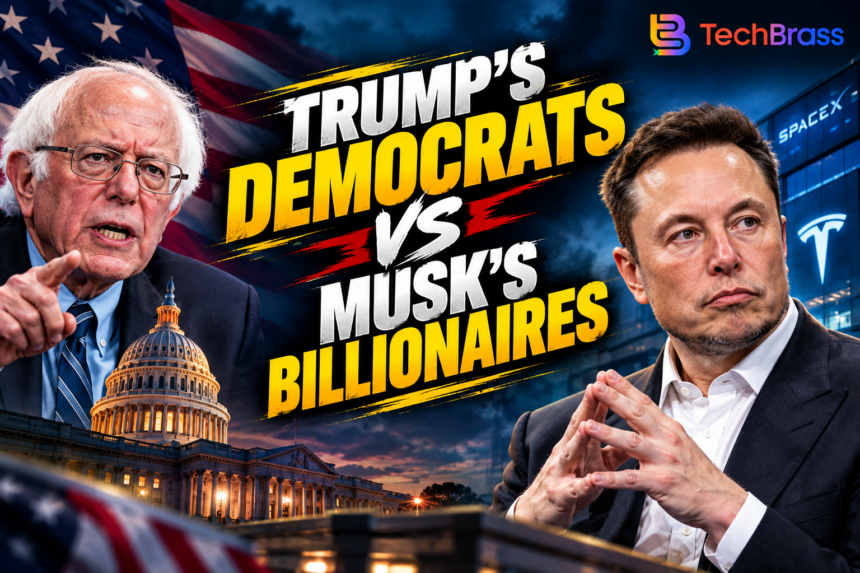
Elon Musk’s growing role in American politics is once again drawing attention to the relationship between technology wealth, campaign financing and political power. U.S. Senator Bernie Sanders has criticised the billionaire after reports that Musk has committed approximately $366 million to the 2026 U.S. election cycle, much of it directed toward efforts to help Republicans retain control of Congress.
Sanders used the slogan “Stop Musk. Stop Oligarchy” in a public post, arguing that Musk’s political spending raises concerns about the influence of extremely wealthy individuals over American democracy.
The controversy extends beyond party politics. Musk leads major technology and aerospace businesses, including Tesla and SpaceX, and owns the social media platform X. His political activity therefore raises broader questions about how the interests, resources and public influence of powerful technology entrepreneurs intersect with government policy.
For technology professionals, businesses and everyday internet users, the story highlights an increasingly important issue: how should democratic societies balance private wealth, political participation and accountability?
What Is Behind the $366 Million Figure?
Reuters reported on October 12, 2026, that Musk had spent approximately $366 million during the 2026 election cycle, which began on January 1, 2025. Of that amount, at least $276 million had gone to Republican-aligned groups and his own political action committee since July.
The reported third-quarter contributions included:
$158 million to the Senate Leadership Fund, which supports Republican Senate candidates.
$20 million to the Congressional Leadership Fund, which supports Republican House candidates.
$76 million to America PAC, the political action committee Musk established.
$10 million to the Lone Star Liberty PAC, which supports Texas Republican Ken Paxton’s Senate campaign.
$10 million to the Republican Governors Association.
$2 million to the Republican Attorneys General Association.
These figures help explain why Musk’s spending has attracted attention. Political action committees, commonly called PACs, can raise and spend money to influence elections. Super PACs can accept large contributions to fund independent political expenditures, although they cannot legally coordinate those expenditures with candidates’ campaigns.
The distinction matters: the reported $366 million is an election-cycle total, while the $276 million figure refers to a more recent period. They are not separate amounts that should be added together.
Why Bernie Sanders Is Criticising Musk
Sanders has long argued that extreme concentrations of wealth can give billionaires disproportionate influence over public policy and elections.
In his latest criticism, he connected Musk’s previous political contributions to his current election spending. Sanders said Musk had spent approximately $290 million to help elect Donald Trump in 2024 and claimed that Musk’s wealth had risen dramatically since Trump returned to office. He then criticised the reported $366 million election-cycle spending figure.
Sanders’ use of the word oligarchy reflects his concern that a small number of very wealthy people could gain excessive influence over political decisions.
However, it is important to distinguish political criticism from independently established facts. The reported campaign contributions can be examined through campaign-finance records, while claims about the precise effect of Musk’s donations on government decisions or his personal wealth require separate evidence.
Musk’s political supporters may view large contributions as a form of political participation protected by U.S. law. Critics, meanwhile, argue that the scale of such donations can create an uneven political playing field.
The debate is therefore not simply about one billionaire or one party. It concerns the rules governing money and political influence in the United States.
How Technology Wealth Is Reshaping Political Influence
Technology companies have become central to the modern economy. Their leaders can accumulate substantial wealth through ownership stakes, business growth and investor valuations. That wealth can also provide the financial resources to support political causes and candidates.
Musk’s involvement is especially notable because his business interests span several strategic industries.
1. Electric vehicles and clean technology
Tesla operates in the electric vehicle and energy sectors. Government decisions on vehicle regulations, tariffs, tax incentives and energy policy can affect the wider business environment in which these industries operate.
That does not prove that a particular donation produces a particular policy outcome. It does, however, help explain why public scrutiny of the relationship between business leaders and government is important.
2. Space technology and government contracts
SpaceX operates in an industry where government agencies are significant customers. Public procurement, national security priorities and space policy can influence opportunities for aerospace companies.
Reuters reported that Musk’s political spending comes amid calls by House Democrats for investigations into his government contracts and his role in the Trump administration’s Department of Government Efficiency. Those calls are part of the political dispute surrounding Musk; they should not be treated as proof of wrongdoing.
3. Social media and public debate
Musk owns X, a platform used by politicians, journalists, companies and the public to share information and debate political issues.
Social media can help political messages reach large audiences quickly. At the same time, the ownership and governance of major platforms raise questions about moderation, transparency, misinformation and the power of private companies to shape online discussions.
These issues are distinct from campaign donations, but together they illustrate the many ways technology leaders can participate in public life.
Can Political Donations Influence Government Policy?
Large political donations can provide candidates and political organisations with resources for advertising, voter outreach, campaign staffing and other election activities. However, a donation alone does not establish that a politician will adopt a donor’s preferred policy.
Several factors determine how political money may affect an election or subsequent policymaking:
Campaign competitiveness: Funding may be particularly valuable in closely contested races.
Public opinion: Voters’ views on the economy, candidates and public policy can outweigh campaign spending.
Party organisation: Established political networks and fundraising operations also shape electoral outcomes.
Legal safeguards: Campaign-finance rules govern how money can be raised, disclosed and spent.
Accountability: Journalists, regulators, watchdog organisations and voters can scrutinise relationships between donors and political decision-makers.
Musk’s contributions have strengthened Republican-aligned campaign organisations financially, according to the reported figures. Whether that spending will help Republicans retain control of Congress is a separate question that can only be answered through the electoral results.
What This Means for the Technology Industry
For technology businesses, the story illustrates why political and regulatory developments deserve attention even when a company does not operate directly in the election industry.
Regulation can affect business strategy
Government policy can shape competition, taxation, data protection, artificial intelligence regulation, telecommunications, energy infrastructure and public-sector technology contracts.
Companies therefore have a legitimate interest in understanding public policy. The challenge is ensuring that political engagement remains transparent and that policy decisions serve the public interest rather than only the interests of well-connected organisations.
Public trust is a business asset
Consumers and employees increasingly scrutinise how companies and their leaders behave outside the workplace. Political donations and public statements can affect a brand’s reputation, particularly when they become part of a divisive national debate.
Businesses can reduce uncertainty by publishing clear policies on political engagement, managing conflicts of interest and complying with applicable disclosure requirements.
Digital platforms need transparency
Political campaigns rely heavily on digital advertising, online fundraising, social media and voter data. Clear advertising disclosures and robust rules around political content can help users understand who is funding a message and why they may be seeing it.
For digital businesses, transparency can support trust among users, advertisers, regulators and investors.
Frequently Asked Questions
How much has Elon Musk spent on the 2026 U.S. elections?
Reuters reported on October 12, 2026, that Musk had spent approximately $366 million during the 2026 election cycle. At least $276 million of that amount had gone to Republican-aligned groups and his own political action committee since July.
Why did Bernie Sanders say “Stop Musk. Stop Oligarchy”?
Sanders used the phrase to criticise Musk’s political spending and express concern that extremely wealthy individuals could gain excessive influence over elections and government policy.
What is America PAC?
America PAC is a super PAC established by Musk in 2024. It supports political causes and candidates aligned with its objectives. Super PACs can raise and spend large amounts on independent political expenditures, subject to U.S. campaign-finance law.
Does Musk’s political spending guarantee that Republicans will retain Congress?
No. Campaign spending can help fund advertising and voter outreach, but it does not guarantee an electoral result. Candidates, public opinion, turnout, economic conditions and other factors also influence elections.
Why does Musk’s political activity matter to the technology sector?
Musk’s businesses operate in industries affected by government decisions, including electric vehicles, aerospace, energy and digital platforms. His political activity highlights broader questions about corporate influence, regulatory independence and public accountability.
Conclusion: The Debate Over Big Tech and Political Power Is Growing
Elon Musk’s reported $366 million in 2026 election-cycle spending has intensified the debate over how private wealth influences American politics. Bernie Sanders’ criticism reflects a broader concern about the concentration of economic and political power, while the reported donations demonstrate the significant resources Musk has directed toward Republican-aligned organisations.
Still, campaign contributions should be assessed separately from allegations about policy influence or claims about personal financial gains. The scale of the spending is clear from the reporting; its eventual electoral and policy effects remain to be seen.
For the technology industry, the larger lesson is that innovation, wealth and political influence increasingly intersect. Transparency, effective campaign-finance rules and independent scrutiny will remain important to maintaining public trust.
Stay connected with TechBrass for more coverage of technology leaders, digital business, artificial intelligence, cybersecurity and the political decisions shaping the global technology industry.