
By TechBrass | AI, Microsoft, OpenAI & Technology Business
Imagine building one of the world’s biggest technology companies, selling software to millions of customers, running a massive cloud business, and powering businesses around the globe. Then, in a single quarter, one AI partnership brings in $10 billion in revenue.
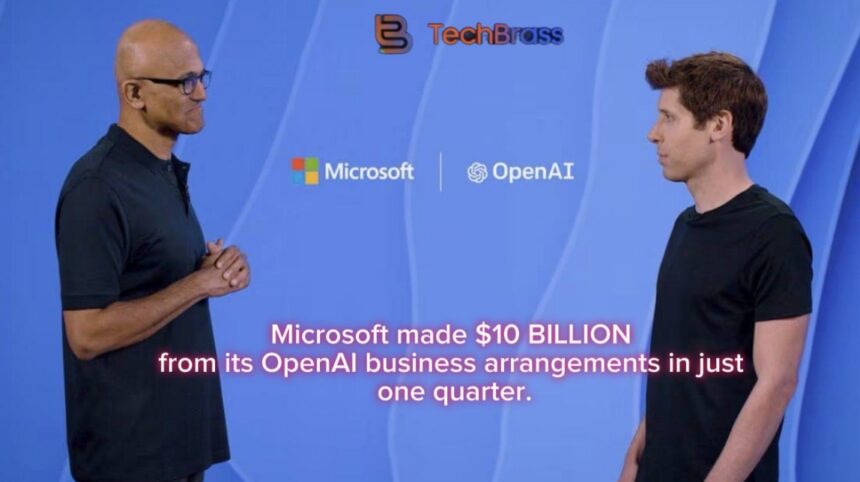
That is the headline behind Microsoft’s latest disclosure about its commercial relationship with OpenAI, the company behind ChatGPT. In the three months ending September 30, 2026, Microsoft recorded $10 billion in revenue from commercial arrangements with OpenAI, including revenue-sharing payments.
That’s not pocket change — even by Big Tech standards.
The more interesting part? Microsoft and OpenAI are not simply business partners anymore. Their relationship sits at the intersection of cloud computing, artificial intelligence, investment, and competition. And as both companies expand their AI ambitions, their financial connection raises a bigger question: how much of the AI boom depends on companies doing business with each other?
Let’s break it down without turning it into an accounting lecture.
The $10 Billion Question: Where Did Microsoft’s Revenue Come From?
Microsoft disclosed the figure in a regulatory filing covering its first quarter of fiscal 2027. The company reported total quarterly revenue of approximately $92.3 billion, meaning its commercial arrangements with OpenAI accounted for nearly 11% of that total.
In other words, roughly one dollar out of every nine in Microsoft’s quarterly revenue was associated with its business relationship with OpenAI.
So, where does the money come from?
The disclosed total includes revenue from commercial arrangements between the two companies, including:
Azure cloud computing: OpenAI uses computing infrastructure to train and operate its AI models.
Revenue-sharing payments: Microsoft receives payments under arrangements connected to the partnership.
Other commercial dealings: The total covers the companies’ broader commercial relationship, although Microsoft has not publicly broken down the $10 billion into individual components.
That final point matters. It would be misleading to claim that the entire $10 billion came from ChatGPT subscriptions or that Microsoft received all of it as revenue-sharing payments. The reported figure combines different commercial arrangements.
And there is another important distinction: revenue recorded is not necessarily the same as cash already collected.
Microsoft reported $7.2 billion in outstanding receivables from OpenAI at September 30, up from $6 billion at the end of June. Receivables represent money owed for transactions already recorded; they are not additional revenue on top of the $10 billion.
Think of it like a business delivering services and issuing invoices. The sale may count as revenue even if the customer has not paid the entire bill yet.
Why This Is Bigger Than a Microsoft–OpenAI StoryThe headline figure becomes more revealing when you compare it with Microsoft’s overall business.
Microsoft generated about $92.3 billion in total revenue during the quarter. Its $10 billion from OpenAI-related commercial arrangements therefore represents a significant source of income — one large enough to draw attention from investors, competitors, and anyone trying to understand the economics of AI.
But this is not just about one company paying another company.
The AI industry needs enormous amounts of computing power. Training and operating advanced models requires specialised chips, data centres, electricity, networking, and cloud infrastructure. Those resources cost money, and providers such as Microsoft can earn revenue by supplying them.
That creates a powerful commercial cycle:
An AI company develops and offers AI products.
Demand for those products creates a need for computing infrastructure.
The AI company pays cloud providers to train and run its models.
Cloud providers earn revenue while investing in more infrastructure and AI services.
In Microsoft’s case, its relationship with OpenAI connects its cloud business with one of the most prominent AI developers.
The opportunity is clear: if AI adoption continues to expand, demand for computing services could grow alongside it. The challenge is that both the demand and the costs of supplying it need to hold up over time.
Microsoft and OpenAI: Partners, Investors — and Increasingly Competitors?
Here is where the story gets especially interesting.
Microsoft has invested heavily in OpenAI and integrates its technology into products and services across its ecosystem. At the same time, Microsoft develops its own AI tools and infrastructure, while OpenAI has been gaining more flexibility to work with other cloud providers. The companies’ relationship has evolved from a tighter partnership into a more complex commercial arrangement.
So, are they partners or competitors?
The answer is both, depending on the product and business opportunity.
Microsoft benefits when OpenAI needs cloud computing and when OpenAI technology helps strengthen Microsoft’s offerings. OpenAI benefits from access to infrastructure, commercial reach, and a major technology partner.
However, each company also has reasons to build its own capabilities, attract customers, and avoid becoming too dependent on another business.
Imagine two restaurants sharing a kitchen supplier while competing to attract customers for lunch. They may have a strong reason to keep buying from the same supplier, but neither wants the other to control its entire future.
That is not a perfect comparison — the AI relationship is far more complicated — but it illustrates the tension between cooperation and competition.
For the wider industry, the key question is whether these arrangements remain mutually beneficial as AI models, cloud providers, and enterprise software products become more competitive.
What the $10 Billion Means for the AI Industry
The disclosure offers a useful glimpse into how money moves through the AI economy. It also highlights three developments worth watching.
1. Cloud computing is becoming a major part of the AI business
An AI chatbot may look like a simple box where you type a question. Behind that box, however, are servers, chips, storage, networking, and a steady supply of electricity.
That infrastructure is a business in its own right.
Microsoft’s cloud platform, Azure, is central to its AI strategy. When AI developers need more computing capacity, cloud providers have an opportunity to earn revenue from the demand. Microsoft’s latest results showed Azure revenue growing 48% year over year to approximately $33.2 billion in the September quarter.
The implication is straightforward: the AI race is not only about which company builds the most impressive model. It is also about who supplies the computing power needed to run it.
2. AI partnerships can create enormous commercial opportunities
Microsoft’s relationship with OpenAI demonstrates how a technology partnership can connect investment, infrastructure, and product distribution.
Microsoft has committed billions of dollars to its OpenAI investment. In its September-quarter filing, it reported total funding commitments of $13 billion, of which $12 billion had been funded by September 30, 2026.
For Microsoft, the relationship creates several potential sources of value: commercial revenue, exposure to OpenAI’s growth, and access to technology that can strengthen its own products.
For OpenAI, Microsoft’s infrastructure and commercial ecosystem have helped support the development and delivery of its AI services.
However, partnerships of this scale also create questions about concentration, bargaining power, and how much each company relies on the other.
3. The financial relationship deserves scrutiny
A large revenue figure can look impressive, but it does not tell the entire story.
Investors still need to understand the economics behind the number: how much revenue comes from cloud services, how much comes from revenue sharing, how quickly customers are paying their bills, and what it costs to provide the computing capacity.
The $7.2 billion in receivables reported by Microsoft is particularly relevant because it shows that a substantial amount of money associated with OpenAI transactions remained outstanding at the end of September. That figure does not, by itself, mean OpenAI cannot pay. It is a financial detail that needs to be considered alongside payment terms, cash flow, and other information that may not be publicly available.
In short, the $10 billion headline is significant. But understanding the long-term value of the partnership requires looking beyond revenue alone.
Is Microsoft Becoming Too Dependent on OpenAI?
This is the question behind the headline — and it does not have a simple yes-or-no answer.
OpenAI-related commercial arrangements represented nearly 11% of Microsoft’s quarterly revenue. That is a meaningful concentration around one business relationship.
However, Microsoft also has major businesses spanning enterprise software, cloud services, productivity tools, operating systems, gaming, and advertising. The OpenAI figure should therefore be understood as a significant component of a much larger business, not evidence that Microsoft relies on OpenAI for all its income.
Still, concentration creates potential risks.
Partnership risk: Changes in the commercial relationship could affect revenue.
Competitive risk: Both companies may pursue overlapping customers and products.
Infrastructure risk: AI services require significant investment in computing capacity.
Demand risk: AI adoption and customers’ willingness to pay may not grow at the pace companies expect.
Payment and cash-flow risk: Revenue recognised in financial statements does not automatically mean cash has already arrived.
These are risks to monitor, not proof that the partnership is in trouble.
For Microsoft, the strategic goal is to benefit from OpenAI’s growth while continuing to develop its own AI products and expand its broader cloud business.
What This Means for Businesses and Entrepreneurs
You do not need to run a billion-dollar AI lab to learn something from this story.
Microsoft’s disclosure highlights a practical lesson for businesses of all sizes: AI depends on infrastructure, partnerships, and a business model that can pay for the technology.
For a small business in Nigeria, for example, using AI to answer customer enquiries, draft marketing content, analyse documents, or support software development can save time. But the business still needs to consider subscription fees, internet access, data privacy, and whether the tool produces enough value to justify its cost.
Here are three useful lessons:
Choose tools based on business value. A popular AI product is not automatically the best option for every task.
Understand your dependencies. If your business relies on one cloud provider or AI platform, consider what would happen if prices changed or the service became unavailable.
Measure results, not hype. Track whether AI actually improves productivity, customer experience, or revenue.
For developers and startups, the wider lesson is that AI infrastructure is becoming a strategic decision. Choosing a model involves more than comparing benchmark scores; price, speed, reliability, data handling, and the ability to switch providers can all matter.
And for students or professionals looking to enter the technology industry, understanding cloud computing and AI economics can be just as useful as learning how to use a chatbot.
What Happens Next?
Microsoft’s $10 billion disclosure gives the public a clearer view of its commercial relationship with OpenAI. The next question is whether the economics remain strong as both companies grow and the AI market becomes more competitive.
Several indicators are worth watching in upcoming reports:
Azure growth: Does demand for cloud computing continue to accelerate?
OpenAI-related revenue: Does Microsoft’s disclosed revenue from the partnership keep growing, stabilise, or decline?
Receivables and cash flow: How do outstanding amounts owed compare with revenue and cash collection over time?
Partnership changes: How do the companies balance cooperation with their own products and relationships with other providers?
AI profitability: Can the industry turn enormous spending on computing infrastructure into sustainable returns?
No single quarter can answer all these questions. But future disclosures should help show whether the current AI boom is producing durable business value — or whether some companies are taking on more risk than the headlines suggest.
Final Takeaway: The AI Boom Is Also a Business Deal
Microsoft’s $10 billion in quarterly revenue from OpenAI-related commercial arrangements reveals just how large the financial side of the AI boom has become.
The story is about more than ChatGPT or Microsoft’s cloud services. It is about the growing relationship between AI developers, infrastructure providers, investors, and the businesses paying to use these technologies.
For Microsoft, the partnership is a significant commercial opportunity. For OpenAI, access to infrastructure and a major technology partner remains an important part of its business relationship. For everyone else, it is a reminder that the future of AI will be shaped not only by smarter models but also by costs, competition, infrastructure, and sustainable business economics.
And here is the question worth keeping in mind: if one AI partnership can generate $10 billion for a technology giant in a single quarter, who will capture the most value as the AI industry grows — the companies building the models, or the companies powering them?
Share your thoughts in the comments, and follow TechBrass for more technology news explained clearly, practically, and without the unnecessary jargon.