
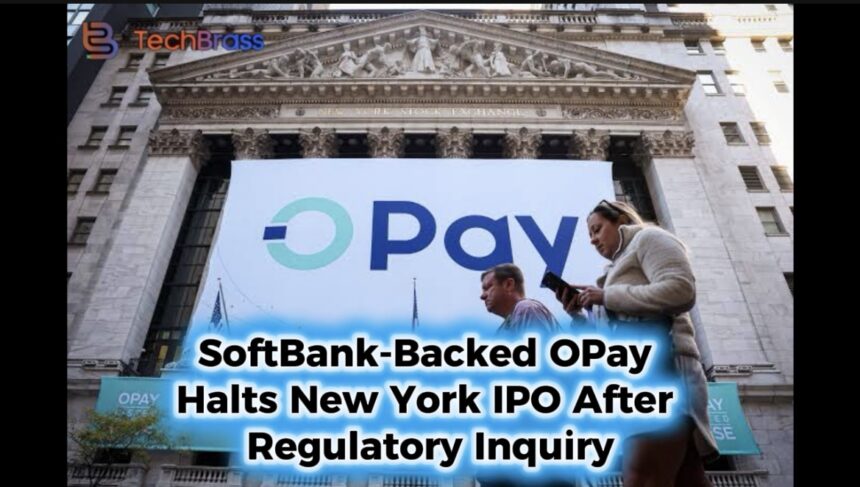
A major international listing was supposed to put OPay on the global investment map. Instead, the fintech company has reportedly put its planned New York IPO on hold after receiving a regulatory inquiry.
The development is significant for more than just OPay. It raises fresh questions about the regulatory challenges facing fast-growing fintech companies, the scrutiny of foreign businesses seeking access to US capital markets, and what the delay could mean for Africa’s technology and investment ecosystem.
For a company with strong roots in African digital payments and backing from major investors, a postponed US listing is a story worth watching.
What Exactly Happened to OPay’s IPO?
On Friday, October 30, 2026, OPay priced its planned US share offering at $19 per American Depositary Share (ADS), the lowest end of its proposed $19–$21 price range.
The offering involved 16 million ADSs, which would have generated approximately $304 million in gross proceeds before fees and expenses. At the offer price, OPay was valued at approximately $4 billion.
The company’s executives even rang the opening bell at the New York Stock Exchange.
But there was a problem.
Before the shares could begin trading under the ticker symbol OPAY, the company disclosed a regulatory inquiry involving an unnamed foreign jurisdiction.
OPay subsequently reached an agreement with its underwriters to terminate the underwriting agreement signed on October 29. The offering would not be completed, and the shares would not begin trading as scheduled.
In other words, OPay got as far as pricing its IPO and preparing for its stock market debut, but the listing was pulled before trading began.
Why Did OPay Withdraw Its New York Listing?
The central issue is a regulatory inquiry in a foreign jurisdiction that OPay has not publicly identified.
The company described the jurisdiction as immaterial to its core business operations. However, it did not disclose:
Which country or jurisdiction is involved.
Which regulatory authority is conducting the inquiry.
What the inquiry concerns.
Whether the matter relates to licensing, documentation, corporate approvals or another regulatory requirement.
OPay said it expects the matter to be resolved satisfactorily in the near future.
It also stressed that the development should not be interpreted as a reflection of its financial condition, business performance, operational integrity or regulatory standing.
One important detail is that OPay’s initial explanation reportedly referred to obtaining a formal regulatory “No-Objection” connected to its US listing. Its subsequent statement went further, confirming that the company and its underwriters had agreed to terminate the offering.
Until OPay provides more information, it would be premature to conclude that the inquiry involves wrongdoing or a breach of Nigerian regulations.
OPay Was Targeting a $4 Billion Valuation
The abandoned IPO was a major milestone in OPay’s growth story.
Founded in 2018, OPay has grown into one of Nigeria’s most prominent digital financial services platforms. Its services include:
Bank transfers and payments.
Digital wallets.
Savings products.
Loan services.
Payment solutions for merchants and businesses.
The company operates across Nigeria, Indonesia, Egypt and Pakistan.
According to its IPO prospectus, OPay had approximately 50 million monthly active users as of July 31, 2026.
Its proposed $4 billion valuation would have placed it among the most valuable African fintech businesses, while giving international investors an opportunity to gain exposure to its digital payments operations.
For perspective, OPay raised $400 million in 2021 at a valuation of $2 billion.
The proposed IPO therefore represented an opportunity to access public-market capital at roughly twice that earlier valuation.
What Does SoftBank Have to Do With OPay?
SoftBank Group
SoftBank is one of the major investors associated with OPay. Its entities held approximately 6.6% of OPay before the proposed IPO, according to Reuters.
SoftBank’s involvement is significant because the Japanese investment group has backed technology companies across several markets.
Its investment in OPay reflects the growing interest of international investors in African fintech businesses, particularly companies building digital payment infrastructure for large, underserved markets.
However, SoftBank’s 6.6% stake does not mean it owned OPay or controlled its operations.
The IPO would also have offered an opportunity for existing investors and the company to benefit from a public-market valuation. With the offering withdrawn, that opportunity is now on hold.
The Withdrawal Also Affects a Potential $200 Million Investment
There is another important financial detail behind the cancelled listing.
Stanbic Africa Holdings, part of South Africa’s Standard Bank Group, had agreed to purchase up to $200 million in new OPay shares through a separate private placement.
Nine other investors had also indicated interest in purchasing up to $270 million worth of shares.
However, the private placement was dependent on the IPO being completed.
Since OPay withdrew the offering, the status of these arrangements is uncertain. The company has not publicly clarified what happens next to the proposed Standard Bank investment or the other investor commitments.
This means the impact extends beyond the cancellation of a stock market debut. A wider fundraising arrangement built around the IPO has also been disrupted.
Will OPay Customers in Nigeria Be Affected?
This is probably the question many Nigerian users will want answered.
If you use OPay for transfers, payments, savings or business transactions, should you be worried?
Based on the company’s public statement, the IPO withdrawal does not affect its normal operations or customer services.
OPay said its services, regulatory standing and operations in Nigeria and its other markets remain unaffected.
It also reaffirmed its commitment to investing in Nigeria’s digital financial services sector.
It is important, however, to understand the difference between an IPO and a company’s everyday operations.
An IPO is the process through which a private company offers shares to public investors. It is a fundraising and ownership-related event, not a requirement for the company to continue providing its existing services.
Therefore, withdrawing an IPO does not automatically mean that a company is shutting down, losing customer deposits or experiencing financial distress.
At the time of the announcement, OPay had not reported that its Nigerian customers needed to take any special action because of the listing withdrawal.
Could OPay Still List on the Nigerian Stock Exchange?
Before the US IPO was withdrawn, OPay had also been preparing for a potential secondary listing on the Nigerian Exchange (NGX).
The idea was to complete its primary listing in New York and subsequently make its shares available to Nigerian investors through a secondary listing.
That would have been an interesting development for Nigeria’s capital market.
Imagine being able to invest directly in a fintech platform whose services you already use for everyday transactions.
However, the planned Nigerian listing was tied to the completion of the US offering. The withdrawal therefore creates uncertainty around the original timetable.
OPay has not announced a new listing date or confirmed when it might revive its international offering.
For now, Nigerian investors will have to wait for further announcements.
What Happens Next?
There are several developments worth watching:
Regulatory clarification: OPay may need to provide more information about the unnamed jurisdiction and the nature of the inquiry.
A new IPO timetable: The company could consider another listing attempt once the regulatory matter is resolved, but no new date has been announced.
Investor commitments: The status of the proposed $200 million Standard Bank private placement and other investor commitments remains unclear.
The Nigerian listing: Investors will be watching to see whether OPay revisits its plan to list on the NGX.
Market confidence: The way OPay handles the situation could influence how investors assess its transparency and readiness for international public markets.
The important point is that the company has withdrawn this particular offering. It has not announced that it is abandoning the idea of becoming a publicly traded company permanently.
Frequently Asked Questions
1. Why did OPay cancel its US IPO?
OPay withdrew its planned $304 million New York Stock Exchange offering after a regulatory inquiry involving an unnamed foreign jurisdiction.
2. How much was OPay expected to raise?
The company priced 16 million American Depositary Shares at $19 each, representing approximately $304 million in gross proceeds.
3. What was OPay’s proposed valuation?
At the IPO price of $19 per share, OPay was valued at approximately $4 billion.
4. Is OPay shutting down in Nigeria?
No. OPay said its operations and customer services in Nigeria and its other markets remain unaffected by the IPO withdrawal.
5. Does SoftBank own OPay?
SoftBank-backed entities held approximately 6.6% of OPay before the proposed IPO. That makes SoftBank an investor, not the sole owner.
6. Will OPay list on the Nigerian Exchange?
OPay had previously secured approval to pursue a secondary listing on the NGX after its planned US listing. However, the withdrawal of the US IPO leaves the timetable uncertain.
Final Thoughts: A Setback for One of Africa’s Biggest Fintech Stories
OPay’s planned New York listing was more than a fundraising exercise. It was an opportunity to demonstrate that an African-focused fintech company could attract international public-market investors at a multibillion-dollar valuation.
The company had priced its shares, secured underwriting support and prepared for its NYSE debut. Then, just before trading began, a regulatory inquiry changed the outcome.
For Nigeria’s technology ecosystem, this is an important development.
African fintech companies are attracting global capital, but international expansion also brings regulatory responsibilities that can influence major business decisions.
OPay may still make it to the public markets. But its next move will depend on how it resolves the outstanding regulatory issue and restores confidence in its listing plans.
What do you think? Should OPay attempt another New York IPO after resolving the inquiry, or should it focus on listing on the Nigerian Exchange first?
Share your thoughts in the comments.