
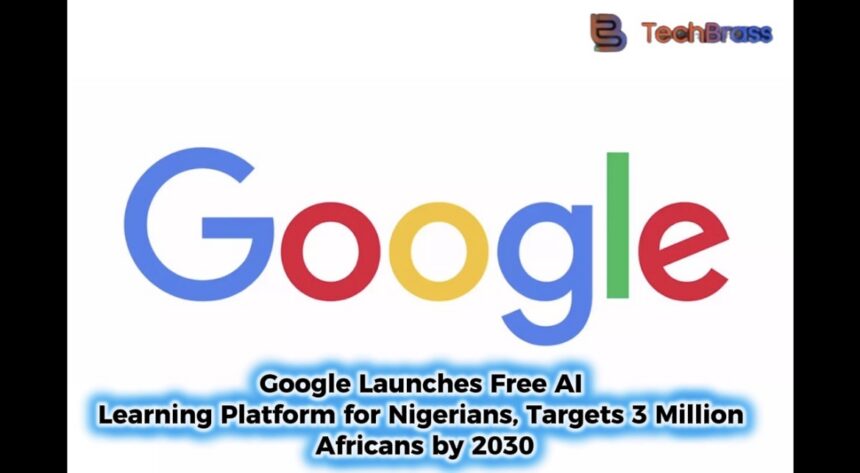
Google has launched a free digital learning platform that allows Nigerians and other Africans to learn artificial intelligence, cybersecurity, cloud computing and other technology skills, even without a continuous internet connection.
The platform, called Skilling Africa with Google, brings more than 15 of Google’s training programmes into one learning hub. Its goal is to equip three million people across Africa with digital and AI skills by 2030.
For Nigerians dealing with expensive mobile data and unreliable internet connections, one feature could make a significant difference: learners can download lessons over Wi-Fi and continue studying offline.
Google says the initiative builds on its previous digital training programmes, which have reached more than seven million young Africans. It has also set an initial target of graduating 250,000 learners by the end of 2026.
What Is Skilling Africa with Google?
Rather than creating an entirely separate collection of courses, Google has brought together more than 15 of its existing training initiatives into one central learning hub.
The idea is to make it easier for people to find relevant training without navigating several different platforms.
Some of the programmes include:
The courses are designed for different groups, including students, job seekers, small business owners, developers and working professionals.
This means the platform is not exclusively for people who want to become software engineers. Entrepreneurs and business owners can also find training relevant to running and growing their businesses.
How Does the Offline Learning Feature Work?
This is arguably the platform’s most interesting feature for Nigerian learners.
Many online learning platforms require users to remain connected to the internet throughout their lessons.
That can become expensive, particularly for people who depend on mobile data.
Google is approaching the problem differently.
With Skilling Africa, users can:
Connect to Wi-Fi or another available internet connection.
Download supported learning materials.
Disconnect from the internet.
Continue studying downloaded lessons offline without consuming additional mobile data.
The platform is also designed to work on entry-level smartphones and laptops.
Importantly, this does not mean every feature works offline. Learners need an internet connection to access the platform and download materials initially. Interactive services such as SCOUT may also require connectivity.
Google Has Introduced an AI Study Assistant Called SCOUT
Google is also incorporating an AI-powered learning companion called SCOUT, short for Smart Companion for Online Understanding and Training.
Think of it as a digital study assistant.
Instead of simply watching lessons and reading materials, learners can use SCOUT to get help understanding unfamiliar concepts.
Its advertised capabilities include:
Answering learners’ questions.
Explaining unfamiliar topics.
Suggesting what to study next.
Helping users organise their learning schedules.
Providing a more personalised learning experience.
The platform also includes interactive skill trees, learning streaks and verifiable badges.
These features are intended to encourage learners to complete their courses rather than register and abandon them halfway.
However, learners should understand that an AI study assistant supports the learning process; it does not replace practical experience or professional expertise.
What Skills Can Nigerians Learn?
The platform covers several areas that are becoming increasingly important in the global economy.
Here are some of the most useful learning paths.
1. Artificial Intelligence
Learn about AI tools, prompting, and how artificial intelligence can be applied to everyday work and business.
2. Cybersecurity
Develop knowledge of digital security, protecting systems and identifying cyber threats.
3. Cloud Computing
Understand cloud infrastructure, services and technologies used to operate modern digital businesses.
4. Data Analytics
Learn how to work with information, analyse datasets and turn numbers into useful business decisions.
5. Digital Marketing
Develop skills in online marketing, search engine optimisation, audience growth and digital measurement.
6. Business Development
Access training designed to help small businesses improve operations, grow and become more resilient.
The Three Million Target: What Google Wants to Achieve by 2030
Google’s ambition goes beyond launching another online education website.
The company wants to equip three million people across Africa with digital and AI skills by 2030.
It has also established an initial milestone of 250,000 graduates by the end of 2026.
The initiative builds on Google’s claim that more than seven million young Africans have already completed foundational digital skills training through its previous programmes.
Google believes Africa has an estimated $2.9 trillion AI-driven economic opportunity.
However, it has also highlighted a major obstacle: the shortage of workers with the skills required to develop and use AI technologies.
The company’s Africa blog says more than 90% of companies across the region report a critical deficit in AI-ready professionals.
That figure is Google’s stated assessment, rather than a universal measurement of every African employer.
The broader point is clear: access to technology alone will not make Africa competitive in the AI economy. People also need the skills to use, build and commercialise it.
How Nigerians Can Access the Free Google Learning Platform
Skilling Africa with Google
Official digital learning hub
Start learning for free
Google says the platform is open to everyone, including students, job seekers, entrepreneurs and developers.
Website: skillingafrica.withgoogle.com
Getting started is straightforward:
Open the official learning platform.
Sign in using your Google account.
Browse the available training programmes.
Select a course that matches your interests or career goals.
Download supported lessons when connected to Wi-Fi if you want to study offline.
Track your progress and earn available badges as you complete learning activities.
There is no separate app-store download requirement, according to Google.
The platform is currently reported to support English, Swahili and Arabic, with additional African languages, including Hausa, expected to broaden access.
Is This a Big Opportunity for Nigerians?
It could be, particularly for people who want to develop practical digital skills without paying for expensive training programmes.
Consider a few examples.
A university student could begin learning data analytics before graduation.
A small business owner could use digital marketing training to improve online visibility and reach more customers.
A job seeker could explore cybersecurity or IT support as potential career paths.
A developer could strengthen their knowledge of cloud technologies.
A content creator could learn how AI tools can improve research, productivity and everyday creative work.
But there is an important distinction: completing an online course does not automatically guarantee employment, income or a professional qualification.
Some Google Career Certificates are structured professional credentials, while other learning activities may offer completion badges. Learners should check the specific course requirements and credential awarded before assuming every programme provides the same certification.
The real value will come from applying what has been learned, building practical projects and demonstrating those skills to employers or clients.
The Bigger Challenge: Turning Free Training Into Real Opportunities
Google’s initiative addresses an important barrier to digital education, but access to courses is only one part of the problem.
Nigeria and other African countries still face challenges involving internet infrastructure, affordable devices, electricity reliability and access to quality employment.
Even when someone completes a cybersecurity or data analytics course, they still need opportunities to gain practical experience.
Businesses must also be willing to hire people with relevant skills.
This is why the success of the initiative should not be measured only by the number of people who register.
The more meaningful questions are:
How many people actually complete their courses?
How many develop practical, employable skills?
How many secure jobs or grow their businesses?
How many use their knowledge to build technology solutions for African problems?
Google has announced an ambitious target. Its long-term impact will depend on whether learners can turn that training into measurable economic opportunities.
Frequently Asked Questions
1. Is Google’s new AI learning platform free?
Yes. Google says Skilling Africa with Google is free and open to everyone across the continent.
2. Can Nigerians study without internet access?
Yes, after downloading supported lessons over Wi-Fi or another internet connection, learners can complete those modules offline without additional mobile data.
3. Does the platform provide certificates?
Some programmes, including Google Career Certificates, offer professional credentials. Other learning activities may provide verifiable badges. The credential depends on the specific programme.
4. Do I need a laptop to participate?
No. Google says the platform is designed to work on entry-level smartphones as well as laptops and desktop computers.
5. Who can register?
Students, job seekers, entrepreneurs, developers, professionals and other interested learners can access the platform.
6. What is Google’s target for Africa?
Google aims to equip three million people with digital and AI skills by 2030, with an initial target of 250,000 graduates by the end of 2026.
Final Thoughts: A Free Opportunity Nigerians Should Take Seriously
Google’s new learning hub is an important development for Africa’s digital education landscape.
Its biggest advantage may not simply be the number of courses available, but the fact that people can download lessons and continue learning without depending on a constant internet connection.
For Nigerians who have wanted to learn AI, cybersecurity, data analytics or cloud computing but struggled with the cost of training and internet access, this is an opportunity worth exploring.
Still, registering is only the first step.
The people who benefit most will be those who choose a relevant skill, complete the training, practise consistently and use what they learn to solve real problems.
The next generation of African technology professionals will not be built by access to technology alone. It will be built by people who know how to use it.
Would you take advantage of Google’s free training programme? And which skill would you learn first?