

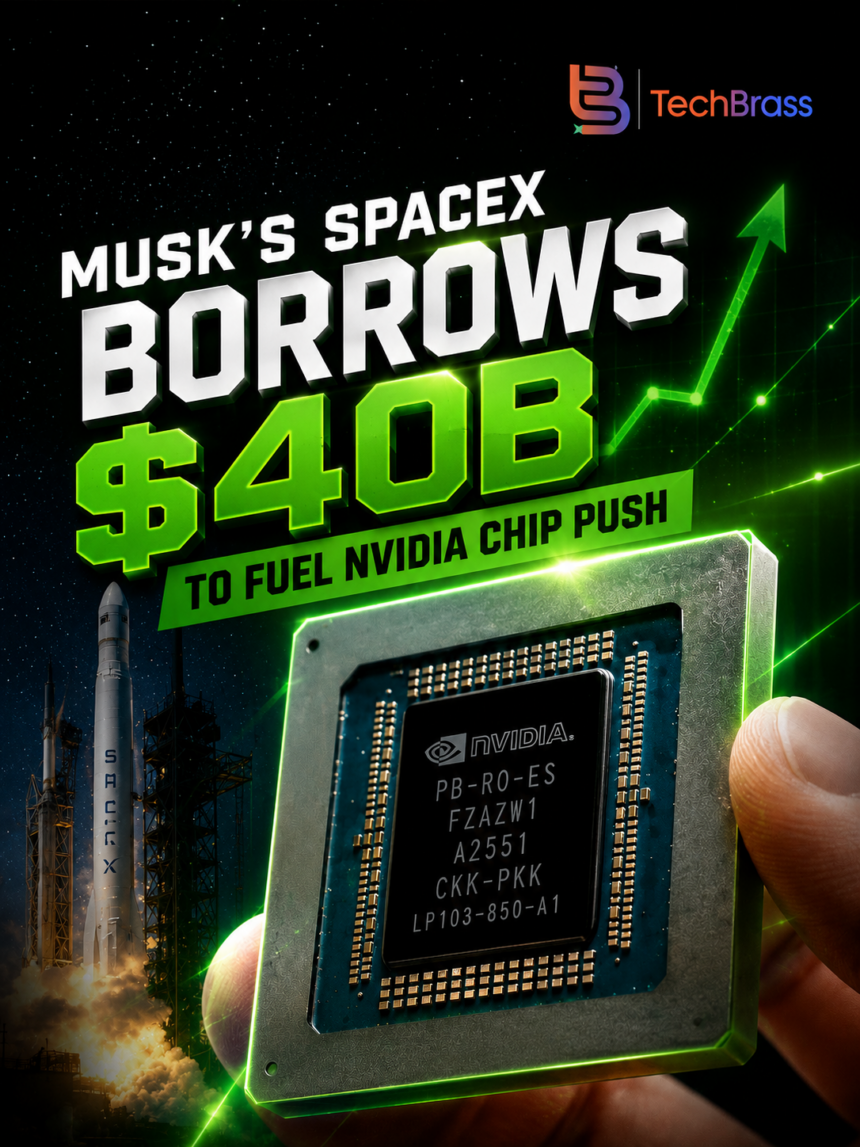
Elon Musk’s SpaceX is reportedly in talks with banks and investors to raise $40 billion in debt to purchase Nvidia AI chips, highlighting just how much capital is now flowing into the infrastructure behind artificial intelligence.
According to reports from the Financial Times, SpaceX is considering a financing package of roughly $10 billion in bank loans and $30 billion in investment-grade debt. Apollo Global Management is expected to lead the financing, while bond manager Pimco is among the investors reportedly involved in discussions.
The discussions are still at an early stage, meaning the deal could change or ultimately fail to close. If completed, however, it would provide another striking example of how the AI boom is increasingly being financed through large-scale borrowing.
SpaceX Wants $40 Billion for Nvidia Chips
SpaceX is seeking approximately $40 billion in financing specifically to fund an order for Nvidia AI processors.
The proposed structure is straightforward:
- $10 billion in bank loans
- $30 billion in investment-grade debt
- Apollo Global Management expected to lead the financing
- Pimco among the investment firms reportedly considering participation
- The transaction is expected to close in 2027, if completed
Reuters reported that the financing plan was originally reported by the Financial Times and said Reuters had not independently verified the report with SpaceX, Apollo or Nvidia.
That distinction matters. This is currently a reported financing plan, not a completed $40 billion transaction.
Why Does SpaceX Need So Many AI Chips?
SpaceX is no longer focused solely on rockets and satellites.
The company is also expanding its computing and artificial intelligence ambitions. Musk has said SpaceX plans to use Nvidia hardware exclusively for its data centers. Reuters also reported that Musk said xAI’s Colossus 2 data center could more than double its Nvidia chip count by December.
The growing demand for GPUs reflects a broader change in the technology industry.
Modern AI systems require enormous amounts of computing power for:
- Training large AI models
- Running AI models for users
- Processing large datasets
- Building AI-powered applications
- Supporting cloud and data-center workloads
As companies deploy more AI services, they need more processors, data-center capacity, electricity and networking equipment.
That is creating a massive infrastructure spending cycle.
The AI Boom Is Becoming a Financing Boom
The SpaceX proposal is significant because it shows that the AI race is not simply about developing better software.
It is increasingly about who can secure enough physical computing infrastructure.
Companies need expensive GPUs before they can offer AI services at scale. However, purchasing huge quantities of chips requires enormous amounts of capital.
As a result, businesses are increasingly turning to banks, asset managers and debt markets to finance AI infrastructure.
Reuters cited Morgan Stanley estimates that AI infrastructure could require $1.5 trillion in external financing by 2028.
That helps put SpaceX’s proposed $40 billion financing into perspective.
It is enormous on its own, but it is also part of a much larger financial ecosystem developing around AI infrastructure.
Why Nvidia Is at the Center of the Deal
Nvidia has become one of the most important suppliers in the AI computing ecosystem because its processors are widely used for demanding AI workloads.
For companies building large-scale AI systems, securing access to advanced processors can therefore become a strategic priority.
SpaceX’s reported financing plan illustrates this directly.
Instead of treating chips simply as another technology purchase, the company appears willing to raise tens of billions of dollars specifically to secure the computing hardware needed for its AI ambitions.
Nvidia is also becoming increasingly involved in the financing side of the AI infrastructure market.
Reuters reported that Nvidia partnered with Apollo, BlackRock, Blackstone, Brookfield, Goldman Sachs and KKR on financing platforms intended to mobilize more than $500 billion for AI infrastructure projects.
This creates an interesting cycle:
AI demand → more chips → more data centers → more financing → more AI capacity.
Why Debt Is Being Used to Fund AI Infrastructure
Building AI infrastructure requires enormous upfront investment.
Companies must spend on GPUs, servers, networking equipment, buildings, electricity and other supporting infrastructure before the resulting computing capacity can generate revenue.
Debt can allow companies to spread those costs over time rather than paying for everything upfront.
For example, imagine a company needs $10 billion worth of computing equipment today but expects that infrastructure to generate revenue over several years.
Instead of paying the entire amount from existing cash, it could potentially finance part of the investment through loans or bonds.
However, borrowing also creates obligations.
The company must eventually repay the debt and cover interest costs, regardless of whether its AI business performs as expected.
That is why investors closely examine the company’s expected cash flow, credit quality and long-term business prospects before purchasing its debt.
SpaceX’s Financing Comes With Risks
The size of the proposed financing also raises important questions.
1. The deal is not guaranteed
The reported discussions are still in their early stages and could end without a completed transaction.
Therefore, the $40 billion figure should not be interpreted as money SpaceX has already raised.
2. AI infrastructure is extremely capital-intensive
AI companies are spending huge amounts of money on computing infrastructure.
The challenge is making sure the resulting computing capacity eventually produces enough revenue and cash flow to justify that investment.
3. Debt creates financial obligations
Unlike equity financing, debt must generally be repaid.
If AI demand grows as expected, the investment could support significant future business opportunities.
If demand or profitability falls short, however, large debt obligations can become more difficult to manage.
4. Technology changes quickly
AI hardware continues to evolve rapidly.
That creates another challenge for companies making enormous investments in computing equipment: today’s cutting-edge hardware can eventually be replaced by newer generations.
For investors, this makes the economics of financing AI infrastructure particularly important.
What the SpaceX Deal Could Mean for the AI Industry
The reported financing could have implications beyond SpaceX.
It demonstrates how the AI infrastructure market is evolving from a traditional technology-spending story into a major capital-markets story.
Banks and institutional investors are increasingly becoming part of the infrastructure supporting the AI economy.
The model increasingly looks like this:
Investors provide capital → companies acquire computing infrastructure → AI companies use the infrastructure → revenue is generated from AI services → companies repay financing and reinvest.
If that cycle works, enormous amounts of capital could continue flowing into AI infrastructure.
If expected AI revenues fail to justify the spending, investors could become much more cautious.
What It Means for Nvidia
The proposed SpaceX financing is also notable for Nvidia.
A large purchase from SpaceX would represent another major demand signal for Nvidia’s AI processors.
More broadly, the financing activity surrounding Nvidia shows that demand for AI hardware is influencing not only semiconductor companies but also banks, asset managers, data-center operators and technology companies.
Reuters reported that Nvidia’s stock rose 0.5% in extended trading following the report, while SpaceX shares fell 1%.
Those market moves should not, however, be interpreted as a definitive judgment on the long-term success or failure of the proposed deal.
What Businesses and Investors Should Watch
The SpaceX situation offers several broader lessons for the technology industry.
Businesses considering major AI investments should pay attention to:
- The cost of AI computing
- Access to advanced chips
- Data-center capacity
- Electricity requirements
- Financing costs
- Expected AI revenue
- Hardware replacement cycles
- Long-term customer demand
For investors, the bigger question is becoming increasingly important:
Will the revenue generated by AI eventually justify the enormous amount of capital being invested in its infrastructure?
That question could shape the technology and financial markets for years.
Frequently Asked Questions
Is SpaceX borrowing $40 billion right now?
Not yet. Reports say SpaceX is in talks with banks and investors about raising approximately $40 billion. The discussions are still at an early stage and could end without a deal.
What would SpaceX use the $40 billion for?
The reported financing would be used to purchase Nvidia AI chips for SpaceX’s expanding computing and AI infrastructure.
How would the $40 billion financing be structured?
The reported plan consists of approximately $10 billion in bank loans and $30 billion in investment-grade debt.
Who is expected to lead the financing?
Apollo Global Management is expected to lead the financing, with Pimco among the investment firms reportedly considering participation.
When could the SpaceX financing close?
The reported transaction is expected to close in 2027, although that depends on negotiations and whether the financing is ultimately completed.
Why does AI require so much financing?
AI systems require expensive processors, data centers, electricity, networking equipment and other infrastructure. As companies expand their AI operations, they need increasingly large amounts of capital to build that capacity.
Conclusion
SpaceX’s reported plan to raise $40 billion for Nvidia AI chips illustrates how dramatically the economics of artificial intelligence are changing.
The AI race is no longer just about who has the best model or the most talented engineers. It is also about who can secure the computing power required to operate those systems at scale.
For SpaceX, the reported financing would represent a major commitment to AI infrastructure. For Nvidia, it demonstrates the continuing demand for advanced AI processors. And for banks and investors, it highlights a growing opportunity — and a growing risk — in financing the infrastructure behind the AI boom.
The important caveat is that the SpaceX financing is still under discussion. Until a transaction closes, the $40 billion figure remains a reported target rather than completed funding.
As AI infrastructure spending continues to grow, however, one thing is becoming increasingly clear: the next phase of the AI race will require not only technology, but enormous amounts of capital.
Want more technology news, AI developments and business insights? Follow TechBrass for original, easy-to-understand coverage of the technologies shaping the future.