
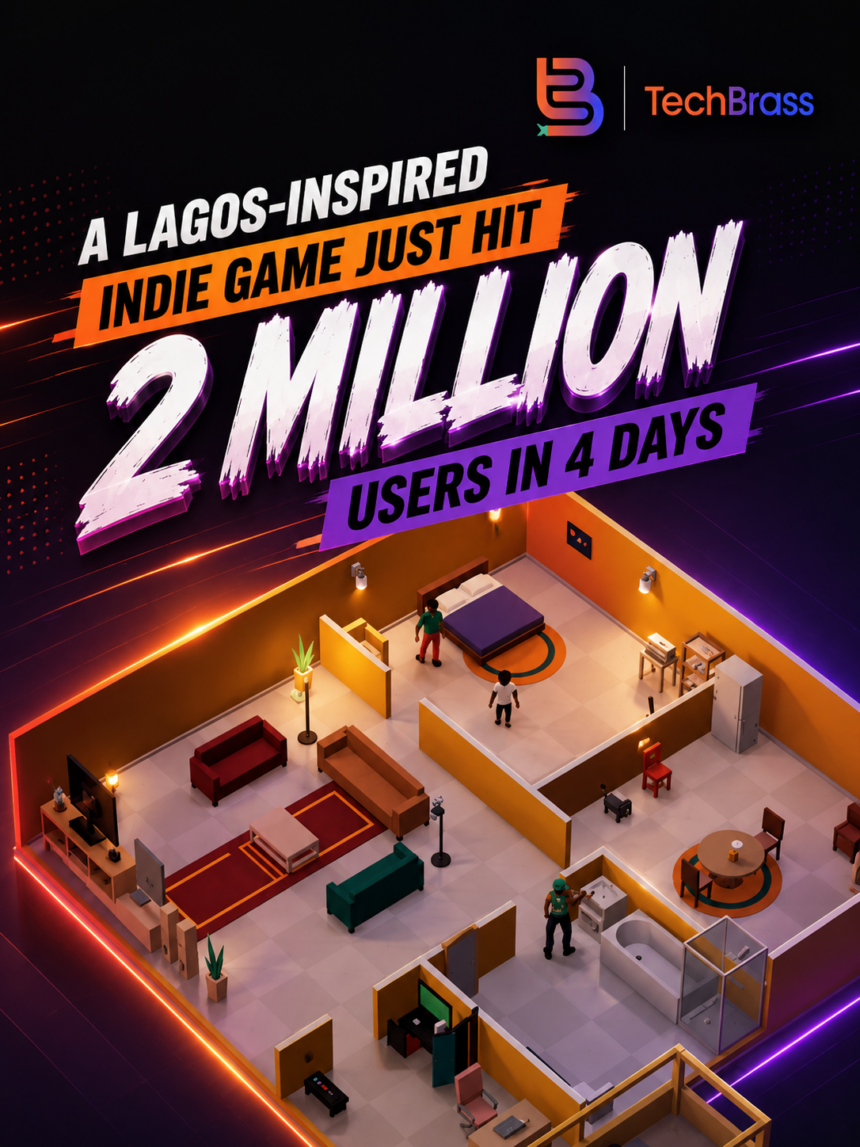
A Nigerian-made browser game is showing how local ideas can capture a massive online audience. Lagos Life, created by Nigerian software developer Shalom Rayhamen, launched on October 1, 2026, and quickly attracted more than two million players, according to figures reported by the developer and technology publications. The game brings everyday Nigerian experiences into a virtual world where players can work, earn virtual money, rent homes, socialise and explore familiar city environments.
But the story goes beyond a viral launch. For African game developers, the bigger challenge is turning sudden popularity into a reliable business. More players mean greater demands on servers, security, customer support and game development. At the same time, the opportunity to attract advertisers and build a loyal gaming community becomes much larger.
Lagos Life offers a timely case study in what happens when a small game project suddenly reaches a huge audience.
What Is Lagos Life?
Lagos Life is a browser-based life-simulation game inspired by The Sims, but with a world shaped by Nigerian culture and everyday urban experiences.
Players create characters and navigate a digital city where they can pursue jobs, earn virtual money, pay rent, acquire items and interact with other people.
Instead of building an imaginary city with little connection to players’ lives, the game draws on recognisable elements of Nigerian society. That familiarity gives the experience a distinctive identity.
The game was developed by Shalom Rayhamen, who posts online as @Shalom_HeyEliy. Reports indicate that the idea gained momentum after she encountered Lagos Run, a separate browser game centred on driving a danfo through Lagos traffic.
Why a browser game matters
One important part of Lagos Life’s appeal is accessibility.
Players can access the game through a web browser without downloading a conventional mobile or desktop game application. This removes an extra installation step and makes it easier for people to try the experience.
For independent developers, that can be a valuable advantage.
A game that loads quickly, works across common devices and is easy to share has fewer barriers between discovery and participation. Players can send a link to friends, post screenshots and invite others into the same virtual world.
That simplicity can help a product spread organically, although it does not guarantee long-term engagement.
How Lagos Life Attracted Millions of Players
Lagos Life’s early growth highlights the potential of combining cultural relevance, accessibility and social interaction.
Several factors help explain why the game attracted so much attention.
1. It reflects a familiar environment
The game draws inspiration from experiences many Nigerians recognise, including work, rent, social life and the everyday challenges of living in a major city.
This familiarity gives players an immediate connection to the world.
Rather than learning the culture of an unfamiliar fictional setting, users can recognise the references, understand the humour and relate to the situations their characters encounter.
For developers, the lesson is that local context can be a product advantage rather than a limitation.
2. It gives players something to share
Games with social features can generate content beyond the game itself.
Players can share funny situations, character interactions, virtual achievements and unexpected experiences on social media. Each post can introduce the game to people who have never played it.
This creates a potential growth cycle:
Someone discovers the game through a post.
They visit the website and start playing.
They experience something worth sharing.
Friends see the post and join.
The growing community generates more conversations.
This is a form of organic distribution. However, the number of people who see a post is not necessarily the same as the number who become active or returning players.
3. It makes participation relatively easy
Traditional games can require downloads, updates, substantial storage or compatible hardware.
A browser-based game can avoid some of these barriers. That makes it easier for interested users to test the product before deciding whether to spend more time with it.
For African developers targeting audiences with different devices and internet connections, accessibility deserves careful consideration from the beginning.
4. It arrived at the right cultural moment
Lagos Life launched on October 1, Nigeria’s Independence Day, giving the release a natural connection to national identity.
Its Nigerian setting also made it easy to discuss within local online communities.
Still, timing alone cannot explain a game’s success. The product must give users a reason to participate, return and recommend it to others.
What Happens When an Indie Game Goes Viral?
A sudden surge in users can look like an entirely positive development. In practice, it can create a new set of technical and operational problems.
A game that works well with a few hundred users may behave differently when tens of thousands try to connect around the same time.
Server capacity and performance
Every active player generates some level of demand on the game’s infrastructure. Depending on the design, this may include account requests, movement updates, chat messages, inventory changes and database operations.
When demand rises sharply, developers must ensure the system can handle it without becoming slow or unavailable.
That may require:
Increasing server capacity.
Optimising database queries.
Reducing unnecessary network requests.
Caching frequently accessed information.
Monitoring response times and error rates.
Testing how the system behaves during peak traffic.
The goal is not simply to keep the website online. It is to provide a consistent experience while the number of users changes.
Security and abuse prevention
A growing online game also attracts more opportunities for abuse.
Players may attempt to manipulate virtual currency, exploit bugs, disrupt other users or gain unfair advantages.
Developers therefore need systems that validate transactions, protect accounts, monitor unusual behaviour and prevent unauthorised changes to game data.
These measures are especially important when a game contains an economy involving jobs, property, purchases and virtual money.
Customer support and community management
A small creator can sometimes respond to early players personally. That becomes more difficult as the audience grows.
Users may report bugs, ask questions, request features or complain about lost progress. Without a clear process for handling these issues, the quality of the player experience can deteriorate.
A growing game needs more than code. It needs a reliable way to listen to users and communicate changes.
How Lagos Life Could Make Money
A large audience creates commercial opportunities, but user numbers alone do not establish whether a game is profitable.
Lagos Life has attracted attention for its advertising approach, which allows real businesses to purchase placements within the virtual environment. Techpoint Africa reported that the game was offering virtual billboards to advertisers.
This model is worth examining because it connects the game’s digital world with the businesses that want to reach its audience.
1. Virtual billboards and brand placements
Businesses can potentially advertise through billboards or other locations inside a game.
For example, a furniture retailer could promote its products through a virtual property, while an event organiser could advertise an upcoming event in a popular in-game location.
The advantage is that advertising becomes part of the environment rather than appearing only as a conventional banner outside the game.
However, the value of a placement depends on factors such as audience attention, player activity, brand suitability and whether users actually notice the advertisement.
2. Sponsored virtual experiences
As the game develops, its creator could explore partnerships with brands that want to participate in its virtual world.
Possible examples include sponsored events, themed locations or interactive brand experiences.
These are potential opportunities, not confirmation that Lagos Life currently offers every such feature.
The challenge is to keep sponsorships relevant without making the game feel like an advertising platform with little entertainment value.
3. Other possible revenue streams
Independent games can also generate income through optional cosmetic items, premium features, paid expansions or partnerships.
Each model comes with trade-offs. Aggressive monetisation can discourage participation, while relying entirely on advertising may leave a developer exposed to changes in advertiser demand.
For Lagos Life, the long-term opportunity will depend on finding a balance between user experience and sustainable revenue.
The $46,900 Revenue Figure: What We Know
The financial claims surrounding Lagos Life deserve careful attention.
On October 5, reporting by WeeTracker cited figures shared by the developer indicating that the game generated approximately $46,900 in revenue during its first four days. The same report described more than 1.8 million total players at that point.
These figures are notable, but they need context.
First, the revenue figure was reported from information shared by the developer. It should not automatically be treated as independently audited financial data.
Second, revenue is not the same as profit. A game may generate income while also incurring costs for hosting, development, payment processing, security and other operations.
Third, a rapid increase in players does not necessarily mean the same growth will continue. Some people may visit once because of social media attention and never return.
To assess the business properly, observers would need more information about operating costs, returning users, revenue sources and the amount of time players spend in the game.
The early figures suggest commercial potential. They do not, on their own, prove long-term profitability.
Can African Indie Games Become Sustainable Businesses?
Lagos Life highlights an opportunity for African developers to create products that appeal to local audiences while remaining accessible to international users.
However, building a sustainable gaming business requires more than an interesting idea.
Build for retention, not just acquisition
A viral launch attracts attention. A durable game gives people reasons to return.
Developers can support retention through meaningful progression, regular improvements, social features and a community that feels worth joining.
Useful measures include:
Daily and monthly active users.
The percentage of players who return after their first visit.
Average session length.
Server reliability.
Revenue per active user.
The cost of acquiring and retaining players.
These measures provide a more complete picture than total registrations or visits alone.
Design infrastructure that can scale
Developers do not always need expensive infrastructure from day one. They do, however, need a plan for growth.
That includes identifying bottlenecks, monitoring usage, testing capacity and selecting hosting arrangements that can expand as demand increases.
Good engineering decisions early in development can reduce the cost and disruption of later growth.
Treat monetisation as part of the product
Revenue strategies work best when they complement the experience.
For example, relevant advertising can help fund a free game without forcing every player to make a purchase. Optional paid features may work for some audiences, but they should not undermine fair gameplay.
The key is to understand what players value and build a business model around that behaviour.
Protect the community
Trust becomes increasingly important as a game grows.
Clear rules, fair moderation, reliable account protection and transparent communication can help preserve the relationship between developers and players.
Without that trust, even a technically successful game may struggle to maintain an active community.
What Lagos Life Means for Nigeria’s Gaming Industry
Lagos Life is part of a wider conversation about the potential of locally developed digital products.
For years, African developers have created games inspired by their surroundings, but turning those products into businesses at scale remains a challenge. Lagos Life’s early audience offers a visible example of how a culturally specific experience can attract substantial attention online.
Its significance lies in several areas.
For developers, it demonstrates the value of building for a clearly defined audience and reducing barriers to entry.
For businesses, it presents another way to reach digital communities through interactive experiences.
For investors, it provides a reason to examine African gaming products more closely while still assessing their underlying economics.
For aspiring creators, it shows that a small project can attract attention without beginning as a large studio production.
Nevertheless, one successful launch cannot establish that every African indie game will achieve similar results. Each product must find its own audience, distribution strategy and path to revenue.
Frequently Asked Questions
What is Lagos Life?
Lagos Life is a browser-based life-simulation game created by Nigerian developer Shalom Rayhamen. Players can build virtual lives, work, manage money, socialise and explore a digital environment inspired by Nigerian cities.
How many players does Lagos Life have?
Reports published on October 6, 2026, said the game had surpassed two million players in less than a week. These figures were based on the developer’s reported statistics and should be understood as self-reported rather than independently audited.
Who created Lagos Life?
Lagos Life was created by Nigerian software developer Shalom Rayhamen, who posts online as @Shalom_HeyEliy.
How does Lagos Life make money?
The game has been reported to use virtual advertising placements, including billboards that businesses can rent. Other monetisation methods should not be assumed to be active without confirmation from the developer.
Is Lagos Life’s reported revenue the same as profit?
No. Revenue is the amount generated before expenses are deducted. Profit depends on costs such as infrastructure, development, payment processing and operations.
What can African game developers learn from Lagos Life?
Developers can learn the importance of cultural relevance, easy access, social sharing, scalable infrastructure, responsible monetisation and player retention. They should also prepare for security, support and performance challenges when demand grows quickly.
Conclusion: Turning Viral Attention Into Long-Term Value
Lagos Life is an interesting example of how a locally inspired digital product can reach a large audience in a short period.
Its early success shows the potential of accessible browser gaming, culturally relevant design and social distribution. At the same time, the attention surrounding the game raises a more important business question: can its creator maintain performance, retain players and generate enough revenue to support continued development?
That is the real test of a viral game.
For Nigeria’s gaming ecosystem, the opportunity extends beyond one title. Developers can build products around familiar experiences, reach communities through the web and explore business models that do not depend entirely on traditional game sales.
But lasting success will require more than impressive launch numbers. It will depend on dependable technology, a committed community and a business model that works after the initial excitement fades.
Follow TechBrass for more technology news, African startup stories and insights into the digital businesses shaping the future.