
For much of the past few years, artificial intelligence has been one of Wall Street’s favourite investment stories. Companies linked to AI attracted enormous investor interest, valuations climbed, and expectations for future growth became increasingly ambitious.
But that confidence is now facing a reality check.
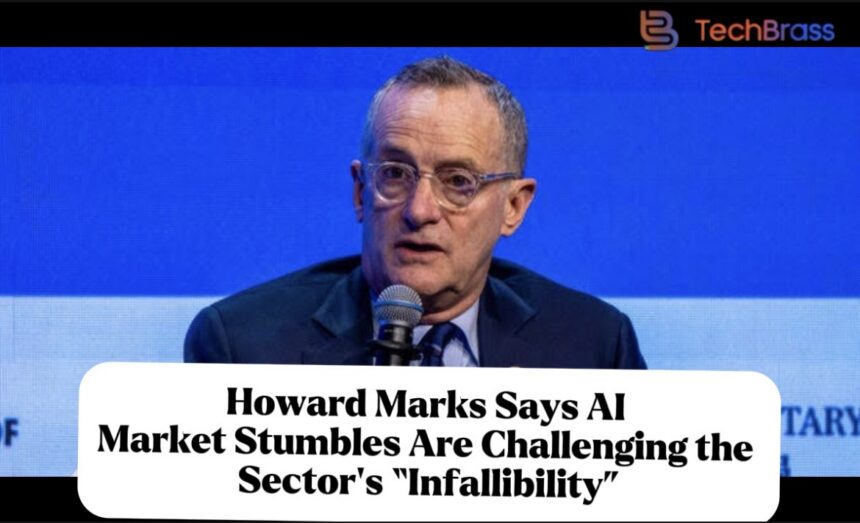
Howard Marks, co-chairman of Oaktree Capital Management, says recent market setbacks in the AI sector have started to weaken the belief that the technology and its biggest beneficiaries are almost impossible to bet against.
His warning raises an important question for investors: are AI stocks experiencing a temporary correction, or is the market beginning to recognise that some expectations have gone too far?
What Triggered the Change in Investor Sentiment?
The shift comes as investors become more demanding about whether the enormous amounts being spent on AI will actually generate enough revenue and profit.
Recent results from Alphabet and Amazon have contributed to concerns that some established technology businesses are facing pressure even as their companies commit enormous resources to artificial intelligence.
The issue is not simply whether AI works. It is whether the financial returns will justify the cost of building it.
For years, investors were willing to reward companies for announcing ambitious AI plans. Now, they increasingly want evidence that those investments can translate into sustainable earnings.
Marks described AI as a crowded investment trade, with considerable excitement surrounding both buying into and lending money to the sector.
Howard Marks’ Warning: Don’t Arrive Too Late
One of the most interesting parts of Marks’ Bloomberg interview was his reference to a familiar investment principle: the wise investor may recognise an opportunity early, while latecomers risk buying after much of the potential gain has already been priced in.
He compared investing to a baseball game, where nobody knows how many innings remain.
His point was that when a popular investment theme has attracted widespread excitement, investors need to consider whether they are entering too late.
Marks highlighted three warning signs:
Lower standards: Investors may become less demanding about the quality of businesses and their financial prospects.
Higher prices: Excitement can push valuations beyond what future earnings reasonably justify.
Crowded positioning: When too many investors are making similar bets, disappointment can trigger a rapid reversal.
His message was not that every AI company is overvalued. It was that investors should stop treating the entire sector as a guaranteed winner.
The Biggest Question: Will AI Spending Generate Enough Profit?
This is where the AI investment story becomes more complicated.
Technology companies are committing enormous sums to AI infrastructure, including data centres, advanced chips, networking equipment, electricity and computing capacity.
The spending is driven by an AI race in which major companies are trying to build better models, secure computing resources and attract customers before competitors get too far ahead.
But infrastructure is expensive. And building it does not automatically guarantee that customers will pay enough to make the investment worthwhile.
Marks questioned whether the amount of business and profit eventually generated by AI will be sufficient to deliver attractive returns on the capital being invested.
His answer was essentially that nobody knows yet.
That uncertainty is important because the market may be pricing in years of strong growth before the companies have demonstrated that they can consistently deliver it.
AI Could Transform the World Without Making Every Investor Rich
There is an important distinction that investors sometimes overlook.
A technology can change the world and still produce disappointing returns for people who invest in it at the wrong price.
Consider the dot-com boom of the late 1990s.
The internet eventually transformed communication, commerce, entertainment and business. But many companies that attracted enormous investor excitement during that period failed, and investors who bought at inflated valuations suffered significant losses.
Marks knows this history well.
In January 2000, he attracted attention with an Oaktree memo titled Bubble.com, warning about excessive enthusiasm surrounding technology, internet and e-commerce stocks before the dot-com crash.
His broader argument is that being right about a technology’s future does not automatically mean being right about the price of its stocks.
The internet became enormously valuable. That did not mean every internet company was a good investment.
The same distinction could apply to artificial intelligence.
Another Concern: Can Companies Adopt AI Fast Enough?
Marks was not the only investment figure raising questions about the AI boom.
In a separate Bloomberg TV interview, Jody Jonsson, vice chair at Capital Group, pointed to a possible disconnect between the expectations of AI companies and the speed at which businesses can actually adopt the technology.
Companies may want AI solutions, but integrating them into existing operations takes time. Businesses also need to establish whether these tools deliver measurable improvements in productivity and profitability.
Jonsson highlighted two important concerns:
Unclear return on investment: Some companies may not be seeing financial benefits as quickly as expected.
Rising financing requirements: The scale of capital needed to fund AI expansion could test the appetite of equity and debt investors.
She also raised concerns about financing arrangements involving off-balance-sheet vehicles and interconnected companies, warning that these relationships could make the system more fragile.
In other words, the AI investment boom is not just a question of technological progress. It is also a question of financing, business adoption and financial sustainability.
Does This Mean the AI Bubble Is About to Burst?
Not necessarily.
Marks did not declare that the AI market has officially entered a crash or that artificial intelligence is a failed technology.
His argument was more measured: recent setbacks have weakened the perception that AI investments are virtually guaranteed to succeed.
That change in sentiment could actually be healthy for the market.
When investors become more selective, companies may have to demonstrate stronger business models, clearer revenue opportunities and more realistic financial projections.
It could also create opportunities for businesses with sustainable earnings, useful AI products and reasonable valuations.
However, if expectations remain far ahead of actual financial results, further market corrections are possible.
The distinction is important: a correction in AI stocks would not necessarily mean the end of AI innovation.
What This Means for AI Investors in Nigeria and Africa
The debate is relevant beyond Wall Street.
Investors across Nigeria and Africa increasingly have exposure to international technology stocks through investment platforms, global brokerage services and funds.
Some are investing directly in companies involved in AI chips, cloud computing, software and data infrastructure. Others are gaining exposure through technology-focused funds.
Marks’ warning offers an important lesson for anyone considering these investments.
Don’t buy a stock simply because artificial intelligence is transforming the world.
Instead, consider:
Whether the company has a real competitive advantage.
Whether its revenue and profits justify its valuation.
How much it is spending to develop AI infrastructure.
Whether customers are willing to pay for its products.
How much debt or external financing it needs.
Whether its current share price already reflects years of expected growth.
AI may create enormous opportunities, but investors still need to distinguish between a promising technology and an attractive investment.
Frequently Asked Questions
1. Who is Howard Marks?
Howard Marks is the co-founder and co-chairman of Oaktree Capital Management, an investment management firm known for its expertise in credit and alternative investments. He is also recognised for his investment memos on market cycles, risk and financial bubbles.
2. Why does Howard Marks believe AI investors should be cautious?
He believes recent market setbacks have weakened the perception that AI-related investments are guaranteed winners. He is concerned about high valuations, crowded investment positions and uncertainty surrounding the returns from massive AI spending.
3. Did Howard Marks say the AI bubble has burst?
No. He said recent setbacks had somewhat burst the sector’s perceived infallibility. This means investors are becoming more sceptical, not that the entire AI market has collapsed.
4. Why are technology companies spending so much on AI?
Companies are investing in data centres, chips, computing infrastructure and AI models to improve their products, compete with rivals and capture potential future demand.
5. Could AI stocks crash like dot-com stocks?
It is possible for individual AI stocks or even the wider sector to experience significant corrections. However, the outcome is uncertain. AI could continue transforming industries even if some companies fail or their shares become overvalued.
6. What should investors learn from Howard Marks’ warning?
Investors should avoid chasing popular trends without examining business fundamentals, valuations, financial risks and the likelihood of earning an attractive return.
Final Thoughts: The AI Revolution Is Real, But So Is Investment Risk
Artificial intelligence could become one of the most important technologies of this generation.
It is already changing how people work, how businesses operate and how software is developed.
But Howard Marks is reminding investors of something that often gets lost during periods of market excitement: a great technology does not automatically make every investment connected to it a great investment.
The companies spending billions on AI still have to prove that those investments can generate sustainable profits.
And investors must decide whether the price they are paying today makes sense for the returns they might receive tomorrow.
The AI opportunity may be far from over. But the days of assuming that every AI-related investment is an automatic winner may be coming to an end.
Do you think AI stocks are entering a healthy correction, or are we beginning to see the early signs of a much bigger market bubble bursting?
Share your thoughts in the comments.