
October 30, 2026
What if the next major cybersecurity breakthrough doesn’t come from a security company, but from an AI model that businesses can download, control, and run themselves?
Imagine a company detecting a cyberattack in the middle of the night. Instead of waiting for an external AI provider to process its request, its security team has an advanced AI system running directly on its own infrastructure, analysing suspicious activity and helping respond to threats.
That possibility is becoming more realistic.
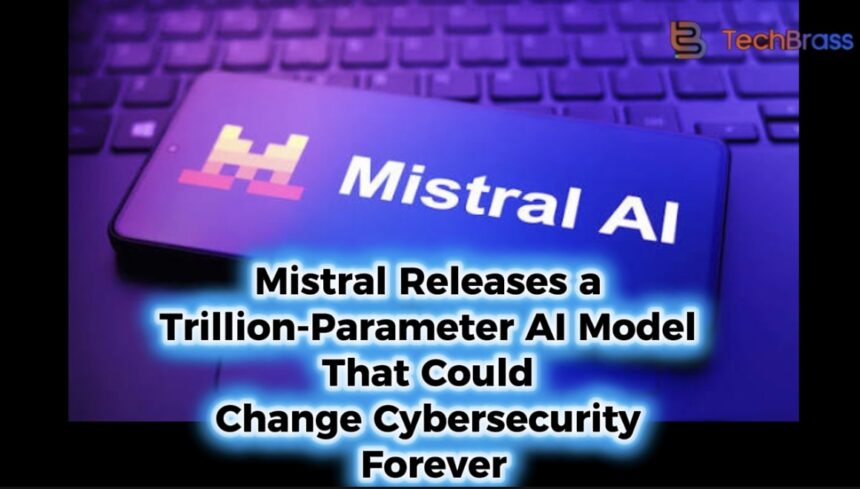
French artificial intelligence company Mistral AI has released the weights of its new trillion-parameter model, Mistral Large 4, also known as Le Chonk. The release gives businesses and governments the ability to download and deploy the model on their own systems.
But this development raises a bigger question: Could giving organisations more control over AI also change how the world defends itself against cybercriminals?
What Makes Mistral Large 4 Different?
Mistral Large 4 is not just another chatbot designed to answer questions.
It is a trillion-parameter multimodal AI model built to handle complex tasks involving coding, reasoning, images, and specialised enterprise workloads.
The model has 52 billion active parameters, meaning it activates a portion of its total parameters when processing a task rather than using all one trillion simultaneously.
Its nickname, Le Chonk, reflects its enormous scale.
However, the most important part of this announcement isn’t its size. It is the decision to release its model weights.
According to Mistral, businesses and government institutions can now download, deploy, and customise the model instead of depending entirely on an external AI provider.
Why This Could Be a Big Deal for Cybersecurity
Cybersecurity teams face a difficult problem: attackers are constantly developing new ways to exploit software, steal information, and disrupt businesses.
Traditional security tools can identify known threats, but detecting unfamiliar vulnerabilities often requires extensive technical investigation.
This is where advanced AI could make a difference.
Mistral says Large 4 has been developed with particular attention to cybersecurity, including identifying vulnerabilities and helping security professionals analyse and fix weaknesses.
The company reports that the model achieved:
82% on a benchmark task involving reproducing and patching a real software vulnerability.
93% on Cybench, a collection of cybersecurity competition challenges.
A position among the top five models globally on the Artificial Analysis Cyber Index, according to its published results.
These results are impressive, although benchmark performance does not automatically guarantee that a model will prevent real-world cyberattacks.
Still, the potential is significant.
Imagine a bank using an AI system to examine suspicious code, investigate potential security weaknesses, and help its engineers respond more quickly.
Or consider a government agency that wants to analyse sensitive systems without sending confidential information to an external AI provider.
That is the kind of flexibility Mistral is trying to offer.
The Biggest Advantage: Businesses Can Control Their Own AI
Here is where Mistral’s strategy becomes particularly interesting.
Most people access popular AI systems through online platforms or APIs.
That means the provider generally controls the infrastructure, access policies, and availability of the service.
With an open-weight model such as Mistral Large 4, organisations can download the weights and run the model on their own infrastructure.
This offers several potential advantages:
1. Greater privacy
Businesses can process sensitive information within their own computing environments, reducing the need to send it to an external AI service.
2. More operational control
Organisations can customise the model and integrate it with their existing security systems.
3. Reduced dependence on external providers
A company running its own deployment is less exposed to an external provider suddenly changing API access, pricing, or service availability.
4. Custom cybersecurity applications
Security teams can adapt AI systems to their own software, internal policies, and security requirements.
For organisations handling government records, financial information, healthcare data, and sensitive business information, these advantages could be particularly valuable.
But There Is a Risk Nobody Should Ignore
Giving organisations more control over powerful AI sounds like a positive development.
However, there is another side to the story.
The same capabilities that help security researchers identify vulnerabilities could potentially help malicious actors understand and exploit them.
This creates a difficult cybersecurity dilemma.
If an AI model becomes powerful enough to identify weaknesses in software, what happens when someone uses that capability for an attack instead of defence?
Unlike a hosted AI service, where the provider can manage access and enforce restrictions centrally, released model weights can be downloaded and modified.
That means safeguards can potentially be weakened or removed by whoever controls the deployment.
Mistral has acknowledged the risks associated with powerful cyber capabilities and says it is continuing to work on safety measures.
In other words, the same technology that could make businesses safer could also create new challenges for cybersecurity professionals.
Could This Challenge OpenAI, Anthropic, and Other AI Giants?
Mistral’s release is also part of a much bigger competition.
Companies such as OpenAI and Anthropic have built powerful AI systems that many users access through controlled services.
Mistral is promoting a different approach: give organisations access to advanced model weights and let them decide how and where to deploy the technology.
This is especially attractive to governments and businesses that want greater control over their digital infrastructure.
It also supports Europe’s broader ambition to reduce dependence on foreign technology providers.
However, open-weight AI does not automatically make Mistral better than every closed model. Performance, reliability, security, cost, and ease of deployment still matter.
The competition is increasingly about more than intelligence. It is also about who controls the infrastructure on which that intelligence operates.
What Does This Mean for Businesses in Africa?
This development is worth watching beyond Europe and the United States.
African banks, fintech companies, telecommunications providers, government agencies, and technology startups face growing demands to protect sensitive information.
A self-hosted AI model could eventually provide another option for organisations that want to build their own security tools.
However, there are practical challenges.
Running a trillion-parameter model requires substantial computing resources, technical expertise, and ongoing security management.
Therefore, downloading the model does not mean every small business can immediately operate it.
For many organisations, cloud-based AI services may remain the more practical option.
Nevertheless, the wider opportunity is clear: businesses could gain more choices over how they deploy and manage advanced AI.
Frequently Asked Questions
1. What is Mistral Large 4?
Mistral Large 4 is a trillion-parameter multimodal AI model developed by French AI company Mistral. It is designed for advanced reasoning, coding, enterprise applications, and cybersecurity.
2. Can businesses download Mistral Large 4?
Yes. Mistral released its model weights on October 29, 2026, making them available through Hugging Face and its API.
3. Is Mistral Large 4 better than ChatGPT?
There is no basis for declaring it universally better. Mistral highlights its performance in coding and cybersecurity, but different AI models have different strengths and use cases.
Final Thoughts: Is Open AI the Future of Cybersecurity?
Mistral’s latest release could represent an important shift in how organisations use artificial intelligence to protect their digital infrastructure.
For years, businesses have depended heavily on external technology providers for advanced AI capabilities.
Now, open-weight models are giving organisations another option: bring powerful AI directly into their own environments and decide how to use it.
But greater freedom comes with greater responsibility.
If businesses can use AI to identify and fix security vulnerabilities, cybercriminals may also attempt to exploit similar capabilities.
The real challenge will be making sure defensive AI advances faster than the threats it is designed to fight.
Here is the question: Would you trust a powerful AI model running on your company’s own servers to protect your business, or would you rather depend on established providers like OpenAI and Anthropic?
Share your thoughts in the comments.
For more updates on artificial intelligence, cybersecurity, and emerging technology, visit **TechBrass — https://techbrass.com**.