
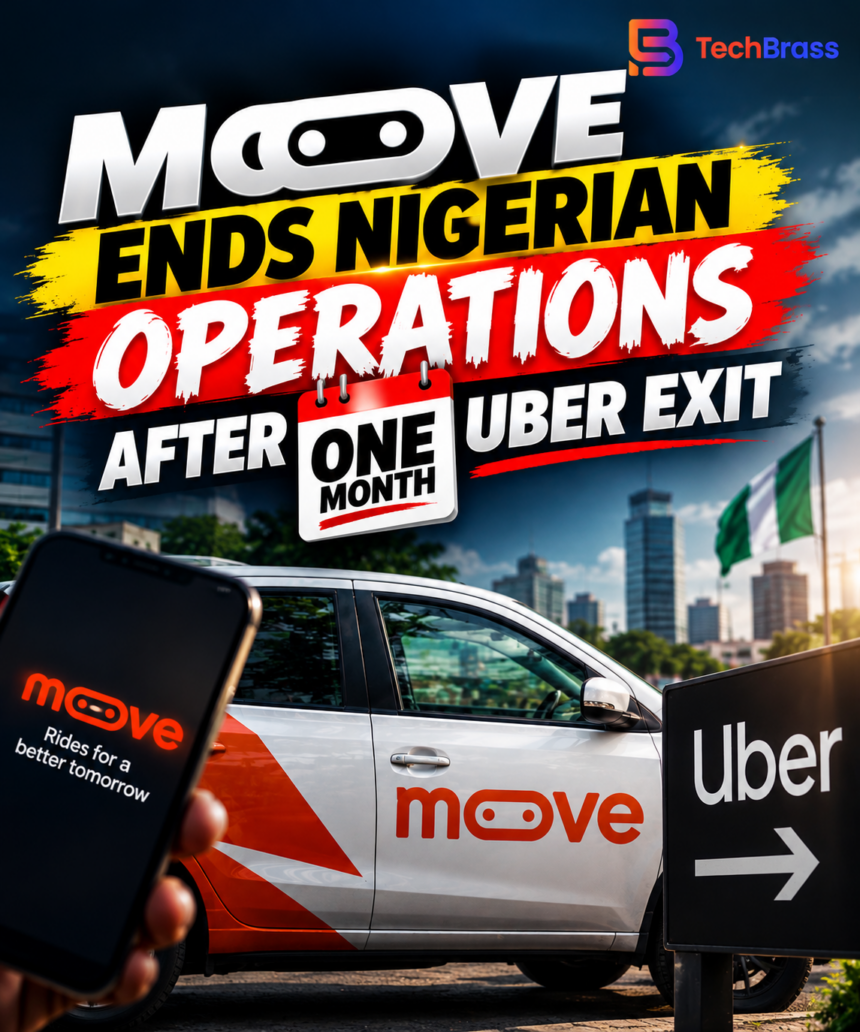
Nigeria’s mobility technology sector has suffered another major shake-up as Moove announces the end of its Nigerian operations, barely a month after Uber ended its ride-hailing business in the country.
The Lagos-founded mobility fintech said eligible customers will receive full ownership of vehicles currently under its Drive-to-Own and rental programmes, with the vehicles valued at approximately ₦35 billion. The transfer is part of Moove’s “Thank You Nigeria” initiative.
The development is significant because Moove was built in Nigeria around the intersection of technology, vehicle financing and the gig economy. Its departure raises fresh questions about the economics of ride-hailing, mobility financing and technology-enabled transportation businesses in the country.
Moove Ends Its Nigerian Operations
Moove announced on October 8, 2026, that it would conclude its operations in Nigeria after six years in the market.
The company was founded in Lagos in 2020 by Ladi Delano and Jide Odunsi. It initially focused on helping mobility entrepreneurs who wanted to earn income from ride-hailing but struggled to access vehicle financing.
Moove started with 76 vehicles in Lagos and developed a model that combined vehicle financing with mobility platforms. According to the company, more than 9,000 customers have used its Drive-to-Own and rental products in Nigeria.
The business subsequently expanded internationally. Moove says the model developed in Lagos helped lay the foundation for a global operation with about 42,000 vehicles across 29 cities.
Why Is Moove Leaving Nigeria?
Moove’s exit comes shortly after Uber ended its Nigerian operations on September 2, 2026, after 12 years in the market.
The timing is particularly important because Uber was a major platform supporting Moove’s Nigerian business model.
In an interview with BusinessDay, Moove co-founder and co-CEO Ladi Delano said Uber’s departure materially changed the company’s operating environment. After evaluating alternatives and the economics of continuing, Moove concluded that its Nigerian operating model could no longer be sustained.
That relationship illustrates how interconnected technology businesses can become within a digital ecosystem.
A mobility ecosystem built around platforms
Moove provided vehicles and financing, while ride-hailing platforms provided an avenue for drivers to generate income.
This created a connected business model:
- Moove finances or provides access to a vehicle.
- A driver uses the vehicle for mobility work.
- The driver earns income through a ride-hailing platform.
- That income supports the driver’s vehicle obligations.
- The vehicle eventually becomes an asset for the driver under the relevant ownership arrangement.
When a major platform disappears, however, the economics of the wider ecosystem can change rapidly.
What Happens to Moove Customers?
One of the most notable aspects of Moove’s exit is its decision to transfer eligible vehicles to customers.
Under the company’s Thank You Nigeria initiative, eligible customers will receive full ownership of the vehicles they currently operate. Moove said no further payment to the company will be required for the vehicles themselves from October 1, 2026.
The vehicles involved are estimated to be worth approximately ₦35 billion.
For qualifying drivers, this could fundamentally change their financial position.
Instead of continuing to operate a vehicle under a financing or rental arrangement, an eligible customer can transition into vehicle ownership. That potentially gives drivers greater control over an asset that can continue supporting their livelihoods.
Moove has also said it will give its Nigerian staff members a free car as part of the exit arrangements.
More Than 9,000 Nigerian Customers Used Moove
Moove said more than 9,000 customers used its Drive-to-Own and rental products in Nigeria.
The company also stated that work performed through Moove-financed vehicles generated approximately ₦57 billion in revenue for customers.
These figures highlight the role mobility-financing companies can play beyond simply providing cars.
For many drivers, access to a vehicle can be the difference between being excluded from the digital gig economy and having the equipment required to participate in it.
Moove’s original proposition therefore addressed two problems at once:
- Limited access to vehicle financing
- Growing demand for ride-hailing and mobility services
What Moove’s Exit Means for Nigeria’s Mobility Technology Sector
Moove’s departure does not necessarily mean that Nigeria’s mobility technology market has no future.
However, it demonstrates how difficult it can be to build a sustainable mobility business when several parts of the ecosystem depend on one another.
1. Platform dependence matters
Mobility companies that finance vehicles for drivers need drivers to have reliable ways to generate income.
If a major ride-hailing platform exits a market, financing companies connected to that ecosystem can face immediate pressure.
2. Vehicle financing remains critical
Nigeria has a large population of potential mobility entrepreneurs, but vehicle acquisition remains a significant barrier.
The challenge is not simply getting people onto a ride-hailing app. Drivers also need access to reliable vehicles, affordable financing, maintenance and sustainable income.
3. Diversification can become essential
The Moove experience also highlights the importance of diversification.
Mobility companies may need to consider multiple platforms, customer segments and revenue streams rather than relying heavily on one ecosystem partner.
4. Ownership can create long-term value
Moove’s decision to transfer eligible vehicles gives its exit a different character from a conventional shutdown.
Rather than simply taking vehicles back, the company is moving ownership to eligible customers. That could leave some drivers with valuable productive assets after the company leaves the market.
What This Means for Nigerian Drivers
For drivers affected by the changes, the immediate priority is understanding exactly what happens to their vehicle and account.
Eligible customers should pay close attention to official communication from Moove regarding:
- Vehicle ownership documentation
- Outstanding obligations
- Transfer procedures
- Insurance and registration
- Maintenance responsibilities
- Any requirements that must be completed before ownership is transferred
Drivers should also avoid relying solely on social media posts or unofficial messages when making decisions about their vehicles.
Is This the End of Mobility Innovation in Nigeria?
Not necessarily.
Nigeria remains one of Africa’s largest technology and consumer markets. The country’s transportation challenges also create opportunities for companies developing new solutions around:
- Vehicle financing
- Fleet management
- Electric mobility
- Logistics technology
- Public transportation
- Autonomous mobility
- Digital payments
- Driver management
- Mobility-as-a-service
The bigger question is whether future companies can build models that are economically sustainable while remaining resilient when major platform partners change their strategies.
Moove’s own evolution demonstrates that Nigerian startups can develop solutions locally and scale internationally. Its current global operation shows that leaving Nigeria does not necessarily mean the end of the company’s broader growth story.
Moove’s Nigerian Story Comes Full Circle
There is an important irony in Moove’s exit.
The company was born in Lagos, using the Nigerian mobility market as the foundation for its business model. Six years later, it is leaving the market while continuing its international expansion.
Its exit also comes just weeks after Uber, one of the most important platforms in its Nigerian ecosystem, left the country.
For Nigerian mobility entrepreneurs, the development is a reminder that technology businesses do not operate in isolation. Financing companies, platforms, drivers, customers and regulators form interconnected ecosystems.
When one major component changes, the effects can spread quickly across the entire market.
Frequently Asked Questions
Why is Moove leaving Nigeria?
Moove said Uber’s departure materially changed the operating environment for its Nigerian business. After evaluating available alternatives and the economics of continuing, the company concluded that its Nigerian operating model could not be sustained.
How much are the vehicles Moove is transferring worth?
Moove said eligible vehicles being transferred to customers are worth approximately ₦35 billion.
Will Moove customers have to pay for the vehicles?
For eligible customers, Moove says there will be no further payment to the company for the vehicles themselves from October 1, 2026. Customers will receive full ownership under the exit initiative.
How many customers used Moove in Nigeria?
Moove said more than 9,000 customers used its Drive-to-Own and rental products in Nigeria.
Did Uber’s exit affect Moove?
Yes. Moove’s co-founder Ladi Delano said Uber was the principal platform supporting the company’s Nigerian model at scale and that its departure significantly changed the business environment.
Is Moove shutting down globally?
No. The announcement concerns Moove’s Nigerian operations. The company continues its international business, with its global mobility operations spanning multiple markets.
Conclusion
Moove’s exit marks another major development in Nigeria’s rapidly changing mobility technology landscape.
The company’s decision to transfer approximately ₦35 billion worth of eligible vehicles to customers makes the departure unusual. For thousands of drivers, the end of Moove’s Nigerian operations could instead become the beginning of outright vehicle ownership.
At the same time, the development highlights the risks that can emerge when businesses are closely connected to major technology platforms.
Following Uber’s exit, Moove’s departure will likely fuel further discussion about the sustainability of ride-hailing, vehicle financing and gig-economy businesses in Nigeria.
For entrepreneurs and technology companies, the lesson is clear: building a digital ecosystem is only part of the challenge. Building one that can survive major changes within that ecosystem is even more important.
Stay with TechBrass for more technology, startup, mobility and digital-business stories shaping Nigeria and the wider African technology ecosystem.