
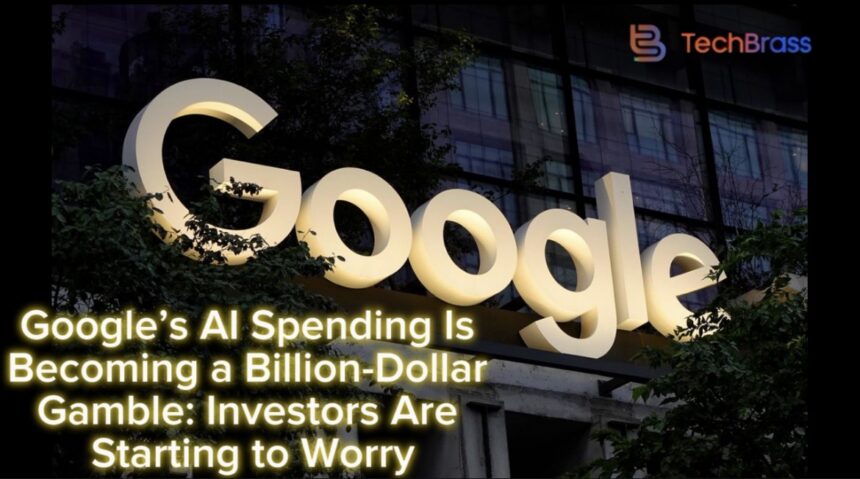
What if the biggest danger to Google’s future isn’t OpenAI, Microsoft, or Meta, but the enormous cost of trying to beat them in artificial intelligence?
Google is racing to dominate the AI industry. It is building data centres, developing powerful AI models, buying advanced computing equipment, and expanding its cloud infrastructure.
But there is a problem.
Investors are beginning to question whether the money being poured into artificial intelligence will generate enough returns to justify the cost.
Alphabet, Google’s parent company, has just experienced a major stock sell-off following disappointing third-quarter financial results. At the same time, the cost of insuring its debt against default has increased.
And that raises an uncomfortable question: Could the race to dominate AI become too expensive, even for one of the world’s richest technology companies?
Google’s Earnings Disappoint Wall Street
Alphabet reported third-quarter 2026 revenue of approximately $127.6 billion, representing a 25% increase compared with the same period last year.
However, the result fell slightly below analysts’ expectations of approximately $128.2 billion.
The company’s adjusted earnings per share came in at $2.67, missing the expected $3.02.
Following the announcement, Alphabet shares plunged more than 10% in extended trading.
Interestingly, Google’s advertising business was not actually shrinking. Advertising revenue reached approximately $82 billion, but it still missed market expectations.
That distinction matters.
The concern isn’t necessarily that Google has stopped making money. Investors are worried that its growth and spending are no longer matching the expectations built into its valuation.
The Debt Insurance Warning Investors Cannot Ignore
Here is where the story becomes particularly interesting.
On October 29, the cost of five-year credit default swaps (CDS) linked to Alphabet increased by as much as 5.3 basis points, reaching 84 basis points.
But what does that mean?
Credit default swaps are financial contracts that allow investors to protect themselves against the possibility that a company might fail to meet its debt obligations.
Think of them as financial insurance.
When investors become more concerned about a company’s credit risk, the cost of that protection can increase.
For Alphabet, the rising CDS price signals increased caution in the credit market.
However, it does not mean Google is about to go bankrupt or that a default is imminent.
The bigger question is why investors are becoming more cautious about a company with such enormous financial resources.
Google’s AI Ambitions Come With an Enormous Price Tag
Artificial intelligence requires much more than clever software.
Behind every major AI chatbot, model, and intelligent search feature are expensive data centres, powerful processors, electricity, networking equipment, and thousands of specialised employees.
Alphabet spent approximately $51.4 billion on capital expenditure during the third quarter alone.
Its free cash flow turned negative, reaching approximately -$9.07 billion.
This means the company’s capital investments and other cash requirements outweighed the cash remaining after its operating activities.
Alphabet has also indicated that its capital expenditure could increase significantly in 2027.
For investors, this creates a difficult situation.
If Google reduces its AI investments, competitors could gain ground.
If it continues spending aggressively, the company must demonstrate that those investments can eventually produce sufficient financial returns.
It is a costly competition where slowing down could be dangerous, but spending without clear returns could also become a problem.
But Is Google Actually Losing the AI Race?
Not necessarily.
There is another side to this story that deserves attention.
Google Cloud delivered an impressive performance, generating approximately $30.7 billion in quarterly revenue, an increase of 103% year over year.
That is significant growth.
The company’s AI infrastructure and cloud services are attracting strong enterprise demand.
Alphabet also reported $265.1 billion in cash and marketable securities at the end of the quarter.
So, this is not a story about a technology company running out of money.
It is a story about a company making enormous investments while investors demand clearer evidence of future profitability.
And that distinction is important.
Could the AI Boom Become a Financial Bubble?
Imagine a situation where technology companies spend hundreds of billions of dollars building AI infrastructure.
Businesses adopt AI. Consumers use AI assistants. Companies develop increasingly powerful models.
But what happens if the revenue generated by these services cannot justify the cost of building and operating them?
That is the uncomfortable possibility investors are beginning to consider.
The AI industry could continue growing while some of the companies investing in it struggle to achieve the returns they expected.
In other words, AI itself could be successful while certain AI business models fail financially.
This is why the next stage of the competition may be less about who builds the most impressive AI model and more about who can operate AI profitably.
Three Things to Watch Next
Alphabet’s financial performance raises three important questions:
- AI profitability: Can Google turn its enormous AI investments into sustainable revenue?
- Cash flow: Will its infrastructure spending continue putting pressure on free cash flow?
- Competition: Can Google maintain its position against Microsoft, OpenAI, Meta, and other AI companies without continually increasing its spending?
The answers could influence how investors value not only Alphabet but the wider technology industry.
Frequently Asked Questions
1. Why are investors worried about Google’s AI spending?
Investors are concerned about the enormous infrastructure costs, negative quarterly free cash flow, and uncertainty over how quickly AI investments will generate sufficient returns.
2. Is Alphabet facing bankruptcy?
No. Alphabet has substantial cash reserves and significant operating revenue. Higher debt insurance costs indicate changing credit-risk perceptions, not an imminent bankruptcy.
3. Is Google’s AI business failing?
There is no evidence that it is failing. Google Cloud’s 103% year-over-year revenue growth demonstrates strong demand. However, long-term profitability remains an important question.
Final Thoughts: The AI Race May Not Reward the Biggest Spender
For years, technology companies have been racing to invest as much as possible in artificial intelligence.
But the rules may be changing.
Investors are increasingly interested in more than impressive AI announcements and expensive data centres. They want to know when those investments will translate into sustainable profits.
Google has the money, infrastructure, and technological expertise to remain a major force in AI.
However, its latest financial results demonstrate that even the biggest technology companies must answer to the financial realities of the market.
Now, here’s a question worth debating: If you were running Google, would you continue spending hundreds of billions of dollars to dominate AI, or would you slow down and focus on making your existing investments profitable?
Share your opinion in the comments.
For more technology news, business insights, and developments shaping the digital world, visit TechBrass — https://techbrass.com.