
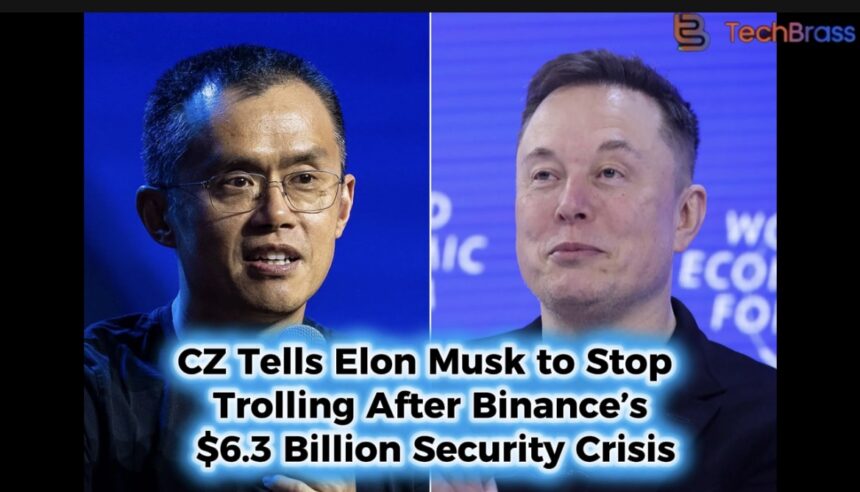
Imagine dealing with one of the biggest security crises in cryptocurrency history. Your exchange is trying to recover billions of dollars, customers are demanding answers, and the crypto market is watching every move.
Then Elon Musk joins the conversation — not with words of support, but with sarcastic posts and emojis.
That was the situation facing Binance co-founder Changpeng Zhao, better known as CZ, after the exchange disclosed a security incident with an estimated impact of $6.3 billion. CZ eventually responded directly to Musk, telling him it was a “bad time to troll” and reminding him that Binance had invested $500 million in Musk’s 2022 Twitter takeover.
The exchange quickly became more than a dispute between two billionaires. It raised questions about crypto security, corporate relationships, financial responsibility and how leaders behave when a major company is under pressure.
What Happened Between CZ and Elon Musk?
The exchange played out on X, the social media platform owned by Musk.
As reports of the Binance incident spread on October 29 and 30, Musk made several posts that appeared to mock the situation. One read, “Everyday is Zeroday” — a play on the cybersecurity term zero-day, which describes a software vulnerability exploited before the developer or vendor has had an opportunity to fix it.
Musk also reacted with laughing, fire and grimacing emojis to posts discussing the incident and Binance’s ability to absorb the financial impact.
CZ was not amused.
In a direct response to Musk, he wrote:
“Elon, have a lot of respect for you, but bad time to troll. Please stop.”
But CZ did not stop there. He reminded Musk that Binance had contributed $500 million towards Musk’s $44 billion acquisition of Twitter in 2022.
He added that the shares connected to that investment were now worth more than $1 billion and asked Musk to show some support.
It was a pointed reminder: Binance had once been a financial backer of Musk’s biggest business acquisition, and CZ clearly expected a little more sympathy during the exchange’s difficult moment.
Why Binance’s $500 Million Twitter Investment Matters
Binance’s investment in Musk’s Twitter takeover dates back to October 2022.
At the time, the cryptocurrency exchange committed $500 million to support the acquisition. The deal was part of a wider group of investors who helped Musk finance the purchase.
Since then, Twitter has been rebranded as X, while Musk has reorganised several of his business interests.
CZ’s latest comments suggest that Binance’s original investment has become linked to SpaceX shares, which he valued at more than $1 billion.
That is a substantial increase on the original $500 million commitment — at least based on the valuation CZ referenced.
However, there is an important distinction: CZ was pointing to the value of the investment, not announcing that Binance would sell its SpaceX-related holdings to pay for the security incident.
He later clarified that he had not proposed selling those shares.
How Serious Is the Binance Security Incident?
The argument between CZ and Musk is attracting attention, but the underlying security incident is the bigger story.
Binance disclosed a major security breach with an estimated impact of approximately $6.3 billion. The exchange’s investigation initially pointed to a compromised DevOps engineer’s laptop, which may have helped an attacker gain access to internal systems.
However, subsequent updates indicated that investigators had identified additional points of breach. The incident was therefore more complicated than a simple phishing attack or one employee clicking a suspicious link.
The breach involved unauthorised transactions from a Binance hot wallet. Hot wallets are cryptocurrency wallets connected to the internet, making them useful for processing transactions but also more exposed to online attacks than offline cold-storage wallets.
Binance said customer funds were not affected and that it would cover the losses. It also reported that around $3 billion in assets had been frozen with help from industry partners and law enforcement.
The company said it had reserved more than $6.34 billion to cover the incident. That figure represents the funds it set aside to address the impact; it should not be confused with a final, independently verified calculation of unrecovered losses.
Can Binance Afford to Cover the Losses?
This is where the story becomes particularly interesting.
A security incident involving billions of dollars naturally raises questions about whether an exchange has enough resources to protect customers and remain financially stable.
CZ offered a rough calculation in response to the discussion. He pointed to the estimated $6 billion-plus impact, approximately $3 billion in frozen assets and more than $1 billion in Binance’s Secure Asset Fund for Users (SAFU).
SAFU is an emergency reserve designed to help protect Binance users in extreme circumstances.
CZ suggested that the remaining financial gap was manageable, although still painful. He also referenced the value of the SpaceX-related shares connected to Binance’s earlier investment.
Binance co-CEO Yi He separately said the company’s revenue for the year was sufficient to cover the losses, meaning it would not need to sell those holdings.
That is an important assurance from the company, but the final financial impact will depend on how much of the affected cryptocurrency can be recovered, frozen or otherwise accounted for.
Why Musk’s Comments Sparked a Bigger Debate
Musk’s reaction has attracted criticism because Binance was dealing with a serious incident that could affect confidence across the cryptocurrency industry.
For some observers, the exchange between the two billionaires is simply another example of Musk’s unpredictable social media behaviour.
For others, it raises a more serious question: should influential business leaders use a company’s security crisis as an opportunity for public jokes?
There is also an interesting contrast in their business relationship.
Binance backed Musk’s Twitter acquisition with $500 million. Now, years later, CZ is publicly asking Musk to show support while Binance faces one of its most difficult security challenges.
The situation is a reminder that business partnerships can become complicated. Companies may be investors, customers, competitors or public critics of one another — sometimes all within the same industry.
And in the cryptocurrency market, where trust is a major part of a company’s value, public perception matters.
What This Means for Cryptocurrency Users
The incident offers a few important lessons for anyone who keeps cryptocurrency on an exchange.
1. Exchange security matters. A large platform can still experience serious security failures. Users should understand the risks of leaving significant assets on centralised exchanges.
2. Transparency is essential. When a breach happens, customers need clear updates about what was affected, what has been recovered and how the company intends to protect their funds.
3. Financial reserves are not the same as perfect security. An exchange’s ability to cover losses is important, but prevention, monitoring and strong internal controls matter just as much.
4. Be careful of recovery scams. Major crypto incidents often attract fake support accounts and people pretending to help victims recover funds. Never share passwords, recovery phrases or verification codes with anyone claiming to represent an exchange.
For Binance users, the sensible approach is to follow official security updates and avoid making rushed decisions based on rumours or viral social media posts.
The Bigger Story: A Billionaire Dispute During a Crypto Crisis
CZ’s response to Musk may become one of the most memorable social media moments from the Binance incident. But the bigger issue is whether Binance can demonstrate that it has contained the breach, protected customers and strengthened the systems that allowed the attack to happen.
Musk’s trolling may have attracted the headlines. Binance’s security response will determine what happens next.
And there is a lesson here for the wider technology industry: a company’s reputation is not tested only when business is booming. It is tested when something goes seriously wrong.
Frequently Asked Questions
Why did CZ tell Elon Musk to stop trolling?
CZ objected to Musk’s sarcastic posts and emoji reactions following Binance’s major security incident. He asked Musk to stop and show some support.
How much did Binance invest in Elon Musk’s Twitter acquisition?
Binance contributed $500 million towards Musk’s $44 billion Twitter acquisition in 2022.
Why did CZ mention SpaceX shares?
CZ said the shares connected to Binance’s original investment were worth more than $1 billion. He referenced their value while discussing how Binance could manage the financial impact of the incident.
How much was Binance’s security incident estimated to affect?
Binance reported an estimated impact of approximately $6.3 billion. This figure should not automatically be treated as the final amount of unrecovered losses.
Will Binance sell its SpaceX-related shares to cover the losses?
CZ clarified that he had not proposed selling the shares. Co-CEO Yi He also said Binance’s annual revenue was sufficient to cover the losses without needing to sell them.
Final Thoughts
There is something unusual about this story: a company that once helped finance Elon Musk’s Twitter takeover is now asking him for support while dealing with a multibillion-dollar security crisis.
But beyond the billionaire back-and-forth, the real test is whether Binance can restore confidence in its security and show customers that their assets are protected.
What do you think about Musk’s reaction? Was it harmless trolling, or should influential business leaders show more responsibility when a company is facing a crisis?
Join the conversation in the comments.